

Top 10 Picosecond Laser Machine Manufacturers for Clinics in 2026
LEFIS Laser · 15 min read · Updated May 2026
A clinic owner in Manila called us in March. She had bought what an online seller called a picosecond laser for $8,000. After three patient sessions, her clients’ melasma got darker instead of fading. The device pulsed in nanoseconds with the wrong wavelengths. It heated pigment rather than shattering it.
Her story is not rare. It is what happens when buyers cannot tell the difference between a real picosecond laser, a hybrid Q-switched platform, and a relabelled nanosecond machine sold under a pico name. The three are different products. They cost different amounts. They produce different clinical results.
This guide will not tell you which device to buy. It will show you how to read a spec sheet, what questions force a manufacturer to be honest, and which ten brands are worth a serious look in 2026. We have seen the failure modes. We have seen the wins. We score each manufacturer on weighted criteria, publish the scores per category, and tell you who LEFIS is and is not the right fit for.
What Is a Picosecond Laser?
A true picosecond laser fires pulses in trillionths of a second. The standard range is 300 to 750 picoseconds. At that speed, light energy hits pigment so fast that the pigment shatters by mechanical shock rather than burning. The clinical name for this is photoacoustic effect. The bad outcomes that haunted older lasers — burns, scarring, post-inflammatory hyperpigmentation on darker skin — drop sharply.
Older Q-switched lasers fire in nanoseconds. A nanosecond is one thousand picoseconds. The math sounds small. The clinical difference is not. Nanosecond pulses rely more on heat. Heat creates the side effects clinics try to avoid, especially on Fitzpatrick IV through VI skin.
Clinics buy pico because patients want fewer visits. A nanosecond device may need ten sessions to clear a tattoo. A real picosecond clears it in four to six. Pigmented lesions like sun spots and freckles often respond in two visits. We wrote a primer on freckle removal last month that walks through the clinical decision.
Key applications include:
- Multi-color tattoo removal
- Sun spots, freckles, and benign pigmented lesions
- Acne scars and wrinkles
- Melasma (in trained hands)
- Overall skin tone and texture improvement
True Picosecond, Hybrid Q-Switched, and Plain Nanosecond
This is the part of the conversation most marketing material avoids. Three categories of devices will be sold under the word pico in 2026.
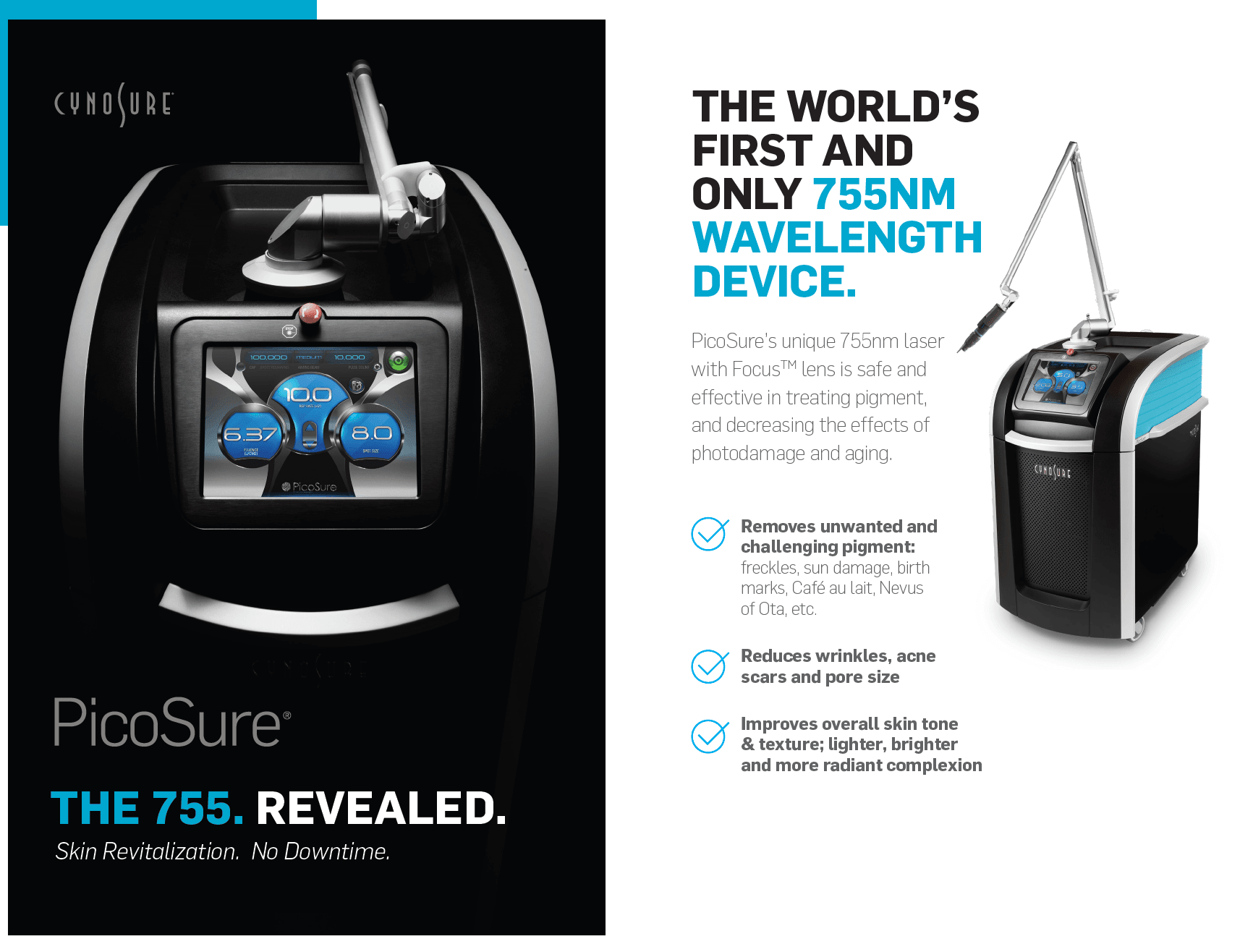
True picosecond systems pulse below 750 picoseconds, usually between 300 and 500. The photoacoustic effect dominates. Heat damage is minimal. Candela PicoWay, Quanta Discovery Pico, Alma Pico Clear, Cynosure PicoSure, and PicoLO sit here.
Hybrid Q-switched platforms use nanosecond pulses, typically two to ten nanoseconds, paired with pulse-to-pulse burst architecture (PTP) that stacks pulses to approximate picosecond effects on dense pigment. The photoacoustic effect is partial. Heat does more of the work. These devices are real technology with legitimate clinical use. They are not the same as true picosecond. Lumenis PiQo4, Cutera Enlighten in its longer-pulse modes, and LEFIS C19 sit here.
Plain nanosecond Q-switched devices relabelled as pico are the third group. There is no PTP architecture and no photoacoustic shortcut — just a nanosecond device with a marketing change. These are the machines that turn up at $5,000 to $15,000 on online marketplaces. The Manila device fell into this group.
The boundary between hybrid and plain nanosecond is the question that costs clinics money to get wrong. Always ask whether the device has PTP burst architecture or some equivalent (different manufacturers name it differently). Always ask for a measured pulse-duration spec on the data sheet, not a marketing brochure number.
How to Pick a Picosecond Laser Manufacturer
We have audited around 200 picosecond machines on factory floors and in clinic rooms over the last decade. Most fail one of five tests. We use these criteria — formalized in our scoring methodology that follows — to evaluate every system:
|
Criterion |
What to look for |
Why it matters |
|
Real pulse duration |
Under 750 ps preferred; under 500 ps excellent; under 300 ps best-in-class |
Shorter pulses produce more photoacoustic effect and fewer side effects |
|
Wavelength coverage |
At least 1064 nm (deep, safe for dark skin) and 532 nm; ideally 755, 694, 730, or 785 nm |
Covers the full range of ink colours and pigment depths |
|
Certifications |
FDA 510(k) clearance (not just FDA listing), CE Mark, ISO 13485 |
Regulatory safety and consistent factory quality. Listing and clearance are not the same. |
|
Service and support |
Fast parts availability, clear warranty terms, hands-on operator training |
Prevents downtime and protects long-term reliability |
|
Clinic fit |
Price band, expected patient volume, operator skill level |
Matches your budget and real case mix |
Our Ranking Methodology
Picosecond manufacturers can be ranked in many ways. We rank by best-fit for the average independent clinic — a weighted score covering practical performance, real cost, service depth, and operational fit.
A high-volume hospital dermatology department with $200,000 of capital to deploy might weigh these criteria differently and arrive at a different order; however, Candela Medical and Quanta System lead any ranking driven purely by technical specification. We are transparent about that, and we publish scores per criterion in each entry below. Three of these clinical-performance criteria — pulse, wavelength, versatility — carry 55 percent of the score altogether.
|
Criterion |
Weight |
What it measures |
|
Pulse performance |
20% |
Measured pulse duration and photoacoustic efficiency |
|
Wavelength coverage |
18% |
Range of clinically useful wavelengths |
|
Clinical versatility |
17% |
Breadth of indications supported on one platform |
|
Value (cost vs. capability) |
18% |
What clinics get per dollar of capital invested |
|
Service and support depth |
17% |
Parts response, training, regional network coverage |
|
Regulatory and certifications |
10% |
FDA 510(k), CE, ISO 13485, regional compliance |
Total score is reported out of 100 in each manufacturer entry. Rankings reflect total weighted score across the 10 ranked manufacturers. We publish the per-criterion scores in every entry so you can re-rank for your own clinic if you need to.
Top 10 Picosecond Laser Machine Manufacturers
Ten manufacturers, ranked by weighted score under the methodology above. Candela leads on the combined strength of true picosecond performance and four-wavelength coverage. LEFIS sits at number seven — a fair position for a hybrid Q-switched platform that competes on value rather than peak pulse specification.
|
Rank |
Manufacturer |
Score |
Category |
Excels at |
|
01 |
Candela Medical |
86/100 |
True Picosecond |
Complex pigmentation via 730 nm and 785 nm wavelengths |
|
02 |
Quanta System |
82/100 |
True Picosecond |
Three-wavelength hospital-grade dermatology platforms |
|
03 |
Alma Lasers |
80/100 |
True Picosecond |
European and MENA clinics with strong local distribution |
|
04 |
Lumenis |
79/100 |
Hybrid Q-Switched |
Multi-modality clinics that want one vendor across devices |
|
05 |
PicoLO (LASEROPTEK) |
78/100 |
True Picosecond |
Korean and Southeast Asian K-beauty market |
|
06 |
PZ Laser |
78/100 |
Mixed (model dependent) |
Mid-market distribution with verified top-tier configurations |
|
07 |
LEFIS Laser |
77/100 |
Hybrid Q-Switched |
Value-tier general pigment, tattoo, and rejuvenation work for emerging-market clinics |
|
08 |
Cynosure |
75/100 |
True Picosecond |
Long clinical heritage and strong patient brand demand |
|
09 |
Cutera |
75/100 |
Hybrid Q-Switched |
Dual-pulse versatility for US dermatology chains |
|
10 |
Sciton |
62/100 |
Not dedicated pico |
Practices already invested in BBL or Halo platforms |
-
Candela Medical Score 86/100

Category: True Picosecond
PicoWay is Candela’s flagship pico. True sub-500 ps pulse duration across four wavelengths (532, 730, 785, 1064 nm) in flagship configurations. The 730 nm and 785 nm options are rare in the category and make PicoWay particularly strong on stubborn melasma and dermal pigment. Clinical record across the dermatology community is extensive.
KEY SPECS
|
Wavelengths |
532, 730, 785, 1064 nm |
|
Pulse Duration |
300–450 ps (true picosecond) |
|
Spot Sizes |
Multiple configurations |
|
Certifications |
FDA cleared, CE |
SCORE BREAKDOWN
|
PULSE |
WAVELENGTH |
VERSATILITY |
VALUE |
SERVICE |
REGULATORY |
TOTAL |
|
92 |
95 |
92 |
60 |
85 |
95 |
86/100 |
|
PROS |
True sub-500 ps performance across the lineup; the rare 730 and 785 nm wavelengths clear dermal pigment that two-wavelength devices struggle with; extensive peer-reviewed clinical record; strong dermatology brand demand. |
|
CONS |
Annual service contracts run 8 to 12 percent of device price. Consumable handpiece economics get expensive at high volumes. Operator training is intensive. Lower-volume practices will not fully use the 730/785 nm capability they pay for. |
|
BEST FOR |
Dermatology-led practices treating complex pigmentation. Hospital-grade clinics that can monetise the rare wavelength advantage. Not the first choice for general aesthetics on tight capital budgets. |
-
Quanta System Score 82/100

Category: True Picosecond
Italian engineering. The Discovery Pico Series is one of the few true three-wavelength picosecond platforms — Alexandrite Ruby at 532 nm, 1064 nm, and 694 nm. VARIOPULSE technology lets you choose three pulse modes per shot. Pulse durations of 370 ps (532 nm) and 450 ps (1064 nm) put it squarely in true-pico territory. The 694 nm Ruby line is the one that clears green and blue tattoo inks other platforms struggle with.
KEY SPECS
|
Wavelengths |
532, 694, 1064 nm |
|
Pulse Duration |
370 ps (532 nm), 450 ps (1064 nm) |
|
Certifications |
FDA 510(k) cleared, CE Mark |
|
Modes |
VarioPulse technology (multiple modes) |
SCORE BREAKDOWN
|
PULSE |
WAVELENGTH |
VERSATILITY |
VALUE |
SERVICE |
REGULATORY |
TOTAL |
|
90 |
92 |
88 |
55 |
80 |
90 |
82/100 |
|
PROS |
Hospital-grade engineering; the 694 nm Ruby clears green and blue tattoo inks; true sub-500 ps across all wavelengths; long European clinical record. |
|
CONS |
Heavy capital cost and physical footprint built for high-volume practice; service network strongest in Europe and weakest in emerging markets. |
|
BEST FOR |
European hospital dermatology and high-volume specialist clinics with stubborn-tattoo and complex-pigment caseloads. |
-
Alma Lasers Score 80/100

Category: True Picosecond
Israeli, with strong presence in Europe and the MENA region. The Harmony platform and Pico Clear cover a wide range of conditions. True sub-350 ps pulse delivery and adjustable energy suit Fitzpatrick I through VI skin.
KEY SPECS
|
Wavelengths |
532, 1064 nm plus additional options |
|
Pulse Duration |
300–350 ps (true picosecond) |
|
Certifications |
FDA 510(k) cleared, CE Mark |
|
Delivery |
Articulated arm options |
SCORE BREAKDOWN
|
PULSE |
WAVELENGTH |
VERSATILITY |
VALUE |
SERVICE |
REGULATORY |
TOTAL |
|
90 |
70 |
85 |
70 |
82 |
85 |
79/100 |
|
PROS |
True sub-350 ps pulse performance; quick service in Europe, the MENA region, and selected Asian markets; adjustable for Fitzpatrick I through VI; broad indication coverage. |
|
CONS |
Limited to dual-wavelength configurations on most models; less dominant in North America compared to Cynosure and Candela. |
|
BEST FOR |
European, Middle Eastern, and selected Asian clinics with mature local distribution. |
-
Lumenis Score 79/100

Category: Hybrid Q-Switched
Israeli company best known for the M22 IPL platform. Their picosecond device, PiQo4 in many markets, mixes hybrid pico and nanosecond modes on a single platform. Pulse performance sits at the upper end of the pico range. The real advantage is multi-modality coverage under one service contract.
KEY SPECS
|
Wavelengths |
532, 585, 650, 1064 nm |
|
Pulse Duration |
600–800 ps plus nanosecond modes |
|
Certifications |
FDA 510(k) cleared, CE Mark |
|
Spot Sizes |
2–15 mm |
SCORE BREAKDOWN
|
PULSE |
WAVELENGTH |
VERSATILITY |
VALUE |
SERVICE |
REGULATORY |
TOTAL |
|
70 |
80 |
88 |
65 |
88 |
90 |
79/100 |
|
PROS |
Excellent multi-modality coverage; one-vendor service across IPL, CO2, hair removal, and pico; broad spot size range up to 15 mm; established global service network. |
|
CONS |
Pulse durations sit at the upper end at 600 to 800 ps; positioned as a multi-modality generalist rather than a pico specialist. |
|
BEST FOR |
Practices wanting one vendor across a broad device ecosystem under a single service contract. |
-
PicoLO (LASEROPTEK) Score 78/100

Category: True Picosecond
Korean specialist known for stability and a compact design. High-speed switching and a price point below the European and US giants.
KEY SPECS
|
Wavelengths |
532, 1064 nm |
|
Pulse Duration |
~380–450 ps (highly stable) |
|
Certifications |
CE Mark, KFDA, FDA (model dependent) |
|
Spot Size |
Large, for faster treatments |
SCORE BREAKDOWN
|
PULSE |
WAVELENGTH |
VERSATILITY |
VALUE |
SERVICE |
REGULATORY |
TOTAL |
|
80 |
70 |
80 |
80 |
75 |
82 |
78/100 |
|
PROS |
Stable pulse delivery at 380 to 450 ps; compact footprint; competitive Asian-market pricing; strong reputation for skin rejuvenation outcomes. |
|
CONS |
Service network thin outside Asia; limited to dual-wavelength configuration. |
|
BEST FOR |
Korean and Southeast Asian aesthetic clinics with local service support; K-beauty market positioning. |
-
PZ Laser Score 78/100

Category: Mixed (model dependent — top-tier units are true picosecond, mid-tier are hybrid)
Zhengzhou-based with the PicoIris series — a flexible multi-mode, multi-wavelength platform. Adjustable spot sizes and three wavelengths are standard. Pulse durations of approximately 350–500 ps put top-tier units in true-pico range.
KEY SPECS
|
Wavelengths |
532, 755, 1064 nm plus additional modes |
|
Pulse Duration |
~350–500 ps |
|
Certifications |
CE, ISO (varies by model) |
|
Modes |
Picosecond, PTP, Multi-Pulse, Long Pulse |
SCORE BREAKDOWN
|
PULSE |
WAVELENGTH |
VERSATILITY |
VALUE |
SERVICE |
REGULATORY |
TOTAL |
|
75 |
80 |
80 |
88 |
70 |
75 |
78/100 |
|
PROS |
Customisable across spot sizes, modes, and wavelengths; competitive mid-market pricing; PicoIris offers four operational modes on one platform. |
|
CONS |
Quality control varies across product tiers. Top-tier units are competitive. Mid and lower-tier models show batch-to-batch inconsistency. Best suited for buyers who can specify top-tier configurations and inspect units before sale. |
|
BEST FOR |
Mid-market distributors and general aesthetics clinics willing to specify top-tier models with verified QC. |
-
LEFIS Laser Score 77/100

Category: Hybrid Q-Switched
Beijing-based manufacturer shipping to clinics in more than 60 countries since 2005. Builds the C16 and C19 systems on a Q-switched Nd:YAG architecture at 532 nm and 1064 nm. The C19 runs a 2–6 ns adjustable pulse width with a 50% pulse-to-pulse (PTP) burst mode that approaches picosecond-class photoacoustic effects on dense pigment clusters. Spot sizes scale up to 10 mm.
This is a hybrid platform — not a sub-500 ps true picosecond system — and the position is intentional. LEFIS competes against the clinics that want roughly 80 percent of pico capability at roughly 30 percent of the capital cost. If you are a high-volume hospital dermatology department treating stubborn dermal melasma on Fitzpatrick V skin, you might want to buy a Candela PicoWay or a Quanta Discovery Pico.
KEY SPECS
|
Wavelengths |
532 nm, 1064 nm |
|
Pulse Architecture |
Q-switched Nd:YAG with PTP burst mode |
|
Pulse Duration |
2–6 ns adjustable (hybrid) |
|
Pulse Energy |
Up to 1000 mJ (1064 nm), 500 mJ (532 nm) |
|
Spot Size |
2–10 mm |
|
Repetition Rate |
Up to 10 Hz |
|
Certifications |
CE, FDA listing, ISO 13485, ROHS |
SCORE BREAKDOWN
|
PULSE |
WAVELENGTH |
VERSATILITY |
VALUE |
SERVICE |
REGULATORY |
TOTAL |
|
65 |
70 |
74 |
98 |
81 |
76 |
77/100 |
|
PROS |
Competitive pricing relative to platform capability; established OEM/ODM program for partners building private-label aesthetic brands; service network across emerging markets where European and US support is thin; 20-year manufacturing track record; ISO 13485 quality system. |
|
CONS |
Hybrid Q-switched architecture rather than true sub-500 ps picosecond. Better suited for general pigment, tattoo, and rejuvenation work than for ultra-resistant dermal pigment cases where Candela’s 730/785 nm and Quanta’s 694 nm Ruby platforms excel. |
|
BEST FOR |
Independent clinics in Latin America, Southeast Asia, the Middle East, and Eastern Europe that need clinical capability without premium pricing. Strong fit for OEM partners building private-label aesthetic brands. If your patient mix is mostly general pigment, freckles, sun spots, basic tattoo removal, and skin rejuvenation, a LEFIS C19 will do the work at the price point. |
-
Cutera Score 77/100

Category: Hybrid Q-Switched
US-based. The Enlighten III uses both nanosecond and picosecond pulse durations on the same platform. Three wavelengths and a Micro Lens Array for rejuvenation.
KEY SPECS
|
Wavelengths |
532, 670, 1064 nm |
|
Pulse Duration |
660–750 ps plus 2 ns mode |
|
Unique Features |
Micro Lens Array for rejuvenation |
SCORE BREAKDOWN
|
PULSE |
WAVELENGTH |
VERSATILITY |
VALUE |
SERVICE |
REGULATORY |
TOTAL |
|
70 |
80 |
90 |
65 |
78 |
88 |
77/100 |
|
PROS |
Versatile dual-pulse architecture handles tattoos and tone with one device; Micro Lens Array supports rejuvenation work; strong US service footprint. |
|
CONS |
Pulse durations sit at the upper end of pico range (660–750 ps); international service support is uneven outside the US. |
|
BEST FOR |
California aesthetic chains and US dermatology groups wanting one device for both tattoo and rejuvenation work. |
09. Cynosure Score 75/100

Category: True Picosecond
Pioneer of the PicoSure and PicoSure Pro — the world’s first 755 nm picosecond systems. Long clinical record with 26+ publications and decades of dermatology data behind the platform. The Focus Lens Array makes the skin revitalization protocol distinctive. The brand has the strongest patient-side recognition in the picosecond category — patients ask for “PicoSure” by name.
KEY SPECS
|
Wavelengths |
755 nm (optional 532 nm, 1064 nm) |
|
Pulse Duration |
550–750 ps |
|
Unique Features |
Focus Lens Array for skin revitalization |
|
Certifications |
FDA 510(k) cleared, CE Mark |
SCORE BREAKDOWN
|
PULSE |
WAVELENGTH |
VERSATILITY |
VALUE |
SERVICE |
REGULATORY |
TOTAL |
|
75 |
65 |
82 |
55 |
90 |
95 |
75/100 |
|
PROS |
Long safety record and clinical heritage; strongest patient brand recognition in the category; distinctive rejuvenation protocols through the Focus Lens Array; excellent North American service network. |
|
CONS |
Capital cost is high relative to technical specifications — Cynosure brand-charges. The 755 nm primary wavelength is best suited to lighter pigment work and Fitzpatrick I–III skin; multi-wavelength capability costs extra where competitors include it as standard. |
|
BEST FOR |
High-end North American dermatology and aesthetic chains where patient brand recognition supports premium pricing. |
10. Sciton Score 62/100

Category: Not dedicated pico
Sciton’s strength is in the BBL broadband light and Halo hybrid fractional platforms — not in dedicated picosecond systems. For pigment and rejuvenation indications often addressed by pico, the company leans on these adjacent technologies. We include Sciton in this ranking because the brand is frequently named in clinical conversations about pigment treatment platforms, and clinics already invested in BBL or Halo may not need to add a dedicated pico.
KEY SPECS
|
Wavelengths |
Limited dedicated pico (integrated fractional modes) |
|
Pulse Duration |
Not a standalone picosecond device |
|
Unique Features |
Strong synergy with BBL and Halo platforms |
|
Certifications |
FDA 510(k) cleared (BBL, Halo lines) |
SCORE BREAKDOWN
|
PULSE |
WAVELENGTH |
VERSATILITY |
VALUE |
SERVICE |
REGULATORY |
TOTAL |
|
30 |
50 |
70 |
60 |
90 |
90 |
62/100 |
|
PROS |
Excellent North American technical support; seamless integration with the broader Sciton platform ecosystem; reliable workmanship across product lines. |
|
CONS |
Not a dedicated picosecond manufacturer. For practices specifically seeking a pico platform, Sciton is the wrong starting point — but for practices already running BBL or Halo, the existing ecosystem covers many of the same indications via different mechanisms. |
|
BEST FOR |
US aesthetic dermatology practices already invested in the Sciton platform (BBL, Halo). Not the first stop for clinics specifically shopping for a picosecond system. |
Summary Comparison
|
RANK |
BRAND |
ORIGIN |
WAVELENGTHS |
PULSE DURATION |
PRICE (NEW) |
SCORE |
BEST FOR |
|
01 |
Candela Medical |
USA |
532, 730, 785, 1064 nm |
300-450 ps |
$150k-$210k |
86 |
Complex pigmentation and melasma |
|
02 |
Quanta System |
Italy |
532, 694, 1064 nm |
370-450 ps |
$120k-$200k |
82 |
Hospital-grade multi-wavelength precision |
|
03 |
Alma Lasers |
Israel |
532, 1064 nm |
300-350 ps |
$100k-$180k |
80 |
Europe and MENA clinics |
|
04 |
Lumenis |
Israel |
532, 585, 650, 1064 nm |
600-800 ps + ns |
$100k-$180k |
79 |
Multi-modality clinics |
|
05 |
PicoLO |
Korea |
532, 1064 nm |
~380-450 ps |
$80k-$130k |
78 |
Asian and K-beauty aesthetic clinics |
|
06 |
PZ Laser |
China |
532, 755, 1064 nm |
~350-500 ps |
$50k-$90k |
78 |
Mid-market distribution |
|
07 |
LEFIS Laser |
China |
532, 1064 nm |
2-6 ns (hybrid) |
$50k-$90k |
77 |
Value-focused independent clinics, OEM partners |
|
08 |
Cutera |
USA |
532, 670, 1064 nm |
660-750 ps + 2 ns |
$120k-$180k |
77 |
Dual-pulse versatility for US chains |
|
09 |
Cynosure |
USA |
755 nm (opt. 532, 1064) |
550-750 ps |
$150k+ |
75 |
High-end North American dermatology |
|
10 |
Sciton |
USA |
Limited dedicated pico |
N/A |
Varies |
62 |
Existing BBL or Halo platform users |
A Note on Sourcing Channels

Buyers researching picosecond systems regularly encounter B2B directories like Ensun (Germany), Alibaba (China), and Made-in-China that aggregate supplier listings. These are research tools, not manufacturers. Ensun in particular shows up in search results for “picosecond laser manufacturers” and the listings on the platform are sourced from third parties with no editorial vetting of suppliers.
Always trace any directory-listed device back to the actual manufacturer before buying. Verify FDA 510(k) or CE Mark certification. Request a factory audit or a video walkthrough of the production line. Compare the listed specifications against the manufacturer's own documentation — directory listings are often outdated or contain marketing language that the manufacturer itself would not put on a spec sheet.
The 10 manufacturers in this guide can be contacted directly through their corporate websites or authorized regional distributors. That is the cleaner path.
How to Choose the Right Picosecond Laser for Your Clinic
Start with what you treat most. A clinic running 80% tattoo removal needs different settings than a melasma-heavy practice. Map your top five procedures before you ask for a quote.
Match wavelengths to your patient mix. If most of your patients are Fitzpatrick IV–VI, 1064 nm is non-negotiable. If you run tattoo work, you need at least 532 nm and ideally 755 nm or 694 nm. If you treat stubborn dermal melasma, look hard at 730 nm and 785 nm options.
Budget honestly. A new tier-one true-pico system runs $130,000 to $200,000. A solid mid-market or hybrid system runs $50,000 to $90,000. Refurbished tier-one machines fall in between. Cheaper than that and you are probably buying nanosecond technology in pico packaging.
Test the service relationship before you sign. Ask for a one-hour engineering call. The way they answer technical questions tells you what the next five years will look like.
A Final Word
The picosecond category has matured fast in the last five years. Today, real choice exists at multiple price points and across both true-pico and hybrid architectures. The best laser technology is the one your team can run safely, profitably, and consistently on the patients walking through your door — not the one with the lowest pulse-duration number on the spec sheet.
LEFIS sits in the practical-clinic tier — strong value, deep service, real OEM support for partners building their own brand and need real capability without the capital weight. If that is your bracket, talk to us. However, if your case mix needs a true sub-500 ps device, talk to Candela, Quanta, or Alma. We would rather you buy the right machine somewhere else than the wrong machine from us
Browse our picosecond laser collection to see specifications, or look across our full equipment range if you are scoping a new clinic build.
FAQs
Who are the top laser manufacturers?
By total weighted score in our methodology, Candela leads, followed by Quanta, Alma, Lumenis, PicoLO, PZ Laser, LEFIS, Cutera, and Cynosure. The “best” depends on your region, patient mix, and budget priorities — there is no single answer.
What is the difference between a true picosecond and a hybrid Q-switched laser?
A true picosecond pulses below 750 ps, usually 300 to 500. A hybrid Q-switched device pulses in nanoseconds but uses pulse-to-pulse burst architecture to approximate picosecond effects. Both treat pigment. The true picosecond clears stubborn dermal pigment and dark-skin cases more cleanly. The hybrid costs roughly a third as much and handles general pigment work well.
Can Pico Laser get rid of melasma?
Yes, with care. The 1064 nm wavelength at low fluence is the standard protocol; 730 nm and 785 nm options on Candela PicoWay extend the indication range. Wrong settings can darken pigment instead of fading it. Always run a test spot two weeks before a full treatment, especially on Fitzpatrick IV and above.
How much does the PicoWay machine cost?
A new PicoWay system runs roughly $120,000 to $180,000 USD depending on configuration and region. Refurbished units sit in the $60,000 to $90,000 range. Service contracts add 8 to 12 percent of the device price per year.
Why is Pico laser expensive?
True picosecond performance needs high-grade crystal cavities, fast Q-switching electronics, precision optics, and strict factory tolerances. Add regulatory testing for FDA and CE, and the cost stack is large. A real pico is not a cheap product to build. Hybrid Q-switched platforms with PTP burst modes (like LEFIS) cost less because they use proven nanosecond architecture to approach pico effects.
Is PicoSure Pro FDA-approved?
PicoSure Pro is FDA-cleared, not FDA-approved — they are different regulatory pathways. It is cleared for benign pigmented lesions, tattoo removal, acne scars, and wrinkles.
What country produces the most lasers?
China leads by unit volume across all laser categories. The United States and Germany lead by value. Israel and Italy are major medical-aesthetic exporters. Korea has grown fast in the picosecond segment.
Which brand has the best laser level?
Different question — laser levels are construction tools, not aesthetic devices. For picosecond aesthetic lasers, see the ranked list above.
Is PicoWay the same as Pico laser?
No. PicoWay is a brand name owned by Candela. “Pico laser” is the category. Every PicoWay machine is a picosecond laser, but not every picosecond laser is a PicoWay.
Do I need a license to buy a laser hair removal machine?
It depends on your country. In the US, most states require a medical or aesthetic license to operate one — the rules on purchase vary. In the EU, CE-marked devices are sold through medical channels. Check local regulations before you order.
Is Pico laser better than Moxi?
They do different jobs. Moxi is a non-ablative thulium fractional designed for tone and texture. Pico targets pigment with photoacoustic shockwaves. For sun damage and pigmentation, pico usually wins. For overall surface smoothing on lighter skin types, Moxi has its place.
Why is my pigmentation darker after Pico?
Most likely post-inflammatory hyperpigmentation. Causes include too much fluence, the wrong wavelength for the skin type, no sun protection after treatment, or treatment of active melasma during a flare. See our age spots guide for more on managing post-treatment pigment shifts.
What are the disadvantages of Pico Laser?
Cost is the obvious one. Beyond that: a real learning curve for operators, the need for proper skin-type assessment, and the flood of fake “pico” devices on the marketplace. Buying from a known manufacturer with a working service network avoids most of these problems.
Sources
Peer-reviewed and authoritative sources informing this guide on picosecond laser technology, clinical applications, and manufacturer landscape.
- A Systematic Review of Picosecond Laser in Dermatology: Evidence and RecommendationsPubMed · National Library of Medicine
- An Update on Fractional Picosecond Laser Treatment: Histology and Clinical ApplicationsNIH · National Center for Biotechnology Information (PMC)
- A Systematic Review of Picosecond Laser in Dermatology (Wu et al., 2021)Lasers in Surgery and Medicine · Wiley Online Library
- Evolution of the Picosecond Laser: A Review of LiteraturePubMed · Dermatologic Surgery
- Picosecond Lasers: A New and Emerging Therapy for Skin of Color, Minocycline-induced Pigmentation, and Tattoo RemovalNIH · Journal of Clinical and Aesthetic Dermatology (PMC)
- Picosecond Laser to Treat Complex Pigmentary Disorders (Mayo Clinic case report)NIH · JAAD Case Reports (PMC)
- Safety of a Picosecond Laser with Diffractive Lens Array in Fitzpatrick Skin Types IV to VIPubMed · Journal of the American Academy of Dermatology
- Treatment Guidelines for the PicoWay® Laser System in Skin of ColorPractical Dermatology
- Picosecond Lasers in Cosmetic Dermatology: Where Are We Now? An Overview of Types and IndicationsPubMed · Lasers in Medical Science
- Medical Applications of Picosecond Lasers for Removal of Non-Tattoo Skin Lesions — A Comprehensive ReviewApplied Sciences · MDPI
- Treatment of Benign Pigmented Lesions Using Lasers: A Scoping ReviewNIH · National Center for Biotechnology Information (PMC)


Looking for something else?

Do Men Get Cellulite? Causes Differences & What to Know
LEARN MORE
Does Radio Frequency Skin Tightening Work? Results & How It Works
LEARN MORE
Do You Shave Before Laser Hair Removal? Prep Tips & Why It Matters
LEARN MORE
How to Get Rid of Age Spots: Treatments. Natural Remedies & Prevention
LEARN MORELooking for something else?
How to Heal Ingrown Hair: Causes. Treatments & Healing Time
LEARN MORE
How to Get Rid of Freckles: Effective Treatments & Natural Tips
LEARN MORE
Top 10 Picosecond Laser Machine Manufacturers for Clinics in 2026
LEARN MOREYou may also like

Further reading

Tattoo Removal Laser Machine Cost and Ownership Guide

CO2 Laser Treatment Room Setup Checklist

Aesthetic Machine Factory Acceptance Test Before Shipment


