

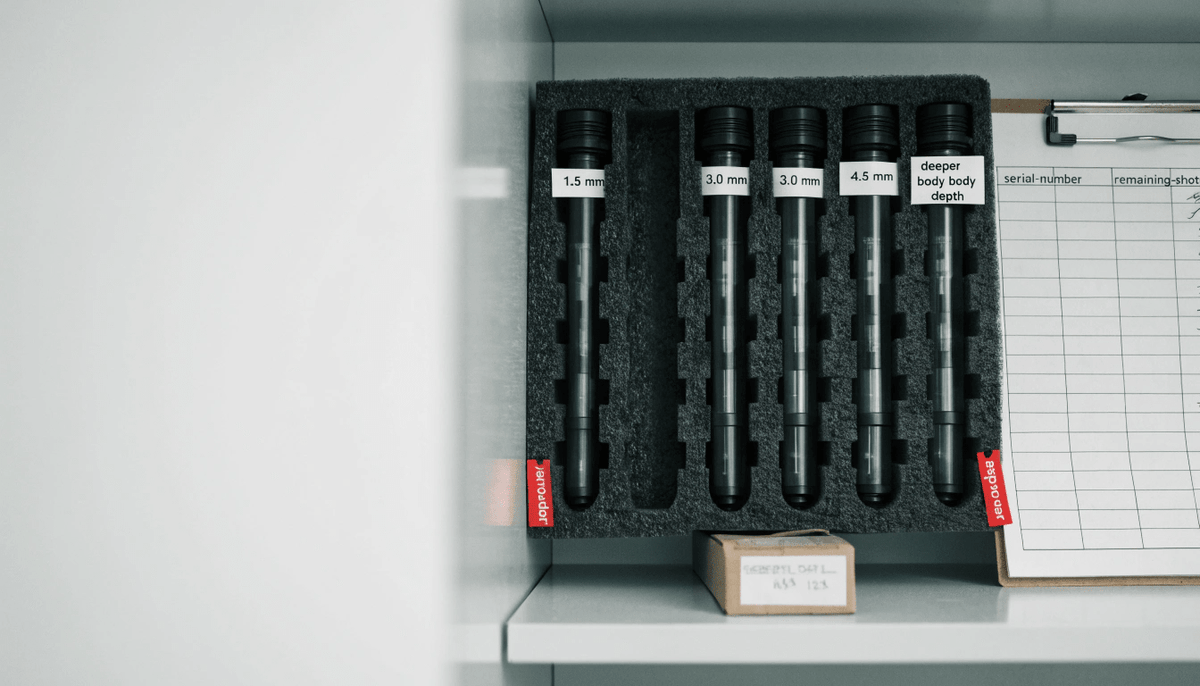
HIFU Cartridge Inventory Guide: Cost per Treatment, Shot Life and Reorder Planning
A HIFU cartridge should be reordered before the clinic's inventory position reaches lead-time demand plus safety stock. Track each cartridge by exact part number, device model, depth, serial number, usable shots and status; calculate cost per treatment from landed cost and logged protocol use, not advertised shot life alone.
Quick answer: How should a clinic plan HIFU cartridge inventory?
Use four numbers for each depth: average daily shot use, usable shots remaining across active and reserve stock, total replenishment lead time, and safety-stock shots. Reorder when inventory position is at or below the reorder point. Order enough units to restore the target stock level, then validate the forecast monthly against actual treatment logs.
How to use this guide
The formulas are planning tools, not clinical protocols or industry benchmarks. All worked values are illustrative. Replace them with model-specific quotations, IFU or label information, clinic usage logs, observed replenishment times and approved protocols. Review the current LEFIS HIFU machine collection only to shortlist platforms; obtain cartridge compatibility, pricing, warranty and supply terms in writing for the exact configuration.
HIFU Cartridge Cost per Treatment Calculator
For readers who need the number immediately, the two formulas and worked example below deliver the primary calculation up front. Every figure used is illustrative — replace each input with the clinic's own supplier quotation, protocol logs, and operational data. The remainder of the article covers how to derive each input defensibly, how to plan inventory around it, and how to avoid the traps that skew the number.
|
Metric |
Formula |
|
Cost per usable shot |
Landed cartridge cost ÷ Budgeted usable shots |
|
Cost per completed treatment |
Cost per usable shot × Shots used per treatment (sum across all depths) |
Worked example — facial multi-depth protocol
Illustrative inputs only. For simplicity, this example assumes each depth uses a separate cartridge with the same $500 purchase price, $50 allocated freight and import cost, 10,000 rated shots and 8,500 budgeted usable shots. That produces $550 ÷ 8,500 = $0.0647 per usable shot for each depth. The sample protocol uses 150 shots at 1.5 mm, 400 at 3.0 mm and 300 at 4.5 mm. In a real comparison, calculate each cartridge separately because prices, rated life and usable life may differ by depth and model.
|
Cartridge Depth |
Illustrative Shots Used |
Cost per Usable Shot |
Cartridge Cost per Treatment |
|
1.5 mm |
150 |
$0.0647 |
$9.71 |
|
3.0 mm |
400 |
$0.0647 |
$25.88 |
|
4.5 mm |
300 |
$0.0647 |
$19.41 |
|
Total |
850 |
— |
$55.00 |
At 85 percent utilization, cost is $0.0647 per shot. With the same $550 landed cost, 70 percent utilization produces $0.0786 per shot (about 21 percent higher than the 85 percent case), while 95 percent produces $0.0579 (about 11 percent lower). The range is asymmetric, so do not describe it as a simple plus-or-minus percentage. Use clinic logs to select and periodically revise the planning assumption.
Build a Cartridge Register and Verify Compatibility Before Calculating Cost
Cost calculations are unreliable when cartridges are recorded only as "HIFU head" or "4.5 mm cartridge." Every cartridge needs its own inventory record, and every cartridge needs verified compatibility against the specific machine it will run on.
What to record for every cartridge
Internal inventory ID, manufacturer, machine model and serial number, cartridge part number and serial number, focal depth, operating frequency, treatment mode, purchase date, activation date, purchase price, freight and import cost, rated shots, guaranteed minimum shots, remaining-shot count, warranty expiration, and storage location.
Cartridge-level vs model-level tracking
|
MODEL-LEVEL TRACKING |
CARTRIDGE-LEVEL TRACKING |
|
Records total cartridges owned |
Identifies each individual cartridge |
|
Cannot isolate a defect |
Supports warranty evidence |
|
Hides uneven use |
Shows usage by depth |
|
Weak reorder planning |
Enables depth-specific forecasts |
|
Difficult across locations |
Supports transfers and accountability |
Depth match vs system match
Two cartridges labeled 4.5 mm are not automatically interchangeable. Compatibility may depend on connector, handpiece, firmware, machine generation, shot-count chip, frequency, delivery mode, or serial-number lock. See HIFU frequency, intensity and pulse settings for depth and frequency conventions.
|
SAME DEPTH ONLY |
CONFIRMED COMPATIBILITY |
|
Both say 4.5 mm |
Correct manufacturer part number |
|
Similar external shape |
Correct connector and firmware |
|
May fit physically |
Recognized by software |
|
May be unsafe or unsupported |
Covered by supplier warranty |
OEM vs third-party cartridges
OEM cartridge: validated for the platform, supplier-backed protocol, clearer warranty path, predictable shot-counter behavior.
Third-party cartridge: may cost less, but compatibility may be unverified, may affect energy delivery, may void warranty, and may lack supplier support. Compatibility and warranty must be verified before use.
Understand What the Machine Counts as One Shot

Suppliers use "shot," "line," and "pulse" inconsistently. Two cartridges with the same shot rating may deliver different treatment capacity.
One trigger does not always equal one treatment line
A machine may count one trigger as one shot, one delivered line as one shot, one dot as one shot, one group of lines as one shot, or multiple thermal points as one cycle. Two cartridges advertised at "10,000 shots" may therefore support very different numbers of treatments.
Shot count vs line count
|
SHOT COUNT |
LINE COUNT |
|
Machine's usage unit |
Number of treatment lines delivered |
|
May represent one trigger |
May include several lines per trigger |
|
Useful for cartridge depletion |
Useful for protocol and time planning |
|
Must be defined by supplier |
Must match delivery mode |
Verify the counter with a live test
Record the starting count, deliver one single-line trigger, record the deduction, deliver one multi-line trigger, record the deduction, remove and reconnect the cartridge, restart the machine, then confirm the count remains accurate. Document the finding in the inventory policy so different managers use the same assumption.
Rated Shot Life vs Usable Shot Life
Rated shot life is the supplier's maximum advertised capacity. Usable shot life is the number of shots the clinic can reasonably use while maintaining acceptable output. The two are not the same. The size of the gap between them varies by device model, operator training level, protocol discipline, storage conditions, and the definition of “acceptable output” the clinic adopts — so this article treats the gap as a scenario input rather than an industry benchmark.
What reduces usable shot life
Factory tests, operator training, practice sessions, setup firing, aborted procedures, cartridge errors, accidental damage, early output drift, connector failure, warranty quarantine, expiration, and shots below the safety threshold.
Rated life vs guaranteed minimum
|
RATED LIFE |
GUARANTEED MINIMUM |
|
Headline maximum |
Contractual floor |
|
Assumes ideal use |
Reflects defined conditions |
|
Often used in marketing |
Better for budgeting |
|
May not address degradation |
Should include failure remedy |
|
Not always warrantied |
Can support a claim |
Use a conservative utilization factor
Estimated usable shots = Rated shots × planning utilization factor. Build at least three scenarios, but derive the percentages from clinic or supplier evidence. If no reliable history exists, the 70 percent, 85 percent and 95 percent cases used here are stress-test assumptions only, not labels for “poor,” “typical” or “mature” clinics. At 10,000 rated shots they yield 7,000, 8,500 and 9,500 budgeted usable shots. Replace a cartridge earlier when the IFU, device diagnostics, visible damage, repeated errors or authorized service guidance requires it.
Calculate HIFU Cartridge Cost per Shot and per Treatment
Basic cost-per-shot formula
Cartridge cost per usable shot = Landed cartridge cost ÷ Budgeted usable shots. Landed cost includes cartridge price, freight, customs or duty, import tax, payment fees, inspection expense, and any emergency-shipping allocation.
Worked example
Cartridge purchase price $500, shipping and import allocation $50, total landed cost $550, rated life 10,000 shots, budgeted usable life 8,500 shots. Cost per usable shot = $550 ÷ 8,500 = $0.0647. Round according to the clinic's accounting policy.
Advertised vs operating cost per shot
|
ADVERTISED CALCULATION |
OPERATING CALCULATION |
|
Purchase price ÷ rated shots |
Landed cost ÷ usable shots |
|
Ignores shipping |
Includes delivery and import |
|
Assumes every shot is billable |
Includes training and waste |
|
No risk allowance |
Uses conservative capacity |
|
Better-looking result |
Better budgeting result |
HIFU cartridge cost per treatment formula
HIFU cartridge cost per treatment = Cost per usable shot × Shots used during the treatment. When several cartridge depths are used, calculate each separately and add. LEFIS's HIFU machine cost and ROI for clinics guide separates cartridge depreciation, gel, staff time, maintenance, and training when discussing full-treatment economics.
MULTI-DEPTH TREATMENT COST STRUCTURE
|
DEPTH |
SHOTS USED |
COST PER SHOT |
CARTRIDGE COST |
|
1.5 mm |
150 |
$0.0647 |
$9.71 |
|
3.0 mm |
400 |
$0.0647 |
$25.88 |
|
4.5 mm |
300 |
$0.0647 |
$19.41 |
|
Total |
850 |
— |
$55.00 |
Illustrative multi-depth facial protocol. Values match the worked example above ($550 landed cartridge cost, 8,500 budgeted usable shots at 85 percent utilization, $0.0647 per usable shot). Replace shots-used values with the clinic's own protocol data; where different depths use different cartridges with different landed costs, recalculate cost per usable shot per depth before summing.
Protocol estimate vs actual usage
|
PROTOCOL ESTIMATE |
ACTUAL USAGE |
|
Planned before treatment |
Read from device after treatment |
|
Useful for pricing |
Useful for margin review |
|
Assumes standard case |
Reflects patient-specific plan |
|
Used for booking model |
Used for cost accounting |
Add other variable expenses
The cartridge figure is not the full treatment cost. Also include coupling gel, disposable barriers, cleaning supplies, operator labor, room occupancy, payment-processing fees, and maintenance reserve.
Track Cost by Cartridge Depth

Blended averages hide inventory problems. A clinic may have low overall cartridge cost while running short of one high-use depth.
Face cartridges vs deeper body cartridges
|
FACE CARTRIDGES |
BODY CARTRIDGES |
|
Facial and neck protocols |
Larger treatment zones |
|
Often more frequent demand |
May be less frequent |
|
Protocol-dependent shots |
Can be higher shot use |
|
Higher reorder frequency |
Depends on body bookings |
|
Running out affects core menu |
Overstock may tie up cash |
Calculate a depth-specific monthly burn rate
Monthly shot burn by depth = Average shots per treatment at that depth × Monthly treatments using that depth. Do not divide stock equally across depths. Order volume should reflect real treatment mix, protocol usage, remaining shots, supplier lead time, seasonal demand, and cartridge shelf life.
Use Protocol Data to Forecast Cartridge Demand
Approved protocol templates convert clinical bookings into cartridge demand.
Build standard protocol templates
Each approved protocol should estimate treatment area, cartridge depths, expected shot range, and frequency of use. See HIFU facial protocols and downtime for facial-protocol context — the clinic should still use training applicable to its exact machine.
Compare forecast with actual use monthly
Usage variance = Actual shots used − Forecast shots. Investigate variance caused by incomplete training, different counting methods, changed protocols, or data-entry errors.
Set Reorder Points, Safety Stock, and Stock Levels
Ordering at zero remaining shots is not inventory planning. Reorder points, safety stock, and stock-level thresholds turn supplier lead time into a scheduling tool.
Separate the Reorder Trigger From the Order Quantity
Reorder point (shots) = Average daily shot use × Total replenishment lead time in days + Safety-stock shots.
Inventory position (shots) = Usable shots remaining in active cartridges + usable shots in reserve stock + confirmed inbound usable shots.
Reorder when inventory position is at or below the reorder point.
For a periodic review system, target stock (shots) = Average daily shot use × (Lead time + Review interval) + Safety stock. Units to order = MAX[0, ROUNDUP((Target stock − Inventory position) ÷ Usable shots per new cartridge)]. This separates the trigger from the quantity. If supplier pack sizes, minimum order quantities, expiry dates or different cartridge capacities apply, adjust the result before ordering.
Supplier dispatch vs total replenishment lead time
|
SUPPLIER DISPATCH TIME |
TOTAL REPLENISHMENT TIME |
|
Time before shipment |
Time until clinic can use cartridge |
|
Excludes transit |
Includes transit |
|
Excludes customs |
Includes customs |
|
Excludes inspection |
Includes receiving checks |
|
Often quoted by sales |
Relevant to operations |
Safety stock varies by operational risk
Higher safety stock is justified by international shipping, customs delays, no local distributor, single-machine dependency, high volume, multi-location operations, or uncertain supplier stock.
Low-volume vs high-volume clinic
|
LOW-VOLUME CLINIC |
HIGH-VOLUME CLINIC |
|
Slower cartridge depletion |
Fast burn rate |
|
Less cash tied in stock |
Greater downtime cost |
|
May hold one spare for core depth |
May need several per depth |
|
Higher overstock risk |
Higher stockout risk |
Minimum, target, and maximum stock levels
Minimum (reorder point): the inventory-position level that triggers replenishment. Target: the order-up-to level that covers lead time, the review interval and safety stock. Maximum: the highest authorized position after delivery, constrained by cash, shelf life, storage, model-obsolescence risk and supplier pack size. Do not use “minimum” to mean zero usable shots.
TABLE — INVENTORY FORECAST WORKSHEET
|
DEPTH |
MONTHLY BURN |
INVENTORY POSITION |
LEAD-TIME DEMAND |
SAFETY STOCK |
REORDER TRIGGER |
|
1.5 mm |
600 |
2,500 |
300 |
200 |
When position ≤ 500 |
|
3.0 mm |
1,200 |
4,200 |
600 |
400 |
When position ≤ 1,000 |
|
4.5 mm |
900 |
3,800 |
450 |
300 |
When position ≤ 750 |
|
Body depth |
200 |
1,500 |
100 |
100 |
When position ≤ 200 |
How to use the worksheet
- Monthly burn (shots) = Average shots per treatment at that depth × Monthly treatments using that depth.
- Lead-time demand (shots) = Average daily shot use × Replacement lead time in days for that depth.
- Safety stock (shots) = Buffer volume covering supplier delay, customs risk, single-machine dependency, and booking pipeline. Increase for imported cartridges, weak local distribution, or full booking calendar.
- Reorder point (shots) = Lead-time demand + Safety stock. Reorder when inventory position—not only the active cartridge counter—is at or below this level.
- Target stock (shots) = Average daily use × (Lead time + Review interval) + Safety stock. Cartridges to order = MAX[0, ROUNDUP((Target stock − Inventory position) ÷ Usable shots per new cartridge)].
Copy this table into a spreadsheet, replace the illustrative values with the clinic's own data, and use inventory position versus reorder point as the alert. Add columns for review interval, target stock, usable shots per new cartridge, reserve stock, confirmed inbound stock and calculated units to order. The values shown are examples, not benchmarks.
Track Treatment Margin After Every Cartridge Replacement
Treatment contribution margin = Revenue − Cartridge cost − Other variable costs. This is not net profit — it excludes fixed overhead, financing, and taxes.
Forecast margin vs actual margin
|
FORECAST MARGIN |
ACTUAL MARGIN |
|
Uses expected shots |
Uses logged shots |
|
Estimated cartridge cost |
Actual landed cost |
|
Useful for price setting |
Useful for management |
|
Assumes full utilization |
Reflects waste and failures |
|
Reviewed before launch |
Reviewed monthly |
Recalculate margin when any input changes
Rerun the calculation after any change to cartridge price, shipping, currency, shot life, protocol, labor cost, promotional pricing, supplier, or machine model. For prepaid packages, reserve cartridge capacity for future appointments rather than treating full payment as unrestricted cash.
Monitor Energy Consistency and Plan Warranty Claims
Shot count alone does not prove a cartridge remains suitable for use. Follow the exact model's IFU, built-in diagnostics, error codes and supplier-authorized test process. Operator sensation or treatment outcome should not be used as a stand-alone energy-output measurement. The HIFU supplier guide explains which test records and warranty evidence to request before purchase.
First-use baseline vs ongoing check
|
FIRST-USE BASELINE |
ONGOING CHECK |
|
Establishes normal operation |
Detects drift |
|
Recorded at activation |
Repeated at set intervals |
|
Supports future comparison |
Supports replacement decision |
|
Useful for warranty |
Useful for quality control |
Possible indicators of cartridge decline
Quarantine a cartridge after visible housing or connector damage, repeated device errors, a failed manufacturer-defined self-test, abnormal heat or noise specified in the IFU, or an instruction from authorized technical support. Do not diagnose output drift from subjective sensation alone. Acoustic or electrical output testing belongs to the manufacturer or a qualified technician using an authorized procedure.
Quarantine status
Any questionable cartridge should be removed from active stock, labeled "Do Not Use," recorded in the inventory system, photographed, linked to its error record, and retained for warranty instructions.
Warranty claim structure
Ask whether the warranty is time-based, shot-based, or whichever comes first. Prepare purchase invoice, cartridge serial number, machine serial number, activation date, remaining shots, error code, photographs, and usage log for every claim. See HIFU training, warranty and after-sales support for the type of post-purchase information LEFIS publishes. A "free replacement" may still cost significantly when the clinic pays international freight, customs, and return shipping.
Include Treatment Speed in Cartridge Economics
Two cartridges with the same nominal cost per line may produce different operational costs if one delivers treatment much more slowly.
Cartridge cost vs appointment cost
|
CARTRIDGE COST |
APPOINTMENT COST |
|
Based on shot consumption |
Includes room and staff time |
|
Direct consumable expense |
Operational capacity expense |
|
Easy to calculate |
Often overlooked |
|
Ignores delivery speed |
Affected by delivery mode |
Faster delivery can reduce other costs
Shorter room occupancy, lower labor time, more appointments per day, and reduced operator fatigue. Speed should not override protocol control, treatment accuracy, client comfort, device limits, or safety.
Manage Cartridge Storage and Handling

Storage errors reduce usable life before the shot counter reaches zero.
Follow manufacturer-specific instructions
Controls may address temperature, humidity, sunlight, vibration, connector protection, cable handling, water requirements, orientation, cleaning, and transport. Cartridge construction varies by model — do not apply universal storage instructions.
Active stock vs reserve stock
|
ACTIVE CARTRIDGE |
RESERVE CARTRIDGE |
|
Assigned to a machine |
Stored unopened or inactive |
|
Count checked frequently |
Condition checked periodically |
|
Used in current treatments |
Held for replacement |
|
Higher handling exposure |
Expiration and compatibility risk |
First-expiring, first-out; document drops
When shelf life or activation deadlines apply, record expiration, rotate older stock first, and inspect packaging before use. A cartridge that appears undamaged may still require inspection after a drop — staff should report incidents rather than silently return items to stock.
Assign Cartridge Responsibility to Staff
Unassigned cartridges lose shots without explanation, and warranty claims fail when nobody can reconstruct usage.
Operator responsibility
Operators should record cartridge used, beginning count, ending count, treatment area, protocol, errors, and any damage.
Operations-manager responsibility
The manager should review remaining shots, usage variance, reorder dates, warranty cases, supplier lead times, cost per treatment, and quarantined stock.
Shared without logging vs controlled shared use
|
SHARED WITHOUT LOGGING |
CONTROLLED SHARED USE |
|
No individual accountability |
Every use is recorded |
|
Shot loss unexplained |
Variance can be investigated |
|
Damage difficult to trace |
Incident linked to operator and time |
|
Weak warranty evidence |
Stronger service history |
Test Replacement Supply and Remote Support
Test supplier support before the clinic is out of stock.
Ask a real inventory question before ordering
Which 4.5 mm cartridge is compatible with our exact model? Is it in stock? What is the price? What is the dispatch time? Does it require a firmware update? What is the warranty? What happens if it fails with unused shots?
Sales availability vs operational availability
|
SALES AVAILABILITY |
OPERATIONAL AVAILABILITY |
|
"We sell that cartridge" |
Exact unit is in stock |
|
No dispatch date |
Confirmed lead time |
|
No model verification |
Part number matched |
|
Verbal price |
Written quotation |
|
No support details |
Warranty and activation included |
Multi-Location HIFU Cartridge Planning
Multi-site clinics face inventory tradeoffs single-location clinics do not.
Central stock vs location-level stock
|
CENTRAL INVENTORY |
LOCATION INVENTORY |
|
Lower overall safety stock |
Faster access |
|
Better purchasing control |
Less transfer delay |
|
Requires internal shipping |
More cash tied across sites |
|
Easier bulk ordering |
Protects local appointments |
Standardize models; record transfers
A mixed machine fleet may create incompatible cartridges, duplicate inventory, more staff training, higher safety stock, and more obsolete stock. Every transfer should record sending and receiving location, cartridge serial number, remaining shots, condition, and staff approval.
Build a Monthly HIFU Cartridge Dashboard
A monthly view converts individual cartridge data into a management decision.
DASHBOARD METRICS
|
METRIC |
GREEN |
AMBER |
RED |
|
Inventory position by depth |
Above target |
Between target and reorder |
At/below reorder |
|
Days of stock remaining |
Lead + review + buffer |
Lead + buffer only |
Below lead time |
|
Monthly usage variance |
Within set tolerance |
Explained exception |
Unresolved variance |
|
Cartridge failures |
No open issue |
Quarantined; covered |
Booking risk |
|
Open POs on time |
Confirmed; buffer covers |
Delayed; buffer covers |
No date; buffer short |
Track active and reserve cartridges, inventory position by depth, monthly usage, treatments completed, shots per treatment, cost per completed treatment, forecast variance, quarantined units, warranty claims, days of stock remaining and open purchase orders. Define Green, Amber and Red thresholds from the clinic's lead time, review interval, booking exposure and approved risk tolerance; the labels are controls, not industry benchmarks.
HIFU Cartridge Planning Worksheet
Use the LEFIS HIFU machine collection to shortlist platforms, then verify every cartridge field against the exact model page, quotation, IFU and warranty schedule. The companion HIFU supplier guide explains how to request the document pack. Product names alone do not establish cartridge depths, compatibility, included quantities, shot life or body-treatment capability.
Information to request for each model
Cartridge depths, cartridge part numbers, frequency by depth, shot-count definition, rated shot life, guaranteed usable life, replacement price, cartridge warranty, machine compatibility, firmware requirements, current stock, shipping time, and storage instructions.
Compare C3-L and C6 by evidence pack, not model label
Review the C3-L and C6 product pages, but build the inventory comparison from written, model-specific evidence. Request the same five fields for each platform: exact cartridge part numbers and depths; standard versus optional items; shot-count definition and usable-life terms; replacement price and lead time; and warranty or failure-credit terms. Do not infer clinic fit from “2-in-1,” “3-in-1” or “D” labels.
HIFU Cartridge Inventory Mistakes to Avoid
Calculating with advertised shot life only
Understates cost when training, waste, errors, and early replacement are ignored.
Treating all depths as one inventory item
Can leave the clinic with cartridges in stock but none for its most-booked protocol.
Ordering only after the counter reaches zero
Exposes the clinic to shipping and customs delays with no buffer for booked patients.
Using cartridge price without landed cost
Freight and import costs can materially change cost per shot.
Keeping damaged cartridges in active stock
Questionable units should be quarantined and assessed before another treatment.
Overstocking before a machine upgrade
Future systems may use different connectors, firmware, or cartridge families.
Final HIFU Cartridge Inventory Checklist
Before setting service prices or placing a cartridge order, confirm the clinic has:
- identified the exact machine model and created a compatibility matrix
- recorded every cartridge serial number in one controlled register
- defined what one shot means on the specific model
- recorded rated shot life and set a conservative usable-shot assumption
- calculated landed cartridge cost and cost per usable shot
- logged shots per treatment and calculated multi-depth treatment cost
- tracked usage by depth and forecast monthly shot demand
- recorded supplier lead time and calculated reorder points
- set safety-stock levels and minimum/maximum stock thresholds
- inspected storage conditions and trained operators on logging
- established quarantine procedures for damaged or drifting cartridges
- reviewed cartridge warranty and prepared claim evidence
- tested supplier support with an inventory question
- reviewed treatment margins monthly against forecast
- prepared a multi-location transfer process where applicable
Request a Model-Specific Cartridge Quotation
Unit price alone cannot show operating cost. Compare landed price, the supplier's shot-count definition, rated and guaranteed life, cartridge compatibility, replacement lead time, warranty remedy, failure-credit terms and the clinic's own cost per completed treatment.
Compare the LEFIS HIFU machines, then use the contact page to request a written, model-specific cartridge quotation. Ask the supplier to identify each cartridge by part number and depth and to separate standard, optional and replacement items.
Information to include in the quotation request
Provide the following operating data so compatibility, pricing and replenishment terms can be returned for the correct model. Use the supplier's written response as an input to the clinic's own planning worksheet; do not treat a supplier estimate as a substitute for usage logs, approved protocols or local financial review.
|
Field |
What to Send |
Why It's Needed |
|
Machine model |
Exact model number and serial number (e.g. C3-L 4D 2-in-1 SN…) |
Confirms cartridge compatibility and shot-count definition |
|
Cartridge depths in scope |
Each depth being priced (e.g. 1.5, 3.0, 4.5, 8.0 mm) |
Different depths carry different cartridges with different landed costs |
|
Current replacement price (if known) |
Landed cost per cartridge if a prior purchase exists |
Anchors the clinic's cost calculation to its actual cost base |
|
Rated cartridge shot life |
Manufacturer's rated shots per cartridge for each depth |
Baseline for the utilization-factor scenarios |
|
Monthly treatments (by depth) |
Average treatments per month using each depth |
Drives monthly burn rate and reorder frequency |
|
Country / landed cost basis |
Destination country plus freight and customs treatment (DDP, DAP, EXW) |
Shipping and duty allocation are material to cost per shot |
|
Replacement lead time observed |
Days from PO to usable stock in clinic (not just supplier dispatch) |
Reorder-point calculation depends on total replenishment time, not dispatch time |
|
Booking pipeline |
Weeks of booked treatments held on the clinic calendar |
Sets the safety-stock buffer against stockout during shipping delay |
|
Contact and quotation reference |
Named clinic contact, email, and any current supplier quotation reference |
Supports model-specific follow-up and a written quotation |
Submit the request through the LEFIS contact page and ask for a written response that identifies cartridge part number, compatible machine model, included shot-count definition, price basis, stock status, total replenishment estimate, warranty period, exclusions and the remedy for failure with unused shots.
FAQs
What is the HIFU cartridge cost per treatment?
Divide the landed cartridge cost by budgeted usable shots, then multiply by the shots used in the treatment. When a protocol uses several depths, calculate each cartridge separately and add the results. Landed cost should include freight, customs, and any inspection or emergency-shipping allocation.
How long does a HIFU cartridge last?
A cartridge lasts until its usable shot capacity is reached or it is removed earlier because of damage, output inconsistency, expiration, errors, or warranty instructions. Calendar life depends on monthly treatment volume and shots used per protocol.
How many treatments can one HIFU cartridge provide?
Treatments per cartridge equal usable shots divided by average shots used per treatment. Do not use rated shots without accounting for training, setup, waste, or multi-depth protocol use. A cartridge budgeted at 8,500 usable shots supports about 85 treatments at 100 shots each — fewer for higher-shot protocols.
Which HIFU cartridge depth is best?
No depth is universally best. Different depths are intended for different tissue targets and treatment areas. Inventory should match the clinic's approved protocols and patient demand rather than stocking every available depth equally.
Why are some HIFU cartridges so cheap?
Price may reflect manufacturing source, transducer quality, shot capacity, warranty, distribution model, or absence of local service. Compare landed cost per usable shot rather than unit price. A cheaper cartridge that fails early or voids warranty can cost more per completed treatment.
What happens when a HIFU cartridge runs out of shots?
The device may prevent further firing or require a replacement depending on the system. Clinics should reorder well before zero remaining shots to protect booked appointments — the total replenishment window includes supplier processing, dispatch, transit, customs, and receiving inspection.
Can HIFU cartridges be refilled or reset?
Only follow the manufacturer's authorized procedure. Unauthorized resetting or modification may affect performance, traceability, warranty, and safety. A reset does not restore the transducer's physical service life.
Do unused HIFU cartridge shots expire?
This depends on the cartridge design and supplier terms. Ask about shelf life, activation date, time-based expiration, storage conditions, and whether unused shots remain valid after long periods. Confirm the answer in writing before ordering large quantities.
Sources
- General Controls for Medical Devices · U.S. Food & Drug Administration
- Medical Device Reporting Requirements · U.S. Food & Drug Administration
- Medical Devices Sector · European Commission
- ISO 13485 — Medical Devices Quality Management Systems · International Organization for Standardization
- ISO 14971 — Application of Risk Management to Medical Devices · International Organization for Standardization
- Medical Electrical Equipment Standards · International Electrotechnical Commission
- Medical Device Databases · U.S. Food & Drug Administration
- Medical Devices — Technical Series · World Health Organization


Looking for something else?

Do Men Get Cellulite? Causes Differences & What to Know
LEARN MORE
Does Radio Frequency Skin Tightening Work? Results & How It Works
LEARN MORE
Do You Shave Before Laser Hair Removal? Prep Tips & Why It Matters
LEARN MORE
How to Get Rid of Age Spots: Treatments. Natural Remedies & Prevention
LEARN MORELooking for something else?
How to Heal Ingrown Hair: Causes. Treatments & Healing Time
LEARN MORE
How to Get Rid of Freckles: Effective Treatments & Natural Tips
LEARN MORE
Top 10 Picosecond Laser Machine Manufacturers for Clinics in 2026
LEARN MOREYou may also like


Further reading

Tattoo Removal Laser Machine Cost and Ownership Guide

CO2 Laser Treatment Room Setup Checklist

Aesthetic Machine Factory Acceptance Test Before Shipment


