

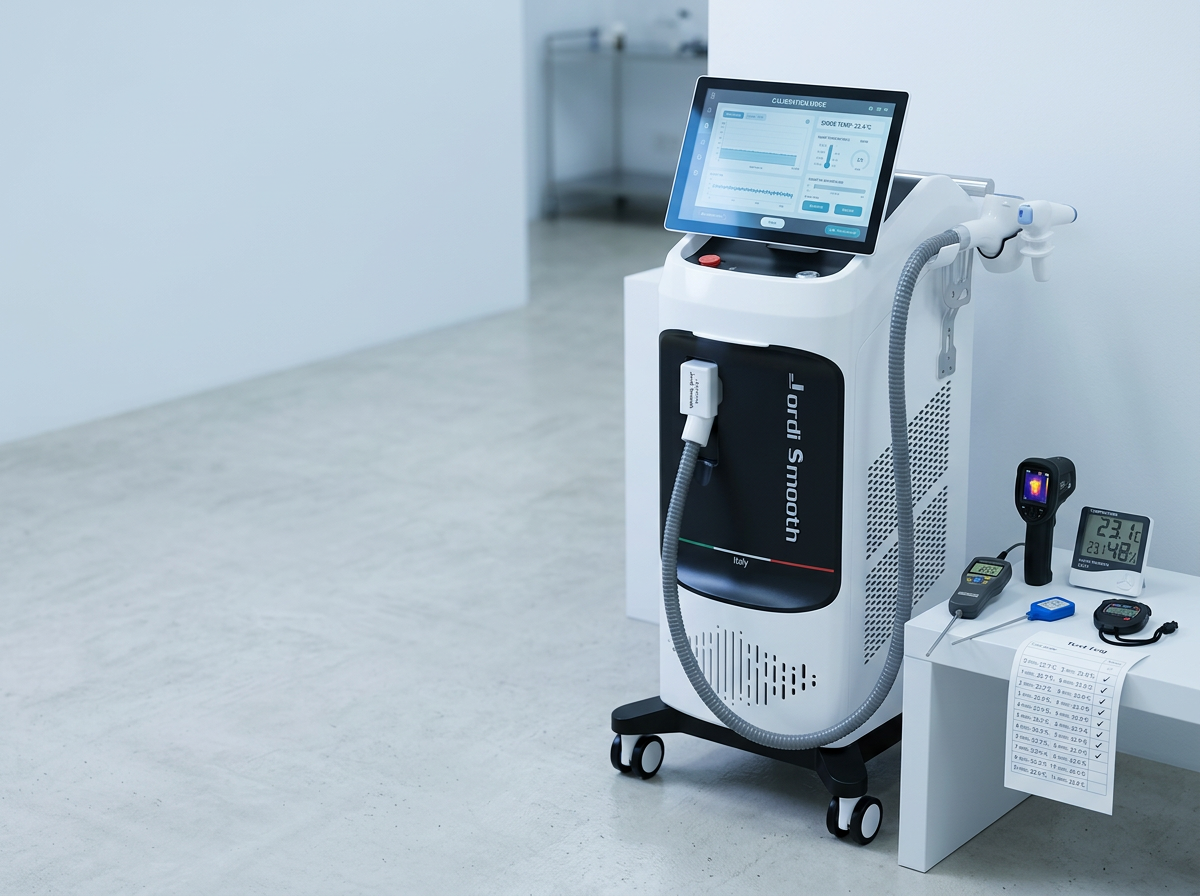
How to Calculate Laser Hair Removal Machine Throughput: Spot Size, Hertz and Session Time
Laser hair removal machine throughput is the number of treatments — and the revenue — one machine can produce in a working day. A machine's maximum hertz is not clinic throughput. Real throughput depends on effective spot coverage, overlap, movement pattern, cooling stability, parameter limits, operator technique, setup time, cleaning, client changeover, and schedule utilization. The calculation moves through four levels: theoretical area per pulse, effective area per second, treatment time per body area, and patients and revenue per working hour. This article treats the calculator as a planning model and was not a guaranteed treatment time. The results depend on assumptions the clinic must verify with its own operators, protocols, and equipment.
QUICK FORMULA BOX
- Spot area (rectangular): width × height (convert millimetres to centimetres first)
- Theoretical coverage rate: spot area × pulses per second
- Effective coverage rate: spot area × Hz × coverage-efficiency factor
- Treatment time: body-area surface ÷ effective coverage rate
- Appointment time: treatment time + consultation + preparation + changeover + cleaning + documentation
- Daily capacity: productive treatment minutes ÷ average appointment minutes
- Revenue per hour: average session price ÷ total room time in hours
VARIABLE TABLE
|
VARIABLE |
SYMBOL |
UNIT |
PURPOSE |
|
Spot width / height |
W / H |
cm |
Pulse dimensions |
|
Spot area |
A |
cm² |
Gross area per pulse |
|
Repetition rate |
f |
Hz |
Pulses per second |
|
Overlap rate |
O |
% |
Repeated coverage between pulses |
|
Coverage-efficiency factor |
E |
Decimal |
Real fraction of theoretical coverage |
|
Body-area size |
B |
cm² |
Estimated treatment surface |
|
Active firing time |
Tₐ |
minutes |
Laser-on time |
|
Changeover time |
T꜀ |
minutes |
Non-treatment room time |
|
Session price |
P |
currency |
Revenue per appointment |
What Does Laser Hair Removal Machine Throughput Mean?
Throughput has four distinct meanings inside a clinic. Confusing them is the fastest way to misjudge a machine.
|
THROUGHPUT TYPE |
MEASURES |
WHAT IT LEAVES OUT |
|
Pulse throughput |
Pulses per second (Hz) |
Spot size and overlap |
|
Area throughput |
Square centimetres per second |
Setup and changeover |
|
Patient throughput |
Completed sessions per day |
Treatment pricing |
|
Revenue throughput |
Revenue per available machine hour |
Margin and operating cost |
A supplier can quote a strong number on any one of these while remaining weak on the others. Buyers should compare all four using the same test conditions.
Spot Size vs Hertz: Which Affects Speed More?

How spot size changes coverage
Spot size sets the area treated per pulse. A larger footprint covers more skin at once but may be awkward on small contours, edges, and precision areas. A smaller footprint is easier to control but requires more pulses to cover the same surface.
How hertz changes pulse frequency
Hertz sets the pulses per second. 1 Hz suits stamping mode; 5-10 Hz suits controlled glide. The clinically usable rate depends on cooling, fluence, and operator hand speed — the maximum machine rate is rarely usable at treatment fluence over a full session.
Larger spot vs higher hertz
|
LARGER SPOT SIZE |
HIGHER HERTZ |
|
Covers more area per pulse |
Delivers more pulses per second |
|
May reduce total pulse count |
May increase movement demands |
|
Helps on legs, back and chest |
Helps in glide mode |
|
Awkward on small contours |
May be limited by cooling or fluence |
|
Improves large-area speed |
Does not guarantee full coverage |
The K12 diode laser lists spot sizes from 12×10mm to 12×35mm and adjustable frequency up to 10 Hz, making it a useful specification example for the calculator. The actual sustained combination should still be tested at real fluence.
Gross Coverage, Effective Coverage, and Overlap
Gross spot area vs effective coverage
Gross spot area is width × height for rectangular tips, or π × radius² for circular tips (convert millimetres to centimetres first). Effective coverage is lower because overlap, edge falloff, handpiece angle, skin contours, and incomplete contact all reduce the productive footprint.
Why overlap matters
A small planned overlap reduces gaps, accounts for hand movement, and helps treat curved surfaces. Excessive overlap increases pulse count, heat accumulation, cooling demand, and session time without adding coverage.
Overlap vs missed spots
|
TOO MUCH OVERLAP |
TOO LITTLE OVERLAP |
|
Slower total coverage |
Missed treatment zones |
|
More pulses fired |
Uneven coverage |
|
Greater heat load |
Faster apparent speed |
|
Longer session time |
Possible touch-up demand |
Coverage-efficiency factor
Use a planning factor rather than a universal percentage. Controlled stamping supports a higher factor; curved areas and inexperienced operators require a lower factor. Square and rectangular spots tile an area more efficiently than circular spots, which naturally create edge gaps or overlap. Body contours prevent perfect geometric tiling regardless of spot shape.
Theoretical Coverage vs Real Operator Coverage
Real coverage = theoretical coverage × movement factor × contact factor × duty-cycle factor. Every factor is less than 1. Multiplying them together explains why a machine that looks fast on paper takes longer in the room.
|
THEORETICAL MODEL |
CLINIC MODEL |
|
Continuous firing |
Includes pauses |
|
Flat surface |
Curved body areas |
|
Perfect overlap |
Human variation |
|
Maximum Hz |
Usable Hz |
|
No cooling limit |
Thermal duty cycle |
|
No documentation |
Full appointment workflow |
The productive fraction is usually 40-70% of theoretical coverage. Buyers who plan against 100% will consistently miss capacity forecasts and revenue projections.
Stamping Mode vs In-Motion Mode Throughput
Stamping mode
Discrete pulse placement, easier pulse counting, precise placement, slower repositioning, controlled overlap. Suited to small or precise areas.
In-motion mode
Continuous handpiece movement, high pulse repetition, cumulative coverage, grid marking, and pass counting. Suited to larger flat areas.
Stamping vs in-motion
|
STAMPING |
IN-MOTION |
|
Easier individual pulse placement |
Faster continuous coverage |
|
Suits small or precise areas |
Suits larger areas |
|
Lower movement speed |
Requires controlled glide speed |
|
Easier to count pulses |
Requires pass and grid tracking |
|
May use higher fluence per pulse |
Often uses repeated lower-energy passes |
High Hz means different things in each mode. Stationary at 10 Hz stacks energy in one location; moving at 10 Hz spaces pulses along the skin. The hand speed required to maintain planned overlap becomes the real bottleneck in glide mode.
How to Calculate Required Handpiece Speed

Distance between pulses = handpiece travel speed ÷ pulses per second. For a target 10% overlap in glide mode using a 3.5 cm spot at 10 Hz, the effective step is 3.15 cm per pulse, giving 31.5 cm per second — faster than most operators can maintain smoothly on curved areas.
Why operators cannot always use maximum Hz
Hand speed becomes impractical, contact cooling loses consistency, grid control becomes harder, small contours require slower movement, and energy settings may cap the achievable rate. A 10 Hz machine may operate reliably at 5-7 Hz during real treatments.
Body-Area Assumptions for Session-Time Calculations
Body-area estimates vary with patient height, body shape, treatment boundaries, gender-based menu differences, and clinic package definitions. Use a range — not a single figure — when planning capacity.
Create clinic-specific area templates
Common menu items include upper lip, chin, underarms, bikini line, Brazilian, forearms, full arms, lower legs, full legs, chest, and back. Each clinic should measure its own client population rather than borrow numbers from another platform.
Surface-area range vs single number
Use a low estimate, typical estimate, and high estimate for every service. The hair removal treatment systems page shows how large-area applications benefit from larger spot sizes and higher usable frequencies.
Active Firing Time, Appointment Time, and Changeover
Five-step calculation
Step 1: estimate treatment surface. Step 2: calculate gross coverage rate (spot area × Hz). Step 3: apply coverage efficiency (overlap, movement, contours). Step 4: apply duty cycle (cooling pauses). Step 5: convert seconds to minutes.
Active time vs room time
|
ACTIVE TREATMENT TIME |
TOTAL ROOM TIME |
|
Machine in use |
Full appointment occupies room |
|
Useful for machine comparison |
Useful for scheduling |
|
Excludes intake |
Includes intake |
|
Excludes cleaning |
Includes cleaning |
|
Can overstate capacity |
Reflects clinic capacity |
Changeover matters more on short sessions
A fixed 7-minute changeover consumes 41% of a 10-minute treatment but only 10% of a 60-minute treatment. Short-session clinics gain more from cutting changeover than from raising machine Hz. Standardized room layout, pre-set trays, digital forms completed before arrival, and preset machine protocols reduce non-firing time without compromising safety or disinfection.
Cooling Capacity and Parameter Limits vs Advertised Speed

Cooling controls how long the maximum Hz can be sustained. Parameter limits control whether that Hz can be reached at treatment fluence at all.
Maximum Hz vs sustained Hz
|
MAXIMUM HZ |
SUSTAINED CLINICAL HZ |
|
Brochure specification |
Usable rate over treatment duration |
|
May be tested briefly |
Tested under thermal load |
|
May use lower fluence |
Must match treatment parameters |
|
Does not prove all-day operation |
Relevant to daily capacity |
Fluence, pulse width, and spot size interact
Some machines cannot hold the highest fluence, widest pulse range, largest spot, and maximum Hz simultaneously. Long pulses take more time; large spots may reduce available energy density. Ask for the specification matrix at every combination — not the highest number in each column separately.
Specification matrix to request
|
SPOT SIZE |
FLUENCE |
PULSE WIDTH |
MAX SUSTAINED HZ |
COOLING CONDITION |
|
Small |
Request |
Request |
Request |
Request |
|
Medium |
Request |
Request |
Request |
Request |
|
Large |
Request |
Request |
Request |
Request |
Operator Speed, Consistency, and Workflow
Experienced vs new operator
|
EXPERIENCED OPERATOR |
NEW OPERATOR |
|
Consistent hand speed |
More pauses |
|
Predictable overlap |
Variable overlap |
|
Faster parameter selection |
More reference checks |
|
Better cable control |
More repositioning |
|
Stable schedule estimates |
Wider time variation |
Where training improves throughput
Body mapping, handpiece grip, grid size, patient positioning, treatment presets, and documentation workflow. LEFIS's diode laser operator training and support covers operator training, warranty coverage, and technical support — all of which shape sustained throughput more than headline machine specs.
Room and machine workflow
One room, one machine: simple scheduling, but changeover blocks the machine. Two rooms, one machine: consultation in one, treatment in the other; machine mobility and cabling become the constraint. Two machines: parallel capacity, higher capital cost, higher staffing burden, lower single-point downtime risk.
Calculate Daily, Weekly, and Monthly Capacity
Daily capacity
Daily completed sessions = available minutes × utilization rate ÷ weighted average appointment time. Subtract opening checks, lunch, breaks, maintenance, and admin blocks from clinical minutes. Use a weighted average appointment time when the menu mixes areas — not a single session length.
Apply utilization
Utilization accounts for unbooked slots, cancellations, no-shows, late arrivals, and equipment downtime. A 100% utilization assumption produces capacity numbers that never materialize.
Weekly and monthly
Weekly capacity multiplies daily capacity by operating days minus maintenance blocks. Monthly capacity subtracts holidays, training days, service days, and seasonal demand shifts. Separate booked sessions, attended sessions, completed sessions, rescheduled sessions, and refunded sessions — they behave differently and should be reported separately.
Revenue per Hour Calculator
Gross revenue per appointment
Realized price = listed price − package discount − membership discount − promotions. Realized price is almost always lower than the price on the menu. Using the list price inflates every revenue calculation downstream.
Revenue per room hour
Revenue per room hour = realized session revenue ÷ total room time in hours. This is the number that translates most directly into P&L. A high active-treatment throughput can produce weak revenue per room hour when changeover, intake, and cleaning are long.
Contribution per machine hour
Subtract operator labour, consumables, handpiece amortization, cleaning supplies, financing allocation, and maintenance reserve from revenue per hour. Contribution is what pays for fixed overhead, not gross revenue.
Treatment mix
|
SERVICE |
PRICE |
ROOM MINUTES |
REVENUE/HR |
VARIABLE COST |
CONTRIBUTION/HR |
|
Small area |
Input |
Input |
Calculate |
Input |
Calculate |
|
Medium area |
Input |
Input |
Calculate |
Input |
Calculate |
|
Large area |
Input |
Input |
Calculate |
Input |
Calculate |
|
Bundle |
Input |
Input |
Calculate |
Input |
Calculate |
Fastest Treatment vs Highest Revenue per Hour
The fastest session is not automatically the most profitable. Speed-first clinics run short appointments with lower ticket size and higher changeover burden. Value-first clinics run larger bundles with higher ticket size and lower changeover share.
|
FASTEST SESSION |
HIGHEST REVENUE PER HOUR |
|
Minimizes treatment time |
Maximizes financial output |
|
Often small areas |
Often bundles |
|
High changeover share |
Lower changeover share |
|
More bookings needed |
Fewer bookings needed |
|
Not automatically most profitable |
Depends on price and cost |
Machine Throughput vs Clinic Throughput
Machine bottlenecks include small spot, low sustained Hz, cooling pauses, slow startup, handpiece changes, and software delay. Clinic bottlenecks include intake, staffing, room reset, late clients, weak scheduling, and payment processing. A faster machine will not fix a scheduling problem.
How to identify the real bottleneck
Time the sequence: client arrival, room entry, machine startup, first pulse, last pulse, room exit, next client entry. The largest gap between events points to the actual constraint. Most clinics discover that reducing changeover by 3-5 minutes adds more capacity than raising machine Hz by 20%.
Theoretical Throughput vs Verified Throughput
Brochure throughput uses maximum spot size, maximum Hz, continuous firing, no overlap adjustment, and no cooling delay. Verified throughput uses defined body area, recorded settings, a trained operator, and repeated sessions. See the diode laser buying guide for how specifications translate into real clinic performance.
|
BROCHURE CLAIM |
BUYER-GRADE VERIFICATION |
|
Maximum Hz |
Sustained Hz |
|
Largest spot |
Effective footprint |
|
"Fast treatment" |
Timed body-area test |
|
No session conditions |
Full parameter record |
|
One demonstration |
Repeated test |
|
Laser-on time |
Full room time |
Supplier Live Throughput Test Checklist
Before the test
Request exact model, exact handpiece, spot size, wavelength mode, pulse width, fluence, Hz, cooling setup, and operator experience level in writing. Missing any of these makes the test uncomprisable.
Select a defined test area
Use a flat test grid, mannequin template, volunteer area where legally and ethically appropriate, or a fixed measured surface. The surface must be reproducible so the test can be repeated.
During the test — record
Startup time, parameter setup time, active treatment time, number of pulses, overlap method, handpiece temperature, pauses, error messages, cleaning time, and reset time. A stopwatch and video camera are non-negotiable.
Repeat the test
First session, back-to-back second session, later-day session, large spot configuration, smaller spot configuration, and realistic fluence. A single demo cannot reveal cooling drift or output stability over a full clinic day.
Test report
Require continuous video, time stamps, settings screen, pulse count, treatment surface, cooling readings, and operator notes. Compare the results against the 2026 diode laser machine ranking and the best laser hair removal machine manufacturers ranking for a fair comparison against reference platforms.
K12 Throughput Specification Example
Use this as a specification-analysis example, not a guaranteed treatment time. The live K12 page lists adjustable frequency up to 10 Hz, spot sizes from 12×10mm to 12×35mm on the current product page, 1-400 ms pulse width, several laser-power configurations, and water, air, semiconductor, and sapphire cooling.
Data to insert into the calculator
Selected spot size, selected frequency, effective overlap, selected body area, duty-cycle factor, and changeover time.
Data still required from a live test
Sustained Hz at treatment fluence, real temperature stability, output consistency, effective operator speed, and body-area completion time. Request a timed throughput demonstration from LEFIS or any competing supplier before signing.
Common Throughput Calculation Mistakes
- Multiplying spot area by maximum Hz and stopping there
- Ignoring overlap
- Using millimetres as if they were centimetres
- Assuming full skin contact on curved areas
- Ignoring repeated passes and cooling pauses
- Using maximum Hz at unrealistic settings
- Excluding client changeover from capacity
- Assuming all body areas are the same size
- Confusing active firing time with appointment time
- Using list price instead of realized price
- Ignoring no-shows and utilization
- Assuming every operator works at expert speed
- Treating one promotional demo as verified capacity
Throughput KPI Dashboard for Clinics
Track machine and workflow KPIs separately. Confusing them hides the real cause of low capacity.
|
MACHINE KPI |
OPERATOR OR WORKFLOW KPI |
|
Sustained Hz |
Hand speed |
|
Spot size |
Overlap consistency |
|
Cooling recovery |
Changeover time |
|
Error rate |
Setup time |
|
Pulse count |
Documentation time |
A monthly review should cover active treatment minutes, room minutes, sessions per day, machine utilization, average changeover, revenue per room hour, contribution per machine hour, cancellation rate, and downtime rate.
Final Throughput Calculation Checklist
Before signing a purchase order or setting menu pricing, confirm:
- exact spot dimensions confirmed and converted to centimetres
- gross spot area calculated
- clinically usable Hz identified
- treatment mode defined (stamping or in-motion)
- overlap and missed-area allowances applied
- cooling duty cycle applied
- body-area surface estimated as a range
- active firing time calculated
- preparation, position changes, cleaning, and documentation added
- utilization rate applied
- daily capacity calculated
- realized session price used
- revenue per hour calculated
- assumptions tested against real sessions
Compare Diode Laser Throughput and Request a Live Test
Spot size and hertz create theoretical speed. Overlap, cooling, and operator technique determine usable coverage. Changeover and documentation determine room time. Utilization determines daily capacity. Realized pricing determines revenue per hour. No single specification captures all five.
Compare diode laser hair removal machines and request a timed, repeatable treatment-speed demonstration using the buyer's expected fluence, frequency, spot size, and body-area protocol. Contact LEFIS Laser to begin.
FAQs
What is laser hair removal machine throughput?
It is the number of treatments — or the revenue — a machine can produce in a working day. It combines spot size, sustained hertz, overlap, cooling, operator technique, changeover, and utilization. Brochure Hz alone does not equal throughput.
How do you calculate laser coverage per second?
Multiply spot area (in cm²) by pulses per second (Hz), then multiply by a coverage-efficiency factor between 0 and 1 to account for overlap, contours, and pauses. That gives effective coverage per second — divide body-area surface by this figure for treatment time.
Does a larger spot size make laser hair removal faster?
Usually yes for large flat areas — legs, back, chest — because the machine covers more skin per pulse. On small or curved areas the largest spot may be awkward or produce edge waste. Fastest overall speed depends on choosing the right spot for each treatment zone.
How does hertz affect laser hair removal treatment time?
Higher hertz means more pulses per second. In practice, cooling, fluence, and operator hand speed limit how much of a maximum Hz rating can be used. A 10 Hz machine may operate reliably at 5-7 Hz during full-fluence treatments.
How much overlap should be included in a throughput calculation?
A modest planning overlap accounts for hand movement and body contours. There is no universal number — controlled stamping supports lower overlap; curved areas or new operators need more. Excessive overlap increases pulse count and heat without adding coverage.
What is the difference between active laser time and appointment time?
Active laser time is when the machine is firing or moving between pulses. Appointment time also includes greeting, consultation, contraindication review, marking, eyewear, gel, aftercare, cleaning, and documentation. Machine specs measure active time; scheduling capacity depends on appointment time.
How do cooling limits affect diode laser throughput?
Sustained cooling — not peak cooling — determines usable Hz. When a machine cannot dissipate heat fast enough it triggers thermal warnings, reduces frequency, or shuts down. A brochure Hz measured briefly can be much higher than the Hz a clinic can hold for a full session.
How many laser hair removal clients can one machine treat per day?
It depends on treatment mix, session length, changeover, and utilization. A machine treating short areas may complete 20+ sessions per day; a machine treating full-leg bundles may complete 6-8. Calculate using weighted average appointment time, not one session length.
How do you calculate laser hair removal revenue per hour?
Divide realized session revenue by total room time in hours. Realized revenue accounts for package discounts, memberships, and promotions — not menu price. This is a stronger financial metric than gross revenue because it reflects actual clinic capacity.
How should a clinic test a machine's claimed treatment speed?
Run a timed, repeatable test on a defined surface at the buyer's expected fluence, spot size, and Hz. Record startup, active time, pauses, error messages, and cleaning time. Repeat back-to-back and later in the day to reveal cooling drift or output stability issues.
Sources
Authoritative regulatory, clinical, and operations sources for laser hair removal throughput planning.
- Laser Facts · U.S. Food & Drug Administration ·
- General Controls for Medical Devices · U.S. Food & Drug Administration ·
- Laser Hair Removal · American Academy of Dermatology ·
- Laser and Light-Based Hair Removal: An Update · American Society for Dermatologic Surgery ·
- ANSI Z136.3 — Safe Use of Lasers in Healthcare · Laser Institute of America ·
- IEC 60601-2-22 — Medical Electrical Equipment: Laser Requirements · International Electrotechnical Commission ·
- ISO 13485 — Medical Devices Quality Management Systems · International Organization for Standardization ·


Looking for something else?

Do Men Get Cellulite? Causes Differences & What to Know
LEARN MORE
Does Radio Frequency Skin Tightening Work? Results & How It Works
LEARN MORE
Do You Shave Before Laser Hair Removal? Prep Tips & Why It Matters
LEARN MORE
How to Get Rid of Age Spots: Treatments. Natural Remedies & Prevention
LEARN MORELooking for something else?
How to Heal Ingrown Hair: Causes. Treatments & Healing Time
LEARN MORE
How to Get Rid of Freckles: Effective Treatments & Natural Tips
LEARN MORE
Top 10 Picosecond Laser Machine Manufacturers for Clinics in 2026
LEARN MOREYou may also like


Further reading

Tattoo Removal Laser Machine Cost and Ownership Guide

CO2 Laser Treatment Room Setup Checklist

Aesthetic Machine Factory Acceptance Test Before Shipment


