

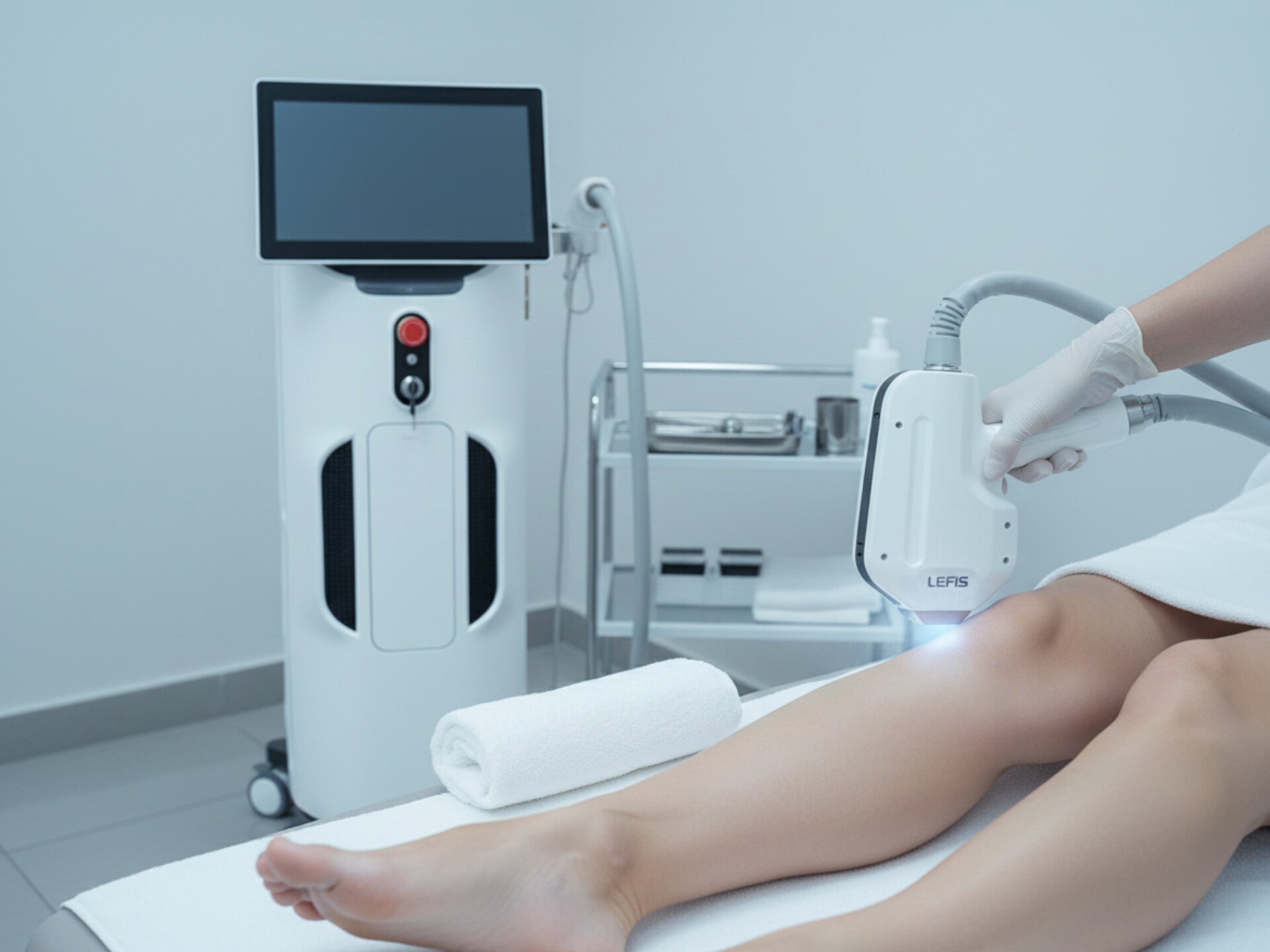
2026 Diode Laser Hair Removal Machine Ranking: 10 Best Options for Clinics
A medspa owner in Casablanca emailed us last spring. She had bought a “quad-wavelength” diode machine from an online listing for $9,000. The brochure promised 4,800 watts and painless treatment on every skin type. Her first ten clients told a different story. Coarse-haired patients saw shedding. Her Fitzpatrick V clients walked out with blisters and two cases of hyperpigmentation that took months to fade.
The machine was not a quad-wavelength system. It was a single 808 nm bar with a cheap chiller and a marketing sticker. The cooling could not hold skin temperature under load, so the epidermis took the heat instead of the follicle. She paid for a platform she did not get, and her patients paid for it too.
Her story repeats across our inbox every month. The diode category is crowded with machines that look identical in a photo and behave nothing alike in a treatment room. This guide will not crown one universal winner, because there is not one. It will show you how to read a diode spec sheet, which numbers actually matter, and which ten systems are worth a serious look in 2026. We have built diode platforms since 2008 and seen the wins and the failures up close.
Quick Answer — Which Diode Laser Hair Removal Machine Is Best?
There is no single best machine. The right diode laser hair removal machine depends on your patient mix, your treatment volume, and your capital budget. A high-end dermatology group and a two-room startup should not buy the same device.
- Large dermatology centers often pick premium triple-wavelength platforms for skin-type range and brand demand.
- High-volume medspas prioritize treatment speed, large spot sizes, and cooling that survives back-to-back sessions.
- New clinics and distributors weigh ROI, consumable cost, and service support more than peak wattage.
Triple- and four-wavelength diode systems keep gaining ground because they treat a wider range of skin and hair than any single 808 nm bar. LEFIS sits in the value-and-OEM tier: real clinical capability without premium pricing, and a strong fit for clinics andprofessional diode laser hair removal equipment supplier partners building a private-label brand. We will tell you exactly where we fit and where we do not.
How We Ranked These Machines
Diode machines can be ranked many ways. We rank by best fit for the average independent clinic — a weighted score covering clinical performance, real cost, service depth, and operational fit. A hospital group with $200,000 to deploy would weight these differently and might reorder the list. We are open about that, and we publish the per-criterion scores in every entry so you can re-rank for your own room.
Three clinical-performance criteria — wavelength range, cooling and comfort, and treatment speed — carry 52 percent of the score together. That reflects what actually drives outcomes and patient retention.
Scoring Criteria and Weights
|
CRITERION |
WEIGHT |
WHAT IT MEASURES |
|
Wavelength range |
20% |
Skin-type and hair-type coverage across delivered wavelengths |
|
Cooling and comfort |
18% |
Skin protection under load; pain control across long sessions |
|
Treatment speed |
14% |
Repetition rate, spot size, throughput per hour |
|
Value (cost vs capability) |
18% |
What a clinic gets per dollar of capital invested |
|
Service and support depth |
16% |
Parts response, training, regional network coverage |
|
Regulatory and certifications |
14% |
FDA 510(k), CE Mark, ISO 13485, regional compliance |
Total score is reported out of 100 in each entry. One note on language we hold ourselves to: FDA listing and FDA 510(k) clearance are not the same thing. A device that is merely listed on the FDA establishment registry has not been cleared as safe and effective for a specific indication. We flag this distinction in every entry, because diode marketing blurs it constantly.
Comparison — 10 Best Diode Laser Hair Removal Machines in 2026

Ten systems, ranked by weighted score under the method above. Note that four entries are not strictly diode platforms — the Candela, Cutera, Lutronic, and Deka systems pair Alexandrite with Nd:YAG. We include them because buyers cross-shop them against diodes for the same hair-removal job, and we mark the architecture clearly.
|
RANK |
MACHINE |
SCORE |
ARCHITECTURE |
BEST FOR |
|
01 |
Alma Soprano ICE Platinum |
86/100 |
Triple-wavelength diode |
Premium high-comfort medspas |
|
02 |
Primelase HR |
84/100 |
Four-wavelength diode |
High-volume laser centers |
|
03 |
Lumenis LightSheer Quattro |
82/100 |
Dual-wavelength diode |
Dermatology practices |
|
04 |
Asclepion MeDioStar |
81/100 |
808 nm diode (configurable) |
Fast, high-throughput rooms |
|
05 |
Candela GentleMax Pro Plus |
80/100 |
Alexandrite + Nd:YAG |
Large dermatology groups |
|
06 |
LEFIS K12 Diode Series |
78/100 |
Multi-wavelength diode |
Value clinics, OEM partners |
|
07 |
Cutera Excel HR |
77/100 |
Alexandrite + Nd:YAG |
Hair plus vascular work |
|
08 |
Lutronic Clarity II |
76/100 |
Alexandrite + Nd:YAG |
Multi-platform practices |
|
09 |
Quanta Light EVO |
75/100 |
Multi-platform laser |
Advanced multi-service clinics |
|
10 |
Deka Again Pro |
74/100 |
Alexandrite + Nd:YAG |
Premium European clinics |
Understanding Diode Laser Technology
A diode laser hair removal machine is a professional clinic device that uses semiconductor diode bars to emit a focused beam of light, typically at 808 nm, which is absorbed by melanin inside the hair follicle and converted to heat to disable future growth.
Melanin absorbs light and then melts it within the hair follicle, causing damage to the structures that regenerate hair. The same thing happens, according to Mayo Clinic: Light is absorbed by the pigment, the heat wreaks havoc on the follicle, and growth is slowed. The idea is to reduce, not cure, and it's a long-term reduction.
How Diode Lasers Work
This principle is called selective photothermolysis. Choose a wavelength absorbed by melanin, use a pulse which is short enough to selectively heat the follicle rather than the surrounding epidermis, and you are left with damaged melanin and undamaged epidermis. The diode bars do this very efficiently, as 808 nm penetrates to the follicle bulb, the site where regrowth starts, 4 to 6 mm.
Hair growth is cyclic, and only anagen follicles are completely sensitive. Only 15-20% of hairs are in anagen at any given time, so a series of treatments must be administered to ensure that each hair is treated when it is susceptible. That is why the American Academy of Dermatology and most clinics schedule a series, as opposed to guaranteeing one solution.
Why 808 nm Became the Industry Standard
- High melanin absorption in the range of melanin's effective targeting.
- Good penetration depth allows for penetration to the follicle bulb/bulge without surface scattering.
- Skin-type tolerance is greater than Alexandrite, as the longer wavelength passes through a lot of the epidermal melanin.
- Proven ROIcomes from a mature, serviceable technology with predictable consumable costs
Single, Triple, and Four-Wavelength Systems Explained
808 nm Single-Wavelength Systems
One wavelength and one job at a time, and reliably. These are the platforms with the most years of clinical use and lowest cost of acquisition. The compromise is flexibility: An 808 nm bar works perfectly for coarse dark hair on light to medium skin, but will not work as well on very fine hair and requires cautious and conservative settings on the darkest skin tones.
Triple-Wavelength Systems (755 + 808 + 1064 nm)
For the fine, light hair, fair skin, add 755 nm. The addition of 1064 nm goes deeper and is safer for Fitzpatrick IV-VI as it interacts less with melanin on the surface. Blended emitters are used to treat the majority of patients that step into the office, so the triple-wavelength diode has dominated the top of the premium end.
Four-Wavelength Systems (755 + 808 + 940 + 1064 nm)
Four wavelengths will provide 940 nm for an additional absorption profile and the widest range of customization. The drawback to range is its cost, which is in the form of price and operator complexity. These are for large rooms where the machine can be used sufficiently enough to warrant the investment.
Honest take:In our experience, more wavelengths in a multi-wavelength diode laser system is not automatically better for your clinic. A practice treating mostly coarse dark hair on medium skin will rarely fire the 940 nm line it paid for, because that wavelength is not the most effective tool for those patients. Match the number of wavelengths to the number of patients in your chair – not to the brochure.
The 10 Best Diode Laser Hair Removal Machines for Clinics in 2026

01. Alma Soprano ICE Platinum
Category: Triple-Wavelength Diode Score 86/100
Alma blends 755, 810, and 1064 nm into a single emitter and pairs it with SHR “in-motion” delivery and ICE contact cooling. The result is one of the most comfortable treatments in the category and genuine coverage across Fitzpatrick I through VI. Patients ask for it by name, which helps a clinic charge a premium.
Key Specs
|
SPEC |
DETAIL |
|
Wavelengths |
755, 810, 1064 nm (blended) |
|
Technology |
SHR in-motion delivery |
|
Cooling |
ICE contact sapphire cooling |
|
Skin types |
Fitzpatrick I–VI |
|
Certifications |
FDA 510(k) cleared, CE Mark |
Score Breakdown
Note: Scores above 80 indicate a strong choice for most clinics; 70–79 suits value-focused buyers.
|
WAVELENGTH |
COOLING |
SPEED |
VALUE |
SERVICE |
REGULATORY |
TOTAL |
|
95 |
95 |
80 |
60 |
88 |
92 |
86/100 |
PROS
Excellent comfort and patient retention; true skin-type range; strong brand pull that supports premium pricing; mature clinical record.
CONS
High acquisition and service cost; SHR motion technique has a learning curve; lower-volume rooms will not recoup the premium quickly.
BEST FOR
Premium medspas and multi-room aesthetic centers that can monetize comfort and brand recognition.
02. Primelase HR
Category: Four-Wavelength Diode Score 84/100
A high-power four-wavelength diode (755, 808, 940, 1064 nm) built for speed. Peak hair-removal output around 4,800 W and large spot sizes clear big areas fast. Sapphire contact cooling keeps the surface protected at high fluence. This is a machine for rooms that run all day.
Key Specs
|
SPEC |
DETAIL |
|
Wavelengths |
755, 808, 940, 1064 nm |
|
Peak power |
~4,800 W hair-removal output |
|
Cooling |
Sapphire contact (Crystal Freeze) |
|
Spot sizes |
Large, multiple options |
|
Certifications |
FDA 510(k) cleared, CE Mark |
Score Breakdown
|
WAVELENGTH |
COOLING |
SPEED |
VALUE |
SERVICE |
REGULATORY |
TOTAL |
|
92 |
85 |
95 |
62 |
80 |
90 |
84/100 |
PROS
Very fast on large areas; broad wavelength range; strong results across hair types including tanned skin; large spot delivery.
CONS
High purchase price; needs an experienced operator to use the power safely; capital only pays back at real volume.
BEST FOR
High-volume laser centers and chains with steady throughput.
03. Lumenis LightSheer Quattro
Category: Dual-Wavelength Diode Score 82/100
Lumenis pairs 805 and 1060 nm with two delivery options: a vacuum-assisted handpiece that stretches and flattens skin for gel-free treatment, and a sapphire ChillTip handpiece. The clinical record is long and the results are consistent, which is why dermatology practices trust it.
Key Specs
|
SPEC |
DETAIL |
|
Wavelengths |
805, 1060 nm |
|
Delivery |
Vacuum-assist + ChillTip handpieces |
|
Cooling |
Sapphire contact + vacuum |
|
Heritage |
Extensive dermatology record |
|
Certifications |
FDA 510(k) cleared, CE Mark |
Score Breakdown
|
WAVELENGTH |
COOLING |
SPEED |
VALUE |
SERVICE |
REGULATORY |
TOTAL |
|
80 |
88 |
82 |
65 |
88 |
92 |
82/100 |
PROS
Reliable, well-documented outcomes; gel-free vacuum handpiece; strong global service network; trusted dermatology brand.
CONS
Premium pricing; dual-wavelength only, so less range than triple-wavelength diode platforms.
BEST FOR
Dermatology practices that value clinical track record and service over lowest cost.
04. Asclepion MeDioStar
Category: 808 nm Diode (configurable) Score 81/100
A German-engineered 810 nm diode (940 and 1064 nm configurable) built around throughput. High output, a dual-handpiece system, and a 20 Hz repetition rate make it one of the fastest single-platform diodes for busy rooms. Internal water cooling holds output stable across long days.
Key Specs
|
SPEC |
DETAIL |
|
Wavelength |
810 nm (940/1064 nm configurable) |
|
Repetition rate |
Up to 20 Hz |
|
Handpieces |
Dual-handpiece system |
|
Cooling |
Internal water + contact Peltier |
|
Certifications |
FDA 510(k) cleared, CE Mark |
Score Breakdown
|
WAVELENGTH |
COOLING |
SPEED |
VALUE |
SERVICE |
REGULATORY |
TOTAL |
|
72 |
88 |
95 |
68 |
84 |
90 |
81/100 |
PROS
Excellent speed and throughput; stable output under load; strong cooling; refined, easy interface.
CONS
Base configuration is single-wavelength, so less skin-type range than blended systems unless upgraded.
BEST FOR
Clinics that need maximum speed and high daily patient counts.
05. Candela GentleMax Pro Plus
Category: Alexandrite + Nd:YAG (not diode) Score 80/100
Not a diode platform, but cross-shopped against diode constantly. Candela pairs 755 nm Alexandrite with 1064 nm Nd:YAG, backed by decades of dermatology data and a cryogen Dynamic Cooling Device. It also treats vascular and pigmented lesions, so it earns its place in a multi-service room.
Key Specs
|
SPEC |
DETAIL |
|
Wavelengths |
755 nm Alexandrite + 1064 nm Nd:YAG |
|
Power |
High output, large spot range |
|
Cooling |
Dynamic Cooling Device (cryogen) |
|
Extra indications |
Vascular, pigmented lesions |
|
Certifications |
FDA 510(k) cleared, CE Mark |
Score Breakdown
|
WAVELENGTH |
COOLING |
SPEED |
VALUE |
SERVICE |
REGULATORY |
TOTAL |
|
82 |
85 |
80 |
60 |
86 |
95 |
80/100 |
PROS
Industry-standard reliability; proven across decades; multi-indication versatility; strong service in North America.
CONS
Premium investment; Alexandrite line needs caution on darker skin; cryogen consumables add running cost.
BEST FOR
Large dermatology groups wanting one trusted multi-indication platform.
06. LEFIS K12 Diode Laser Hair Removal Series
Category: Multi-Wavelength Diode Score 78/100
This is our own platform, so we will be blunt about where it fits and where it does not. The LEFIS K12 diode laser hair removal machine for clinics is built on a high-power diode bar with double contact cooling, 1,600 W output, handpiece recognition, and a rated 30 million shots of bar life. It runs the 808 nm core with multi-wavelength configurations, and our full diode laser hair removal machines range covers portable SHR/IPL units up to the K12 clinic platform.
We place LEFIS at number six on purpose. We do not out-engineer Alma on comfort or Asclepion on raw speed, and we do not pretend to. What we compete on is delivered capability per dollar: roughly the clinical work of a tier-one diode at a fraction of the capital, plus a service network in markets where the big brands are thin, and a real OEM/ODM program for partners building their own label.
Key Specs
|
SPEC |
DETAIL |
|
Wavelength |
808 nm core (multi-wavelength configurations) |
|
Peak power |
1,600 W |
|
Cooling |
Double contact cooling |
|
Bar life |
Rated ~30 million shots |
|
Extras |
Handpiece recognition; OEM/ODM program |
|
Certifications |
CE, ISO 13485, ROHS; FDA establishment listing |
Score Breakdown
|
WAVELENGTH |
COOLING |
SPEED |
VALUE |
SERVICE |
REGULATORY |
TOTAL |
|
72 |
80 |
78 |
96 |
80 |
70 |
78/100 |
PROS
Strong value against platform capability; double contact cooling and 1,600 W on the K12; long rated bar life; established OEM/ODM program; service across emerging markets where US and EU support is thin; 20-year manufacturing record and ISO 13485 quality system.
CONS
Lower global brand recognition than legacy manufacturers, which matters in markets where patients request a device by name. Our current regulatory position is FDA establishment listing alongside CE Mark and ISO 13485 — not a model-specific FDA 510(k) clearance.
US buyers who require cleared-indication status for a specific treatment should request the latest model-level documentation from us in writing before placing an order.Comfort and peak speed trail the premium tier; buyers should request current specifications per model.
BEST FOR
Independent clinics and growing medspas in Latin America, Southeast Asia, the Middle East, and Eastern Europe that need clinical capability without premium pricing, plus distributors and OEM partners building a private-label aesthetic brand. If your case mix is mostly coarse-to-medium hair on light-to-medium skin, a K12 will do the work at the price point. If you treat heavy volumes of fine light hair or run a melasma-and-vascular practice, look at the triple-wavelength systems above.
07. Cutera Excel HR
Category: Alexandrite + Nd:YAG (not diode) Score 77/100
A US dual-wavelength system (755 nm Alexandrite + 1064 nm Nd:YAG) with electrically adjustable spot size and sapphire cooling. The 1064 nm line treats vascular lesions too, so clinics that want hair removal plus vascular work get two services from one device.
Key Specs
|
SPEC |
DETAIL |
|
Wavelengths |
755 nm Alexandrite + 1064 nm Nd:YAG |
|
Spot size |
On-screen electrically adjustable |
|
Cooling |
Sapphire contact cooling |
|
Extra indications |
Benign vascular lesions |
|
Certifications |
FDA 510(k) cleared, CE Mark |
Score Breakdown
|
WAVELENGTH |
COOLING |
SPEED |
VALUE |
SERVICE |
REGULATORY |
TOTAL |
|
80 |
82 |
78 |
65 |
80 |
92 |
77/100 |
PROS
Adjustable spot size without swapping optics; dual-service hair plus vascular; reliable US service footprint.
CONS
Needs more specialized training; service support uneven outside the US; not a diode platform.
BEST FOR
Practices wanting hair removal and vascular treatment from one device.
08. Lutronic Clarity II
Category: Alexandrite + Nd:YAG (not diode) Score 76/100
A 755/1064 nm platform with IntelliTrak energy delivery and cryogen cooling that needs no gel. Strong on fine light hair and darker tones alike, and useful for pigmentation services. Not a diode, but it lands on diode shortlists for high-comfort, multi-service rooms.
Key Specs
|
SPEC |
DETAIL |
|
Wavelengths |
755 nm Alexandrite + 1064 nm Nd:YAG |
|
Delivery |
IntelliTrak with automatic overlap |
|
Cooling |
Integrated cryogen cooling |
|
Extra indications |
Pigmentation services |
|
Certifications |
FDA 510(k) cleared, CE Mark |
Score Breakdown
|
WAVELENGTH |
COOLING |
SPEED |
VALUE |
SERVICE |
REGULATORY |
TOTAL |
|
80 |
85 |
80 |
60 |
80 |
90 |
76/100 |
PROS
Even coverage via tracked delivery; cryogen comfort; strong on fine and light hair; reduces operator fatigue.
CONS
Premium cost; cryogen consumables add running cost; not technically a diode system.
BEST FOR
Multi-platform practices wanting hair removal plus pigmentation services.
09. Quanta Light EVO
Category: Multi-Platform Laser (not diode) Score 75/100
A modular Alexandrite/Nd:YAG platform with up to four wavelengths and IPL options. Built for clinics that want one chassis to cover hair, vascular, pigment, and resurfacing. The breadth is the selling point; the complexity is the cost.
Key Specs
|
SPEC |
DETAIL |
|
Wavelengths |
755, 532, 1064, 1320 nm (configurable) |
|
Cooling |
Contact cooler + air cryo |
|
Modularity |
Up to 10 configurations |
|
Extra indications |
Vascular, pigment, resurfacing |
|
Certifications |
FDA 510(k) cleared, CE Mark |
Score Breakdown
|
WAVELENGTH |
COOLING |
SPEED |
VALUE |
SERVICE |
REGULATORY |
TOTAL |
|
82 |
80 |
78 |
58 |
78 |
90 |
75/100 |
PROS
Very broad treatment range; modular and upgradeable; strong on multi-service caseloads.
CONS
Higher complexity and training burden; capital cost; not a dedicated diode platform.
BEST FOR
Advanced multi-service practices that need one flexible chassis.
10. Deka Again Pro
Category: Alexandrite + Nd:YAG (not diode) Score 74/100
An Italian 755/1064 nm system with the MOVEO sliding technique and twelve spot sizes on the standard handpiece. Comfortable, fast on large areas, and popular in European clinics. Premium pricing and a non-diode architecture keep it at the bottom of this shortlist for value-focused buyers.
Key Specs
|
SPEC |
DETAIL |
|
Wavelengths |
755 nm Alexandrite + 1064 nm Nd:YAG |
|
Delivery |
MOVEO sliding technique |
|
Spot sizes |
12 on standard handpiece |
|
Cooling |
Cooled MOVEO handpieces |
|
Certifications |
FDA 510(k) cleared, CE Mark |
Score Breakdown
|
WAVELENGTH |
COOLING |
SPEED |
VALUE |
SERVICE |
REGULATORY |
TOTAL |
|
80 |
84 |
82 |
55 |
76 |
90 |
74/100 |
PROS
Comfortable near-painless treatment; large-area speed; broad spot range; strong European presence.
CONS
High purchase price; service strongest in Europe; not a diode platform.
BEST FOR
Premium European aesthetic clinics that value comfort and brand.
Diode Laser vs IPL

Treatment Precision
A diode fires one tight wavelength straight at follicular melanin. IPL fires a broad band of light from roughly 500 to 1200 nm, so its energy scatters across more targets and less of it reaches the follicle. For hair removal, focused beats broad. We unpack the full trade-off in our breakdown of IPL versus diode laser hair removal for clinics.
Treatment Results
Diode generally delivers stronger long-term reduction in fewer sessions. IPL often needs more visits for a similar result, and the outcome depends heavily on operator skill and the device's filtering. For a clinic charging per session, fewer sessions to a happy result protects both margin and reputation.
Skin-Type Considerations
Diode, especially with a 1064 nm option, handles a wider span of skin tones safely. IPL is generally limited to lighter skin (Fitzpatrick I–III); pushing it onto darker skin raises the risk of burns and pigment change. On Fitzpatrick IV–VI, a longer-wavelength diode or Nd:YAG is the safer tool.
|
Factor |
Diode Laser |
IPL |
|
Best for |
Long-term hair reduction across mixed patient demographics |
Lighter-skinned hair removal plus multi-purpose light treatments |
|
Skin types |
Fitzpatrick I–VI with multi-wavelength platforms; safe to IV–VI with 1064 nm |
Fitzpatrick I–III; higher risk on IV and above |
|
Typical sessions to course completion |
6 to 8, spaced 4 to 8 weeks apart |
8 to 12, often more |
|
Wavelength delivery |
Single focused wavelength on follicular melanin |
Broad band of light (roughly 500 to 1200 nm) scattered across many targets |
|
Margin per patient |
Higher in a hair-removal-led service line |
Higher in a clinic running multiple light-based services from one device |
Diode vs Alexandrite vs Nd:YAG
Alexandrite (755 nm)
Fast and highly absorbed by melanin, so it excels on fine, light hair and fair skin (Fitzpatrick I–III). The same strong absorption makes it risky on darker tones, where it can scorch surface pigment.
Nd:YAG (1064 nm)
The deepest, safest wavelength for dark skin because it largely bypasses epidermal melanin. The trade-off is lower efficiency on fine hair, which can mean more sessions.
Diode (808 nm and blends)
Sits in the middle and balances safety, speed, ROI, and skin-type range better than either single wavelength alone. A blended diode that adds 755 and 1064 nm gives one handpiece the reach of both ends. That balance is why diodes are the workhorse of most general clinics.
section
|
Wavelength |
Best For |
Skin Types |
Typical Sessions |
|
Alexandrite (755 nm) |
Fine light hair on fair skin |
Fitzpatrick I–III only |
6 to 8 |
|
Diode (808 nm and blends) |
General clinic workhorse — broad hair and skin range |
Fitzpatrick I–VI with multi-wavelength platforms |
6 to 8 |
|
Nd:YAG (1064 nm) |
Coarse hair on dark skin; safest deep wavelength |
Fitzpatrick IV–VI primarily |
8 to 10 |
Benefits of Diode Laser Hair Removal
-
Long-Term Hair Reduction
A planned course damages follicles enough to thin and slow regrowth durably. Cleveland Clinic notes that results last for months to years, with finer, lighter regrowth when hair does return.
-
Faster Treatment Times
Large spot sizes and high repetition rates clear legs or a back in a fraction of the time older systems needed. Faster sessions mean more patients per day and better return on the machine.
-
Suitable for Multiple Body Areas
Legs, underarms, chest, back, bikini line, and face all respond, with energy and spot size tuned per zone. One platform covers a clinic's full menu.
-
Reduced Ingrown Hairs
By thinning growth at the follicle, diode treatment cuts down the trapped hairs that cause irritation and bumps. For patients who battle them, see our guide on treating and healing ingrown hairs.
-
Strong Clinic ROI
Predictable consumable costs, high throughput, and steady demand make hair removal one of the most reliable revenue lines in aesthetics. Run the math on machine cost against session price and volume before you buy.
Common Side Effects
Redness, mild swelling, warmth, and temporary irritation are normal and usually settle within hours. The Mayo Clinic lists these as the typical short-lived reactions after treatment.
Less Common Side Effects
Burns, blistering, and pigment changes (hyper- or hypopigmentation) are uncommon but real, and the risk rises on darker skin when settings or cooling are wrong. This is exactly what happened to the Casablanca clinic at the top of this guide.
Why Proper Training Matters
The machine is only half the result. Correct energy selection, an honest skin-type assessment, a test pulse, and disciplined cooling protocols separate a clean outcome from a complication. Buy the training, not just the box.
How Many Sessions Are Usually Needed?
Hair Growth Cycles
Hair moves through anagen (active growth), catagen (transition), and telogen (rest). Lasers only damage follicles in anagen, and at any moment most follicles are not in that phase. That biology, not machine quality, is why one session is never enough.
Typical Treatment Plan
Most patients need 6 to 8 sessions spaced 4 to 8 weeks apart, timed to catch new follicles entering anagen. Coarse dark hair on lighter skin tends to clear faster; fine or light hair needs more visits.
Maintenance Sessions
After the initial course, occasional touch-ups keep regrowth in check, especially where hormones drive new growth. Annual maintenance is common.
Buying Guide for Clinics
Before you ask for a quote, map your top five procedures and your typical patient skin types. The machine should match your room, not the other way round. Work through these checks in order.
- Check wavelength options. Single 808 nm for coarse dark hair on lighter skin; add 1064 nm if you treat Fitzpatrick IV–VI; add 755 nm for fine light hair.
- Evaluate cooling. Ask whether the cooling holds skin temperature under continuous load, not just for one pulse. Weak cooling is the most common cause of burns.
- Compare spot sizes. Larger spots cover big areas faster; smaller spots handle the face and bikini line.
- Review peak power. Higher power enables larger spots and faster work, but only matters if cooling and operator skill keep pace.
- Verify certifications. Confirm FDA 510(k) clearance versus listing, plus CE Mark and ISO 13485. Ask for the actual certificate, not a brochure claim.
- Assess manufacturer support. Parts lead time, warranty terms, and operator training decide your next five years. Ask for a one-hour engineering call before signing.
- Calculate ROI. Model machine cost against session price, daily throughput, consumables, and maintenance. A cheaper machine with high downtime is the expensive one.
Spec-sheet test: ask for a measured power spec and a cooling spec on the data sheet, not a marketing brochure number. If a seller cannot produce a model-specific 510(k) or CE certificate and a real cooling figure, treat the “quad-wavelength” label with suspicion. That single question would have saved the Casablanca clinic $9,000.
Why Many Clinics Choose LEFIS

Clinics choosing a diode laser hair removal machine for long-term ROI tend to land on LEFIS for the same set of reasons: real clinical capability, transparent value pricing, and a manufacturer that picks up the phone two years after the sale. The section below covers the three commercial models we support and the practical reasons clinic buyers and OEM partners pick this route.
Flexible Business Models
Clinics can buy direct, distributors can stock a tested range, and brands can run a full OEM/ODM program. We follow the project from R&D through after-sales, the same way we describe on our aesthetic device manufacturing pages.
Professional Diode Laser Portfolio
The lineup runs from portable SHR/IPL units to the K12 clinic platform. Browse the current diode laser hair removal machines collection for live specs and configurations.
Support Beyond Hardware
Operator training, custom branding, and technical support across emerging markets where the legacy brands run thin. We would rather a clinic buy the right machine — even a competitor's — than the wrong machine from us. If you also offer skin-tightening services, our overview of how radio frequency skin tightening works is a useful companion read.
Conclusion
Diode laser hair removal is still one of the most profitable and dependable services in aesthetics in 2026. Multi-wavelength systems keep gaining share because they treat more skin and hair types from one handpiece.
Premium platforms from Alma, Primelase, and Lumenis lead on comfort, speed, and brand pull, and they earn their price in the right room. LEFIS sits in the practical-clinic tier: strong value, real service depth, and a working OEM program for partners building their own brand.
Before you buy, compare wavelength range, cooling under load, service support, genuine certifications, and long-term ROI — not just the biggest wattage number on the page. The best machine is the one your team can run safely, profitably, and consistently on the patients walking through your door.
FAQs
Is diode laser good for hair removal?
Yes. Diode is one of the most effective hair-removal technologies for coarse, dark hair, especially on light-to-medium skin. The 808 nm wavelength is absorbed strongly by follicular melanin and penetrates deep enough to reach the follicle bulb. Most patients see meaningful reduction over a planned course of sessions. Results depend on hair color, density, and operator skill as much as on the machine itself.
Which is better, an IPL or a diode laser?
For hair removal, a diode laser is generally better. It fires a single focused wavelength straight at the follicle, while IPL spreads a broad band of light that scatters across more targets. Diode usually delivers stronger reduction in fewer sessions and handles a wider range of skin tones safely. IPL still has a place for lighter skin and multi-purpose skin treatments, but for pure hair removal the focused beam wins.
What are the disadvantages of diode laser hair removal?
The main drawbacks are cost, the need for multiple sessions, and the risk of side effects when settings or cooling are wrong. Common reactions are temporary redness, swelling, and warmth. Less commonly, burns or pigment changes can occur, and the risk rises on darker skin with poor technique. Diode also works poorly on very fine, light, gray, or red hair, which has too little pigment to absorb the energy.
Is diode laser hair removal better than normal laser hair removal?
“Normal” usually means Alexandrite or Nd:YAG. Each has strengths: Alexandrite is fast on fine light hair and fair skin, while Nd:YAG is safest on dark skin. Diode sits in the middle and balances speed, safety, and skin-type range, which is why it is the workhorse of most general clinics. The best choice depends on your patients' skin and hair, not on any single label being universally superior.
Can diode remove hair permanently?
Diode delivers long-term hair reduction rather than guaranteed permanent removal. It damages follicles enough to thin and slow regrowth, often for months to years. Some regrowth can return because hormones or the natural hair cycle reactivate dormant follicles. This is why clinics describe the goal as durable reduction and often recommend occasional maintenance sessions after the initial course.
Can I shave between diode laser treatments?
Yes. Shaving is the recommended way to manage hair between sessions because it leaves the follicle intact for the next treatment. Avoid waxing, plucking, or epilating, since those remove the follicle target the laser needs. Most clinics ask you to shave the treatment area the day before your appointment so the energy targets the follicle rather than surface hair.
Can I shave one day after laser hair removal?
It is usually best to wait until any redness or irritation has settled, often a few days, before shaving the treated area. Shaving too soon over inflamed skin can cause further irritation. Once the skin feels normal again, gentle shaving is fine and will not affect your results. Always follow the specific aftercare advice your clinician gives for your skin.
Can I do diode laser every two weeks?
Generally no. Sessions are spaced 4 to 8 weeks apart to match the hair growth cycle, because the laser only damages follicles in the active growth phase. Treating every two weeks does not catch enough new anagen follicles to improve results and can irritate the skin. Spacing sessions correctly is what makes a course of treatments work.
What is the healthiest hair removal method?
There is no single “healthiest” method for everyone, but professional laser and IPL are low-risk when performed by trained staff with proper cooling and skin assessment. Shaving is the gentlest temporary option since it does not pull the follicle. Waxing and epilation can cause more irritation and ingrown hairs. For long-term reduction with minimal recurring irritation, a planned laser course is a strong choice.
Is diode laser safe for dark skin?
Yes, when operated correctly. On Fitzpatrick IV–VI skin, clinicians use longer wavelengths such as 1064 nm, conservative energy settings, strong contact cooling, and a test spot first. These steps protect surface pigment while still targeting the follicle. The danger comes from poor technique or weak cooling, which is why an experienced operator matters more on darker skin than on any other factor.
How many diode laser sessions are needed?
Most patients need 6 to 8 sessions, spaced 4 to 8 weeks apart, with the exact number depending on hair type, density, and treatment area. Coarse dark hair on lighter skin tends to clear fastest. Fine or hormonally driven hair often needs more visits, plus occasional maintenance. A consultation and a clear treatment plan will set realistic expectations for your case.
Does diode laser help with ingrown hairs?
Yes. By thinning and reducing hair growth at the follicle, diode treatment cuts down the trapped, curling hairs that cause ingrowns and the bumps and irritation that come with them. Many patients turn to laser specifically because shaving and waxing make their ingrowns worse. For more on managing them, see our guide on treating and healing ingrown hairs.
What wavelength is best for hair removal?
808 nm is the diode industry standard because it balances melanin absorption, penetration depth, and skin-type tolerance. For very fine light hair, 755 nm Alexandrite is more effective; for dark skin, 1064 nm Nd:YAG is safest. Blended diode systems combine these so one handpiece covers a wider range. The “best” wavelength depends on the patient's skin tone and hair color.
Sources
- Mayo Clinic — Laser Hair Removal
- American Academy of Dermatology — Laser Hair Removal: FAQs
- Cleveland Clinic — Laser Hair Removal
- U.S. FDA — Medical Devices
- ASDS — Laser Hair Removal
- DermNet — Laser Hair Removal
- PubMed — Laser Hair Removal Review
- PubMed — Selective Photothermolysis. (1983)
- PubMed — Diode Laser Hair Removal Clinical Review
- NCBI Bookshelf — Hair Biology and Growth Cycle
- PubMed — Long-Term Hair Reduction Studies


Looking for something else?

Do Men Get Cellulite? Causes Differences & What to Know
LEARN MORE
Does Radio Frequency Skin Tightening Work? Results & How It Works
LEARN MORE
Do You Shave Before Laser Hair Removal? Prep Tips & Why It Matters
LEARN MORE
How to Get Rid of Age Spots: Treatments. Natural Remedies & Prevention
LEARN MORELooking for something else?
How to Heal Ingrown Hair: Causes. Treatments & Healing Time
LEARN MORE
How to Get Rid of Freckles: Effective Treatments & Natural Tips
LEARN MORE
Top 10 Picosecond Laser Machine Manufacturers for Clinics in 2026
LEARN MOREYou may also like


Further reading

Tattoo Removal Laser Machine Cost and Ownership Guide

CO2 Laser Treatment Room Setup Checklist

Aesthetic Machine Factory Acceptance Test Before Shipment


