

Fat Reduction Machines That Actually Work: Cryolipolysis, RF, Vacuum & EMS Compared
A fat reduction machine is a professional device used by body contouring clinics to reduce localized fat bulges and improve body shape. Depending on the technology inside, the same category of equipment can also tighten skin, soften the appearance of cellulite, or stimulate muscle tone.
The various modalities are based on different types of energy: cold (cryolipolysis), heat (RF, laser), mechanical disruption (ultrasound cavitation), vacuum suction, focused electromagnetic energy (HIFEM), or a combination of these energies. Some devices directly target fat; others enhance skin firmness or muscle tone to give the body a more sculpted look without actually eliminating fat.
This guide is for clinic owners, medspa buyers, distributors, and patients researching fat reduction machine options in 2026. The central message: there is no single best fat reduction machine. There are six different mechanism categories — cryolipolysis, RF, vacuum cavitation, ultrasound cavitation, laser lipolysis, and EMS/HIFEM — and they target completely different patient needs. Choosing the wrong category for your patient base is the most expensive mistake in body contouring equipment buying. Browse options at the LEFIS body slimming machines page.
Quick Answer: Which Fat Reduction Machines Actually Work?
All six major categories work — but for different things. Cryolipolysis is best known for localized pinchable fat using cooling applicators. RF is useful for fat heating combined with skin tightening support. Vacuum cavitation excels at body shaping, circumference reduction, cellulite improvement, and lymphatic-style massage packages. Ultrasound cavitation targets localized adipose fat for contour smoothing. Laser lipolysis uses heat-based fat cell injury for selected areas. EMS/HIFEM focuses on muscle toning with some platforms offering fat reduction via combined RF.
Critical caveat: none of these treatments replace weight loss. They work best for patients close to a stable weight who want body shaping rather than weight reduction. Long-term results depend on lifestyle: If fat cells are damaged by any of these technologies, they are cleared by the body and do not regenerate. The fat cells that remain in surrounding tissue, however, can still grow larger if the patient gains weight.
How Non-Invasive Fat Reduction Works

The physiology is the same for all, damage the fat cells by some controlled stress (cold, heat, mechanical, electromagnetic) then the body slowly removes them through normal metabolic pathways, through the lymphatic system and liver.
Fat clearance is not instant — visible results typically appear 4-12 weeks post-treatment depending on the device. Multiple sessions are usually required. The difference between technologies is which patients respond best, which body areas are accessible, and what secondary effects (skin tightening, muscle tone, cellulite improvement) come along with the fat work.
Cryolipolysis Machines
The cryolipolysis technique is based on the principle of controlled cooling, which is applied to cells in a range of -5°C to -11°C, selectively damaging the fat cells. The applicator draws fat into a cooling cup by vacuum suction, and cools the tissue for 35-60 minutes. Fat cells are less insulated than skin and muscle and tend to undergo apoptosis during the recovery of the other tissues.
Best treatment areas: abdomen, flanks, inner and outer thighs, upper arms, back fat, bra line and submental areas (with suitable applicators).
Ideal candidates: those with localized fat pockets that can be easily identified, and a near stable body weight.
Advantages: high consumer awareness due to CoolSculpting marketing, no incisions, little downtime, and good results for well-defined fat pockets.
Limitations: Not suitable for use with loose skin only or large patches of fat, fit of applicator is critical, requires multiple sessions to achieve results, takes 8-12 weeks to see results. Side effects include slight redness, bruising, numbness, tenderness, swelling, tingling, and occasionally, paradoxical adipose hyperplasia, which is a paradoxical increase in fat rather than a decrease.
Clinic buyer notes: check the shape and size of the applicators, inquire about the precision of cooling control, verify vacuum stability, request a cost per cycle for consumables, and ensure training and warranty. Platforms range $15,000 (value tier) to $130,000+ (premium branded).
Radiofrequency Fat Reduction Machines
RF is a method of heating tissue at depth with electromagnetic waves. Body contouring relies on the RF's ability to heat deeper layers to target the fat cells as well as stimulate collagen remodeling for skin tightening – which is why patients with both fat and mild skin laxity are targeted for RF. In the 2022 Clinics in Dermatology review, RF was included among the five primary non-invasive modalities of body contouring along with cryolipolysis, focused ultrasound, laser and HIFEM.
Best treatment areas: abdomen, flanks, thighs, arms, buttocks, waist, areas with cellulite, milder zones of skin slacking.
Ideal candidates: patients who have mild to moderate amounts of fat and mild skin laxity and clinics who want fat reduction and tightening from a single platform.
Advantages: supports both contouring and tightening, treats broader areas than suction-based machines, generally comfortable, useful for cellulite.
Limitations: results are very temperature and operator dependent; surface temperature is not necessarily the deep tissue temperature; many RF devices marketed as fat burners are actually skin tone devices.
Clinic buyer notes: inquire about monopolar (5-20mm penetration), bipolar (1-5mm dermis only), multipolar and combined RF. Verify if the platform is dedicated to fat, skin tightening, cellulite or all three. For background, read LEFIS coverage of radiofrequency body shaping, and the guide to how radiofrequency skin tightening works.
Vacuum Cavitation Body Contouring Machines
Vacuum cavitation platforms combine multiple technologies into one device — typically ultrasound cavitation (40kHz or 80kHz), vacuum suction, RF heating, and roller massage. The combination targets localized fat through cavitation, supports body shaping and circumference reduction through mechanical action, improves cellulite appearance through suction and warming, and supports lymphatic-style drainage. This is the workhorse category for clinics building body slimming menus — particularly in markets where patients value multi-session packages over single-cycle premium treatments.
Best treatment areas: abdomen, waist, thighs, buttocks, arms, flanks, cellulite prone areas.
Ideal candidates: those requesting body contouring and size enhancement, cellulite looking patients, and clinics looking for slimming platforms that offer flexibility to provide a range of services.
Advantages: category is versatile, cost less than premium branded fat freezing devices ($4,000-$15,000 vs. $30,000+), it can be used for body shaping/cellulite/skin smoothing at the same time, and can be combined with RF or EMS protocols.
Limitations: results more operator-dependent than cryolipolysis, more sessions required (8-12+ vs 2-3 for cryo) and not a substitute for cryolipolysis on "pinchable" fat.
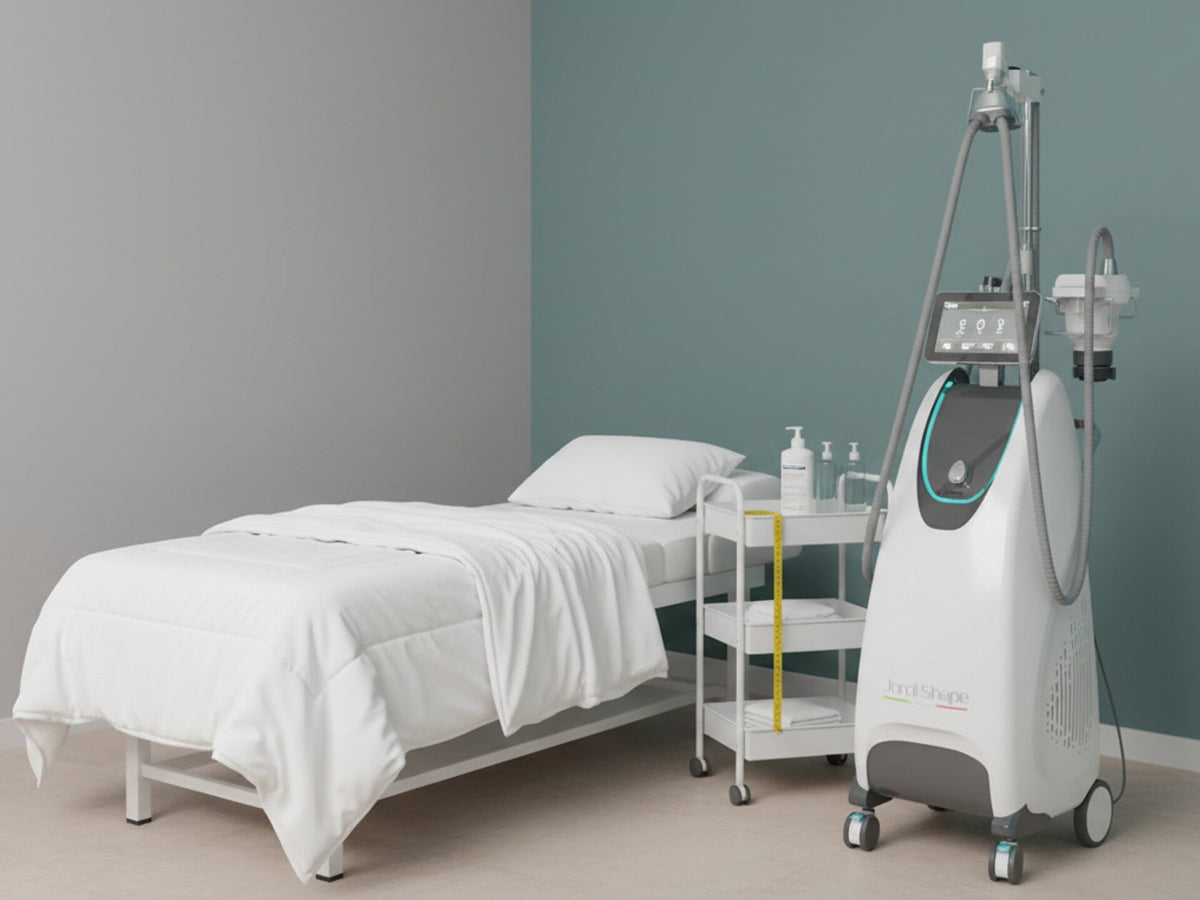
Clinic buyer notes: ask about ultrasound frequency (40kHz penetrates deeper, 80kHz works more superficially), RF support integration, vacuum pressure adjustability, handpiece options, treatment protocols, and consumables. Explore options at the LEFIS vacuum cavitation body contouring machines collection — the H6 Vacuum Cavitation Body Slimming Machine is one example of a Jordi Shape-style platform.
Ultrasound Cavitation Machines
The pressure variation around fat deposits is produced by low-frequency ultrasonic waves, usually 40kHz, in the ultrasound cavitation process. The waves create micro-bubbles which cause the release of fat cells from their membranes, allowing the fat to be burned in the lymphatic system and the liver. WebMD notes the process is best for contour smoothing rather than major fat removal — patients should expect modest gradual circumference reduction across a multi-session series.
Best treatment areas: abdomen, flanks, thighs, hips, and upper arms.
Ideal candidates: patients with localized soft fat, patients who do not want any downtime, patients who are willing to commit to a series of treatments (usually 6-12 treatments 1-2 weeks apart).
Advantages: non-invasive, generally comfortable, can be used in combination with RF and vacuum, useful for greater body contouring program.
Limitations: not for fat loss in large amounts, the outcomes can differ from patient to patient, it can have a big impact on lifestyle, and not all medical histories are appropriate.
Contraindications are: pregnancy, breastfeeding, active infection/inflammation in treatment area, implants/pacemakers, treatment over bony areas, and serious medical conditions that require clearance..
Laser Lipolysis and Heat-Based Laser Fat Reduction
The SculpSure-style (FDA-cleared in 2015) non-invasive laser fat reduction technology involves a 1060nm diode laser to warm fat cells, and integrated cooling to protect the skin surface. The injury to adipocytes is caused by the heat itself and results follow as the body eliminates damaged fat cells in the next 6-12 weeks. Every treatment session lasts approximately 25 minutes, which is one of the shortest times for any non-invasive fat reduction treatment.
Best treatment areas: abdomen, flanks, thighs, back and under-chin (depending on platform).
Ideal candidates: Patients who have moderate localized fat that may not be enough for certain cryolipolysis applicators and patients who do not want to undergo any type of suction treatment.
Advantages: require multiple sessions to treat multiple zones, may have some discomfort, may require additional cooling, no incisions, no anesthesia.
Limitations: not a weight loss treatment, heat tolerance will differ from patient to patient, not all laser systems will be suitable for all skin or body types, and care must be taken in energy delivery.
Risks: heat, pain, swelling, firmness around the treated area for several days, temporary redness and burns if the device is used incorrectly.
EMS / HIFEM Body Sculpting Machines
EMS (Electrical Muscle Stimulation) is a treatment that involves using electrical current to stimulate muscle contraction. The EMSCULPT category, HIFEM (High-Intensity Focused Electromagnetic energy), is based on the use of focused electromagnetic energy to create supramaximal tonic muscle contractions, which are deeper than those that can be achieved via electrical stimulation. The main emphasis of these treatments is towards toning and body sculpting. The newer platforms utilize RF heating and HIFEM to accomplish fat reduction and muscle development at the same time — the EMSCULPT NEO category.
Best treatment areas: abdomen, buttocks, arms, thighs, calves, flanks (as per applicator design).
Ideal candidates: patients seeking muscle tone improvement, firmer abdomen, fitness clients and post weight loss clients.
Advantages: No surgery, no needles, little to no downtime, helps build or tone muscle (no other category can do this), improves body definition.
Limitations: not for large fat deposits, not a replacement for exercise, not recommended for use with pacemakers or some metal implants, effectiveness is related to the total treatment period and maintenance.
Clinic buyer notes: inquire if it is pure EMS or true HIFEM, they are not the same, HIFEM yields deeper, stronger contractions. Explore differences in contraction depth and intensity, applicator design, protocol presets and contraindication information. Check out the EMS / HIFEM body sculpting machines line or the V5 portable HIFEM body contouring machine for a mini muscle stimulation and fat reduction machine.
Fat Reduction Machine Comparison at a Glance

|
TECHNOLOGY |
MAIN TARGET |
BEST FOR |
TREATMENT FEEL |
TYPICAL SESSIONS |
MAIN LIMITATION |
|
Cryolipolysis |
Pinchable fat |
Localized bulges |
Cold, suction, numbness |
1–3+ per area |
Applicator fit matters |
|
RF |
Fat heating + tightening |
Fat with mild laxity |
Warm |
Series-based |
Technique-dependent |
|
Vacuum Cavitation |
Contour, cellulite |
Body slimming packages |
Suction, massage, warmth |
8–12+ sessions |
Operator-dependent |
|
Ultrasound Cavitation |
Localized soft fat |
Abdomen, thighs, hips |
Gentle vibration |
6–12 sessions |
Not for major fat loss |
|
Laser Lipolysis |
Heat-based fat injury |
Localized fat zones |
Warm cycles |
1–3+ per area |
Heat tolerance varies |
|
EMS / HIFEM |
Muscle + secondary fat |
Muscle tone, sculpting |
Strong contractions |
4+ sessions |
Not a pure fat-loss treatment |
Which Fat Reduction Machine Works Best for Each Goal?
- Best for Pinchable Fat
Cryolipolysis. Designed specifically for fat pockets that fit into cooling applicators. Strong brand awareness drives consumer demand.
- Best for Fat Plus Mild Loose Skin
RF or RF-plus-vacuum platforms. The simultaneous heating action stimulates collagen while addressing fat — useful for post-pregnancy clients and patients in their 40s-50s with combined concerns.
- Best for Cellulite Appearance
Vacuum cavitation and RF-vacuum systems. Mechanical suction combined with warming improves skin texture and body smoothing. Pure cryolipolysis does not address cellulite.
- Best for Waist and Thigh Circumference Packages
Vacuum cavitation, ultrasound cavitation, or RF combination systems. These technologies underlie most multi-session slimming packages clinics build around circumference goals.
- Best for Muscle Definition
EMS or HIFEM. No other category builds muscle. This is the unique outcome of electromagnetic muscle stimulation.
- Best for Clinics Wanting a Multi-Service Body Menu
Combination platforms integrating vacuum, cavitation, RF, and optionally EMS/HIFEM. One device supports multiple treatment packages around different patient goals — a multi-service mistake we see clinics make every quarter when they commit to a single-purpose unit before mapping their actual patient mix.
What Fat Reduction Machines Can and Cannot Do
Non-invasive fat reduction machines for clinics can deliver real, measurable contour improvement in the right patient. They cannot, however, replace weight-loss treatment, surgery, or sustained lifestyle change. The two lists below set the realistic boundary.
- Can do:
- Reduce localized fat bulges
- Improve body contour
- Support waist/thigh/arm/flank/abdomen shaping
- Tighten mild skin laxity
- Improve cellulite appearance
- Build or tone muscle (depending on technology)
- Offer little to no downtime compared with surgery.
- Cannot do:
- Replace weight-loss medication, diet, or exercise
- Treat obesity as a standalone solution
- Remove large volumes of fat like liposuction
- Guarantee permanent results if weight gain occurs
- Work equally well for every body type.
Patients who arrive expecting non-invasive fat reduction to substitute for sustained lifestyle change will be disappointed regardless of the platform used.
Patient Selection: Who Is a Good Candidate?

Good candidates:
- Adults near a stable weight
- Patients with localized fat pockets
- Patients with mild skin laxity
- Patients who do not want surgery
- Patients with realistic expectations
- Patients willing to maintain results through diet/exercise/hydration
- Patients without contraindications for the chosen technology.
Poor candidates:
- Patients seeking major weight loss (any non-invasive fat reduction at best yields 15-25% fat reduction in treated areas — not whole-body weight loss)
- Patients with severe obesity (refer to bariatric or medical weight management)
- Patients with severe loose skin needing surgical correction
- Pregnant or breastfeeding patients
- Patients with active infection in the treatment area
- Patients with pacemakers or metal implants for relevant energy devices
- Patients with uncontrolled medical conditions
- Patients expecting instant dramatic results from a single session.
Treatment Areas: Which Machine Fits Each Body Zone?
|
BODY AREA |
TECHNOLOGY OPTIONS |
NOTES |
|
Abdomen |
Cryolipolysis, RF, vacuum cavitation, ultrasound, EMS/HIFEM |
Match fat thickness and muscle tone |
|
Flanks |
Cryolipolysis, RF, laser lipolysis, ultrasound |
Cryo works well if fat is pinchable |
|
Thighs |
RF, vacuum cavitation, ultrasound, cryolipolysis |
Cellulite may need vacuum/RF |
|
Arms |
RF, vacuum, cryolipolysis |
Loose skin may need RF support |
|
Buttocks |
EMS/HIFEM, vacuum/RF |
Focus on lift, tone, cellulite |
|
Under chin |
Cryolipolysis, RF, laser lipolysis |
Needs special applicator and training |
|
Back fat |
Cryolipolysis, RF, laser lipolysis |
Applicator placement is critical |
Results Timeline
Immediately after treatment, patients typically experience mild redness, warmth or numbness, temporary swelling, and tenderness — no major visible change for most fat reduction treatments. At 1-4 weeks, early contour changes may appear; RF skin tightening may show gradual firmness. At 6-12 weeks, more visible fat reduction appears — cryolipolysis, laser lipolysis, and ultrasound results become clearer; EMS/HIFEM muscle changes become noticeable. At 3-6 months, final or near-final results manifest. Maintenance planning depends on patient goals.
For HIFU body contouring specifically, see LEFIS guidance on HIFU before and after results.
Are Fat Reduction Machine Results Permanent?
Damaged fat cells are cleared by the body and do not regenerate. Remaining fat cells, however, can still enlarge with weight gain — meaning results last longer when patients maintain weight, and can be compromised by lifestyle changes. Clinics should avoid claiming "permanent weight loss" because the underlying physiology does not support that framing. Better consultation language: "long-lasting contour improvement with stable weight maintenance," or "fat cells treated by some technologies may be permanently reduced, but lifestyle affects final and long-term outcomes."
Risks and Side Effects by Technology
- Cryolipolysis: redness, bruising, swelling, numbness, tingling, tenderness, rare paradoxical adipose hyperplasia.
- RF: warmth, redness, burns if misused, swelling, temporary tenderness. Vacuum cavitation: bruising from suction, redness, suction marks, tenderness, mild swelling.
- Ultrasound cavitation: redness, warmth, temporary sensitivity; not suitable for certain medical conditions.
- Laser lipolysis: heat discomfort, redness, tenderness, swelling, burns if misused.
- EMS/HIFEM: muscle soreness post-treatment, temporary fatigue, cramping sensation during treatment; not suitable for patients with pacemakers or certain implants.
Across all categories, risk increases significantly with poorly trained operators, inappropriate patient selection, and devices that lack proper safety features like temperature monitoring or vacuum pressure control.
Fat Reduction Machine Buying Guide for Clinics

The Mexico City story in the opening illustrates the most important rule: match the device to your service menu and patient demographic, not to what is most heavily marketed. Walk through this 10-point checklist before purchase.
- Step 1: Match the platform to your service menu
- Step 2: Verify treatment depth and mechanism
- Step 3: Confirm applicators and handpieces fit your treatment areas
- Step 4: Cost out consumables per session and per year
- Step 5: Lock in training and treatment-protocol support
- Step 6: Audit safety features (temperature, cooling, vacuum control, emergency stop)
- Step 7: Verify regulatory certifications by model number (FDA, CE, ISO 13485)
- Step 8: Confirm warranty terms and regional service response time
- Step 9: Model five-year total cost of ownership
- Step 10: Request a reference call with an existing clinic running the platform
Body Slimming and Fat Reduction Machine Options
LEFIS produces professional body slimming and body contouring equipment for clinics, salons, and distributors across multiple technology categories. Clinics comparing a fat reduction machine can review the LEFIS body slimming solutions page. For circumference reduction and cellulite work, the LEFIS vacuum cavitation body contouring machines collection includes the H6 and H8 Vacuum Cavitation platforms and the HK6-C VelaShape-style machine. For muscle-focused sculpting, the LEFIS EMS / HIFEM body sculpting machines collection includes the V5 Portable HIFEM and Vk6 EMS muscle stimulator.
LEFIS positions in the value-tier of the body contouring equipment market — clinical-grade capability at lower capital cost than premium Western branded systems, with OEM/ODM partnership available for distributors. Visit lefislaser.com for full collection access and B2B quotes.
Conclusion
Fat reduction machines work when the technology category matches the patient's body type and the clinic's treatment goal. Cryolipolysis serves localized pinchable fat. RF serves fat-plus-tightening combinations. Vacuum cavitation and ultrasound cavitation serve body slimming packages, circumference reduction, and cellulite programs.
EMS/HIFEM serves muscle tone and sculpting, with fat reduction as a secondary effect depending on the platform. Clinics that buy based on hype instead of patient demographics make the Mexico City mistake. The best machine choice depends on training, safety features, applicator options, patient demand, and realistic ROI.
FAQs
What is the best fat reduction machine for clinics?
There is no universal best. Cryolipolysis suits pinchable fat clients; RF suits fat-plus-tightening cases; vacuum cavitation suits circumference and cellulite packages; EMS/HIFEM suits muscle tone goals. The right choice depends on patient demographics and clinic service menu.
Do fat reduction machines really work?
Yes, with realistic expectations. Most platforms deliver 15-25% fat reduction in treated areas across a treatment series. None replaces weight loss, exercise, or healthy diet. Results are gradual over 6-12 weeks.
What is the difference between cryolipolysis and RF fat reduction?
Cryolipolysis uses controlled cooling to damage fat cells in pinchable pockets. RF uses electromagnetic heating to affect fat at depth while supporting skin tightening. Cryolipolysis is narrower-focused; RF is more versatile but more operator-dependent.
Is vacuum cavitation good for fat reduction?
Yes for circumference reduction, body shaping, and cellulite improvement across multi-session packages. Less effective than cryolipolysis for discrete pinchable fat pockets, but more flexible for whole-body slimming protocols.
Is EMS the same as fat reduction?
No. EMS and HIFEM primarily build and tone muscle. Some platforms combine RF heating with HIFEM for simultaneous fat reduction, but pure EMS is muscle stimulation, not fat removal.
Which fat reduction machine is best for belly fat?
For pinchable abdominal fat, cryolipolysis. For mild belly fat with skin laxity post-pregnancy, RF or RF-vacuum combinations. For overall circumference reduction with cellulite, vacuum cavitation. For abdominal muscle definition, HIFEM.
How many sessions are needed for non-invasive fat reduction?
Cryolipolysis: 1-3 sessions per area. Laser lipolysis: 1-3 sessions per area. RF: series of 6-8. Vacuum cavitation: 8-12+ sessions. Ultrasound cavitation: 6-12 sessions. EMS/HIFEM: 4-6 sessions over 2-3 weeks plus maintenance.
Are fat reduction machine results permanent?
Damaged fat cells do not regenerate. Remaining fat cells can still enlarge with weight gain, so results last longer with stable weight maintenance. Clinics should never claim "permanent weight loss."
Can fat reduction machines replace liposuction?
No. Liposuction removes large volumes of fat in a single procedure. Non-invasive fat reduction delivers 15-25% reduction per session in treated areas over weeks. They serve different patient goals — liposuction for volume removal, non-invasive for body shaping with no downtime.
What are the risks of non-surgical fat reduction?
Most risks are mild and temporary: redness, swelling, bruising, tenderness. Specific risks per technology include paradoxical adipose hyperplasia (cryolipolysis), burns (RF, laser), suction marks (vacuum), and contraindication risks for patients with pacemakers or metal implants.
Who is not a good candidate for fat reduction treatments?
Patients seeking major weight loss, patients with severe obesity, pregnant or breastfeeding patients, patients with active infection in the treatment area, patients with pacemakers or certain metal implants for relevant energy devices, patients with uncontrolled medical conditions, and patients with unrealistic expectations.
How should clinics choose a fat reduction machine?
Match the device to your patient demographic and service menu, not to marketing hype. Verify training, safety features, applicator coverage, consumable cost, warranty, ROI fit, and supplier after-sales support before purchase.
Which machine is better for cellulite, RF or vacuum cavitation?
Vacuum cavitation generally outperforms standalone RF for cellulite because mechanical suction plus warming addresses both fat and connective tissue patterns. Combined RF-vacuum platforms deliver the strongest cellulite results.
What is the difference between body contouring and weight loss?
Body contouring shapes specific areas through fat cell reduction, skin tightening, or muscle toning. Weight loss reduces overall body mass through caloric deficit. They are complementary goals — body contouring works best on patients already near a stable weight.
How long does it take to see results from fat reduction machines?
Immediate post-treatment changes are minimal. Early results appear at 1-4 weeks. More visible fat reduction at 6-12 weeks. Final or near-final results at 3-6 months for most platforms. EMS/HIFEM muscle changes appear similarly gradual.
Sources
- Non-Invasive Body Contouring Technologies · U.S. Food & Drug Administration ·
- Nonsurgical Fat Reduction · American Society of Plastic Surgeons ·
- Cryolipolysis · American Society of Plastic Surgeons ·
- Non-Invasive Body Contouring Treatments · American Society for Dermatologic Surgery ·
- Non-Invasive Body Contouring · American Society for Laser Medicine & Surgery ·
- Cryolipolysis for Noninvasive Body Contouring: Clinical Efficacy and Patient Satisfaction · NIH / PMC ·
- Review of the Mechanisms and Effects of Noninvasive Body Contouring Devices on Cellulite and Subcutaneous Fat · NIH / PMC ·
- Body Contouring for Fat and Muscle in Aesthetics: Review and Debate · Clinics in Dermatology ·
- Radiofrequency Heating and High-Intensity Focused Electromagnetic Treatment for Fat Reduction and Muscle Stimulation · Plastic and Reconstructive Surgery ·
- What to Know About Ultrasonic Cavitation · WebMD ·
- Non-Surgical Fat Removal Procedures Worth Considering · CareCredit Well U / Synchrony ·
- Fat-Melting Device That Actually Works · NYU Langone Health News ·
- Noninvasive Body Contouring: Literature Review and Summary of Objective Data · Skin: Journal of Cutaneous Medicine ·
- Update on Noninvasive Body Contouring Techniques · Cutis / MDedge ·


Looking for something else?

Do Men Get Cellulite? Causes Differences & What to Know
LEARN MORE
Does Radio Frequency Skin Tightening Work? Results & How It Works
LEARN MORE
Do You Shave Before Laser Hair Removal? Prep Tips & Why It Matters
LEARN MORE
How to Get Rid of Age Spots: Treatments. Natural Remedies & Prevention
LEARN MORELooking for something else?
How to Heal Ingrown Hair: Causes. Treatments & Healing Time
LEARN MORE
How to Get Rid of Freckles: Effective Treatments & Natural Tips
LEARN MORE
Top 10 Picosecond Laser Machine Manufacturers for Clinics in 2026
LEARN MOREYou may also like


Further reading

Tattoo Removal Laser Machine Cost and Ownership Guide

CO2 Laser Treatment Room Setup Checklist

Aesthetic Machine Factory Acceptance Test Before Shipment


