

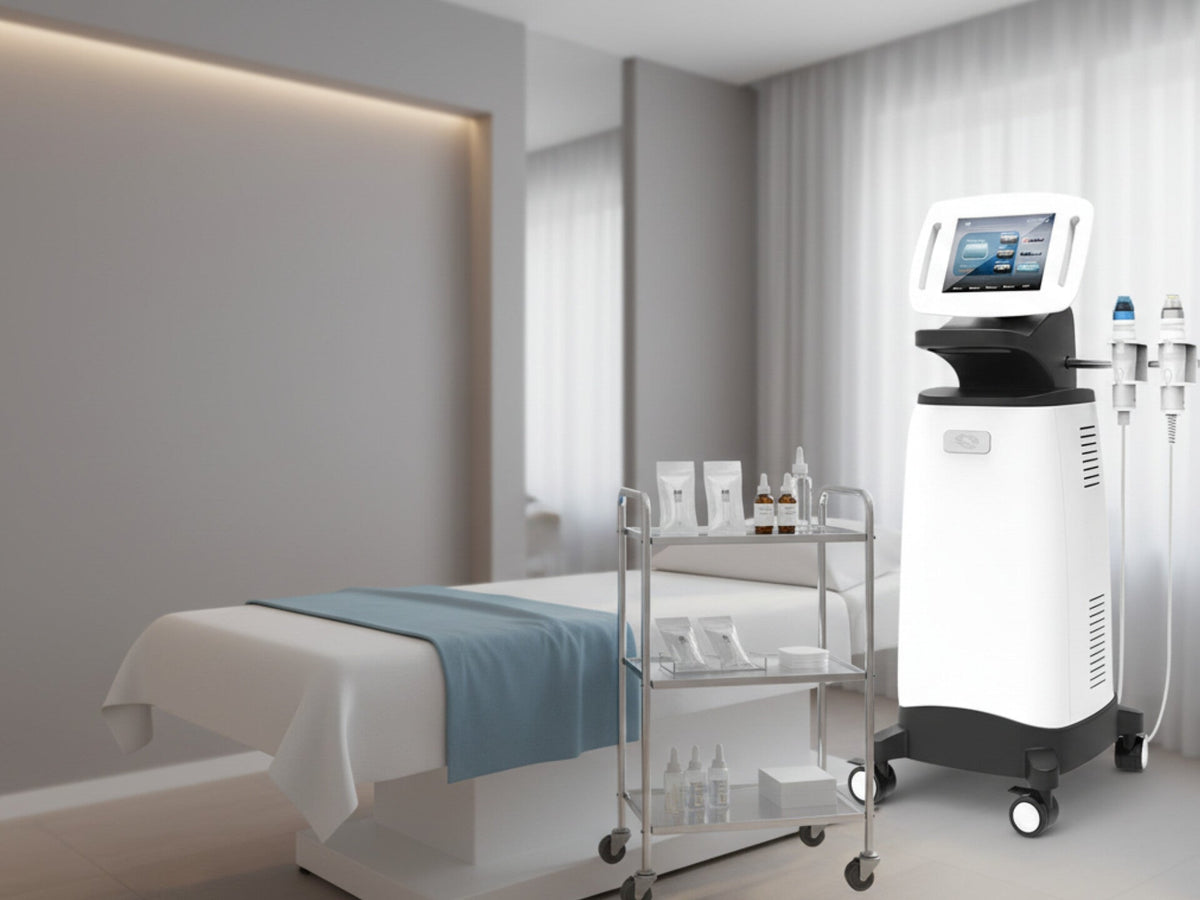
13 Best Professional Beauty Devices for Skin Rejuvenation Clinics in 2026
A Karachi clinic owner spent $45,000 in 2023 on an "all-in-one skin rejuvenation platform" — RF, IPL, LED, microcurrent, hydrodermabrasion, ultrasound, all in one cabinet. The pitch was seductive: one device, every concern. Six months later, every function was mediocre. The clinic eventually bought three focused machines for $38,000 combined — and finally started delivering results.
The takeaway: few clinics buy purely from ranked lists. Most buy based on their clinic profile, the patients they actually serve, and the capital they actually have. This guide is structured accordingly.
Below: five clinic profiles, the devices that fit each one, the devices to skip, and the math behind the decisions. All 13 of the 2026 best-in-class professional skin rejuvenation machine options appear inside the profile they actually serve.
Why We Use a Profile-Based Structure
Flat 1-to-13 rankings have their place, but in this category they tend to pit devices against each other that were never designed for the same job.
A profile-based structure works better because it starts with the questions that actually drive the purchase. Questions like, what does your clinic look like today, and what do your patients walk in asking for?
So while we will be giving you the 13 Best Professional Beauty Devices for Skin Rejuvenation Clinics in 2026, they won't be in a ranked list pitting them against each other. Instead, they are grouped by the kind of clinic each one genuinely fits, thereby helping you to identify the ones that best suit your practical use application.
The Lumenis M22 is excellent for pigment. Morpheus8 is excellent for texture. A hydrodermabrasion machine is excellent for entry-level revenue. Ranking them against each other is like ranking a hammer against a screwdriver — they're not competing for the same job.
Skin rejuvenation breaks into six technology categories: IPL, RF microneedling, fractional CO2 laser, HIFU, LED, and hydrodermabrasion. Each serves different patients at different price points. The rest of this guide maps these six technologies across five clinic profiles, so readers can see both the full landscape and the specific shortlist that fits their practice.
The right device for your clinic depends on three things: who your patients are, what capital you have, and what skill set you can hire. Not on which manufacturer's marketing team has the loudest voice.
For technical background on the most common professional category, see how RF skin tightening works and types of radio frequency beauty devices. For a broader overview of treatment modalities, this guide on professional skin rejuvenation machines and treatment optionscovers IPL, RF, and laser side-by-side.
Find Your Profile
Five real clinic buyer profiles. Pick the one that describes your situation today — not where you want to be in three years.
|
IF YOUR CLINIC LOOKS LIKE… |
YOUR PROFILE |
CAPITAL |
|
New salon or facial studio adding professional skin services |
1: Starter |
$5k–$25k |
|
Established medspa building anti-aging and acne-scar service |
2: Texture-Focused |
$15k–$40k |
|
Dermatology practice or pigment-heavy medspa |
3: Pigment-Focused |
$60k–$120k |
|
Premium aesthetic center building a full anti-aging menu |
4: Premium |
$200k+ |
|
Distributor, OEM buyer, or private-label brand operator |
5: B2B Buyer |
Varies |
Profile 1: The Starter Clinic

|
WHO YOU ARE · New salon, facial studio, or first-year medspa adding skin services CAPITAL RANGE · $5,000 – $25,000 PAIN POINT · Need professional results without committing to clinical-tier capital |
Your patients are walking in for facials. They want glow, hydration, and a relaxing service experience. They're not coming to you for melasma treatment or jawline lifting — and you shouldn't pretend otherwise. Buy for what they actually want.
Hydrodermabrasion Facial Machine
Technology: Water-based exfoliation + suction + serum infusion · Best for: Cleansing, hydration, dull skin, glow
Hydrafacial-style platforms and value-tier alternatives deliver instant glow through gentle exfoliation and serum delivery. The lowest barrier-to-entry rejuvenation device in this guide. Strong repeat-service economics — most clients book monthly.
- Pros: low downtime, easy operator training, good for most skin types, strong repeat-service revenue
- Cons: does not tighten skin, results are short-term, requires ongoing sessions, not for deep scars or wrinkles
- Why it fits this profile: instant glow drives word-of-mouth; sessions feel like spa services, not medical procedures
Professional LED Light Therapy
Technology: LED panels with red, blue, near-infrared wavelengths · Best for: Acne support, redness, recovery, glow
Dermalux, Celluma, Omnilux. Photobiomodulation across multiple wavelengths. Comfortable, low-cost-per-session, easy to bundle with hydrodermabrasion as a glow-and-recovery package.
- Pros: comfortable, low downtime, easy to package with other services, maintenance-friendly
- Cons: subtle results, needs consistency, not enough for laxity, quality varies by brand
- Why it fits this profile: pairs cleanly with hydrodermabrasion to extend each treatment with a passive recovery step
WHAT TO SKIP AT THIS STAGE
- ✗ SKIP RF microneedling — too much capital, too much training liability for your current patient base
- ✗ SKIP Fractional CO2 laser — requires physician-level oversight you don't have yet
- ✗ SKIP HIFU — premium service positioning doesn't match your current price points
- ✗ SKIP All-in-one platforms — the Karachi mistake; mediocre everything
Profile 2: The Texture-Focused Medspa

|
PROFILE 2 / TEXTURE-FOCUSED WHO YOU ARE · Established medspa adding anti-aging, acne-scar, or firmness services CAPITAL RANGE · $15,000 – $40,000 PAIN POINT · Want clinical results without Morpheus8-tier capital outlay |
Your patient base is 30-55, comes in for results, and will pay for a treatment series. They want their pores tighter, their fine lines softer, their acne scars less visible. RF microneedling is the workhorse for this patient. Three mid-tier and value-tier options below.
Cutera Secret RF
Technology: Fractional RF microneedling, depth 0.5-3.5mm · Best for: Texture, acne scars, fine lines, mild laxity, pores
The practical mid-tier workhorse. Strong clinical track record. Good fit for clinics that want a branded RF microneedling system without committing to premium-tier pricing.
- Pros: flexible depth/energy, treatment-series packages, strong clinical evidence, mid-tier capital
- Cons: requires numbing, single-use consumables, multi-session protocol, less brand demand than Morpheus8
- Why it fits this profile: the safe default; patients who've researched know the name, operators get clinical confidence
Sylfirm X
Technology: Pulsed wave + continuous wave RF microneedling · Best for: Sensitive skin, rejuvenation, redness-prone patients
Dual-wave RF positioned for clinics treating complex skin concerns — vascular issues, sensitive skin, melasma-supportive plans with careful protocols. Training-heavy.
- Pros: dual-wave technology, supports complex skin presentations, conservative-protocol-friendly
- Cons: training-heavy, marketing claims need conservative wording, not every patient is a candidate
- Why it fits this profile: if your patient base skews darker (Fitzpatrick IV-VI) or includes vascular-prone clients
LEFIS H2-K6 Microneedle Fractional RF Machine
Technology: Fractional RF microneedling, adjustable depth · Best for: Value-tier RF microneedling for clinics watching capital
The LEFIS H2-K6 is a value-tier fractional RF microneedling platform built specifically for the texture-focused medspa. The clinical envelope covers everything a Profile 2 clinic actually works: skin tightening, acne scars, stretch marks, enlarged pores, and texture work across face and body.
Honest positioning matters here. H2-K6 will not outperform Morpheus8 or Genius RF on peer-reviewed clinical evidence depth, but for a medspa that needs a workhorse RF microneedling system at 40 to 70 percent lower capital outlay than the premium branded alternatives, H2-K6 competes credibly with Secret RF and Sylfirm X on the bread-and-butter cases that drive the service line.
- Pros: B2B/OEM-friendly with private-label options, quote-based pricing, customization support, capital cost typically below premium branded alternatives
- Cons: requires topical anesthesia and 2-5 days downtime, single-use tip consumables, no real-time tissue impedance feedback (Genius RF differentiator), single-mode RF delivery without Potenza's monopolar/bipolar versatility, multi-session protocol for results
- Why it fits this profile: when capital efficiency matters more than premium brand recognition; also when you want LEFIS's customization support for private-label branding
ADD-ON FOR THIS PROFILE
- ✓ ADD Professional LED Light Therapy — for recovery rooms after RF microneedling sessions; speeds healing, justifies higher package pricing
- ✗ SKIP Premium RF microneedling (Profile 4 territory) until volume justifies the capital
Profile 3: The Pigment-Focused Practice

|
PROFILE 3 / PIGMENT-FOCUSED WHO YOU ARE · Dermatology practice or established medspa treating photoaging and pigment CAPITAL RANGE · $60,000 – $120,000 PAIN POINT · Pigment is the primary patient concern; need a clinical-grade IPL platform |
Your patients come in with sunspots, melasma, rosacea, broken capillaries, and uneven tone. They want their face to look more even, brighter, less weathered. IPL is the primary tool. Three premium platforms below — each with a different fit.
Lumenis M22 Universal IPL
Technology: IPL with 9 ExpertFilters and Optimal Pulse Technology · Best for: Photorejuvenation, pigmented lesions, redness
The IPL platform patients recognize by name. Nine filters swap in seconds with computer-enabled recognition for safety. OPT equalizes energy distribution across the pulse for gentler treatment at lower effective fluences. Strongest IPL evidence base.
- Pros: flexible filter system, strongest IPL evidence base, comfortable OPT delivery, broad indications
- Cons: not for every skin type, eye protection mandatory, premium pricing, training-intensive
- Why it fits this profile: when patient demand is brand-driven and consultation pricing supports the capital outlay
Alma Harmony XL PRO
Technology: Multi-platform laser + IPL + RF + RF Pixel · Best for: Pigment, vascular, texture, fine lines
Multi-platform that integrates lasers, IPL, RF, and RF Pixel into one console with interchangeable applicators. Real engineering — not a consumer-grade all-in-one. Best for clinics running multiple service lines from one device.
- Pros: broad treatment menu, strong professional reputation, real multi-service flexibility
- Cons: higher capital ($80,000-$150,000+), training-intensive, configuration affects cost significantly
- Why it fits this profile: when you want IPL plus other modalities (laser, RF) in a single console to save floor space
Candela Nordlys
Technology: IPL + fractional non-ablative laser · Best for: Pigment, redness, texture, photodamage
Combines IPL with fractional non-ablative laser for clinics that want both light-based pigment work and resurfacing from one platform. Strong dermatology positioning.
- Pros: dual-modality, broad indications, strong dermatology fit, treatment flexibility
- Cons: higher investment, settings must match skin type carefully, not plug-and-play
- Why it fits this profile: when you want IPL plus light fractional resurfacing without buying two separate systems
ADD-ON FOR THIS PROFILE
- ✓ ADD Mid-tier RF microneedling (see Profile 2) — for patients with both pigment and texture concerns, very common in 35+ demographics
Profile 4: The Premium Aesthetic Center

|
PROFILE 4 / PREMIUM WHO YOU ARE · Multi-room aesthetic center or dermatology group with full anti-aging menu CAPITAL RANGE · $200,000+ PAIN POINT · Patients pay premium consultation fees; clinic needs the full clinical envelope |
Your patients pay $1,500–$4,000 per treatment and expect best-in-class everything. Capital outlay is significant. You're buying across categories — RF microneedling, IPL (see Profile 3), CO2 resurfacing, and HIFU. LED in recovery rooms. Five devices below in the categories not yet covered.
InMode Morpheus8 — Premium RF Microneedling
Technology: Fractional RF microneedling, depth up to 8mm with Body handpiece · Best for: Face/body remodeling, laxity, texture, scars
The most-marketed RF microneedling system globally. Celebrity endorsement drives premium consultation pricing. Aggressive depth settings carry fat-atrophy risk in thin-faced patients.
- Pros: strong brand demand, deep energy delivery, face and body flexibility, scar revision
- Cons: requires anesthesia, 2-5 days downtime, fat-atrophy risk if mis-set, expensive consumables ($120-200/tip)
- Why it fits this profile: patients walk in asking for Morpheus8 by name; brand pull alone supports premium pricing
Lutronic Genius RF — Intelligent RF Microneedling
Technology: RF microneedling with real-time tissue impedance feedback · Best for: precision tightening, acne scars and wrinkles.
Measures real time tissue impedance and modifies energy accordingly. Great reputation with physicians. Very good in Fitzpatrick I-VI.
- Pros: real-time tissue feedback, controlled energy delivery, safe across skin types
- Cons: cost of consumables, trained provider needed, higher device cost, variable comfort level
- Why it fits this profile: This is ideal for the patient demographic of Fitzpatrick IV-VI, when you have a requirement for device-level safety margin
Cynosure Potenza RF — Multi-Mode RF Microneedling
Technology: combines monopolar + bipolar RF with 1MHz + 2MHz · Best for: Acne scars, texture, wrinkles, and mild skin laxity.
Flexible RF delivery options and interchangeable tips. Flexibility supports broad treatment menus. Protocol complexity is higher than single-mode systems.
- Pros: broad customization, multiple needle tips, face and body use, multi-service medspa fit
- Cons: protocol complexity, consumable tip costs, training-intensive, not one-size-fits-all
- Why it fits this profile: when you want one device that handles multiple RF protocols across different patient presentations
Fractional CO2 Laser System
Technology: Ablative fractional 10,600nm laser · Best for: Deep resurfacing, scars, advanced wrinkles, sun damage
Alma Pixel CO2, Lumenis Acupulse, and value-tier alternatives. The strongest correction tool in this guide. 5-10 days of downtime. Pigment risk on Fitzpatrick IV-VI.
- Pros: strongest correction potential, supports premium pricing, useful for advanced texture work
- Cons: 5-10 days downtime, pigment risk on darker skin, training-heavy, not for all skin types
- Why it fits this profile: for the resurfacing tier of your service menu; premium per-session pricing offsets the longer recovery
HIFU Facial System
Technology: High-intensity focused ultrasound · Best for: Non-surgical lifting, jawline, neck tightening
Ultherapy, Ultraformer, Sofwave, and value-tier alternatives. Outcomes depend heavily on candidate selection — not every face shape responds.
- Pros: no needles, lifting-focused service, supports premium packages, no downtime
- Cons: can be uncomfortable, not for every face shape, gradual results, candidate-dependent
- Why it fits this profile: rounds out your anti-aging menu with a non-surgical lifting option for the 50+ patient
ADD-ONS FOR THIS PROFILE
- ✓ ADD IPL platform from Profile 3 — Lumenis M22 or Alma Harmony XL PRO
- ✓ ADD Professional LED in recovery rooms for post-procedure care
Profile 5: The B2B Buyer

|
PROFILE 5 / B2B BUYER WHO YOU ARE · Distributor, OEM buyer, or operator building a private-label brand CAPITAL RANGE · Varies (quote-based) PAIN POINT · Need OEM/ODM customization, private-label support, and competitive unit economics |
Your buying criteria are different from a clinic. You're not optimizing for a single patient consultation. You're optimizing for inventory economics, private-label branding flexibility, distributor margins, and supplier responsiveness. Premium Western manufacturers don't typically serve this segment well — their margins are built around clinic capital sales, not distributor wholesale.
The Beijing-based manufacturer ecosystem (LEFIS and others) is where this profile actually shops. RF microneedling is the strongest sub-category for B2B because the technology is mature, consumable economics are well-understood, and clinical demand is broad.
LEFIS H2-K6 — Value-Tier RF Microneedling for B2B
Technology: Fractional RF microneedling, adjustable depth · Best for: Distributors, OEM buyers, private-label operators
The LEFIS H2-K6 is designed for buyers building inventory, not for a single clinic transaction. LEFIS Laser, operating since 2005 from Beijing, supports the workflow with OEM/ODM customization (your brand, your specifications, your packaging), quote-based pricing that adjusts to volume commitments, and after-sales support coordinated through your distributor relationship. Clinical capability covers the standard RF microneedling envelope: skin tightening, acne scars, stretch marks, pores, texture, face and body.
- Pros: OEM/ODM private-label support, volume-tiered pricing, customization across appearance and specifications, supplier-direct relationship without retail markup
- Cons: requires topical anesthesia and 2-5 days downtime, single-use tip consumables, no real-time tissue impedance feedback (Genius RF differentiator), single-mode RF delivery without Potenza's monopolar/bipolar versatility, multi-session protocol for results
- Why it fits this profile: when your buying criteria include private-label branding, customization, and direct supplier relationship — not single-clinic-transaction economics
If you're a B2B buyer evaluating other categories, the same logic applies: look for manufacturers with established OEM/ODM workflows. Most value-tier IPL, HIFU, and hydrodermabrasion platforms are produced in the same manufacturing ecosystem, but RF microneedling has the strongest B2B fundamentals because clinical demand is broad, training is standardized, and consumable revenue is recurring.
Universal Decisions: Apply to Every Profile

Regardless of which profile fits your clinic, these decisions apply. The buying guide, cost framework, and clinical considerations don't change with your profile — only the device shortlist does.
6 Decisions Before You Purchase
- Match device to service menu: audit your last 100 consultations and buy for the dominant concern, not for the marketing copy on a brochure.
- Verify specs with independent data: ask for 510(k) numbers, verify them on the FDA database, and demand measured pulse durations, RF type, and wavelength specs. Generic logos and one-page CE certificates are not specifications.
- Audit consumables over 36 months: RF microneedling tips run $30 to $200 each, IPL filters and laser cartridges add up fast, and HIFU shot life caps revenue per cartridge. A clinic running 200 sessions a year on a $100 tip burns $20,000 a year in consumables alone.
- Verify training scope: premium manufacturers provide 2 to 5 days of in-person training plus protocol guidance. Cheap imports provide a PDF. Operator skill drives outcomes more than specs.
- Model realistic ROI: average per-session pricing: IPL $300 to $500, RF microneedling $600 to $1,500, CO2 laser $1,500 to $4,000, HIFU $1,500 to $3,000. Most clinics need 12 to 24 months for payback.
- Confirm after-sales response time: a premium device with 30-day repair turnaround is worse than a value-tier device with 48-hour response. Verify spare parts inventory, service contract terms, and distributor response time before signing.
Cost Reference Across All Profiles
|
TIER |
CAPITAL COST |
TYPICAL BUYER |
|
Entry-level facial machines |
$2,000–$10,000 |
Profile 1 starters |
|
Mid-tier RF / hydrodermabrasion |
$10,000–$30,000 |
Profile 2 medspas |
|
Premium IPL and RF microneedling |
$30,000–$80,000 |
Profile 3 dermatology |
|
Premium fractional CO2 lasers |
$60,000–$150,000 |
Profile 4 specialty |
|
Multi-platform systems |
$80,000–$200,000+ |
Profile 4 top-tier |
|
B2B RF microneedling platforms (e.g., LEFIS H2-K6) |
$8,000–$25,000 |
Profile 5 distributors |
|
At-home consumer devices |
$130–$500 |
Not for clinics |
Professional vs At-Home Devices
Professional skin rejuvenation machines for clinics deliver substantially higher power, deeper tissue penetration, and tighter safety controls than any at-home device on the market. Mainstream coverage in Vogue, Forbes, and NYT Wirecutter regularly reviews consumer RF devices like NuFace, Therabody, Medicube, and CurrentBody, helping to drive patient awareness of the category. However, it should not be seen as an equivalent comparison to clinic-grade equipment. They are simply useful as maintenance tools between clinic sessions.
Results and Longevity Across Categories
Here is how long the results of different professional skin rejuvenation devices typically last under realistic clinical conditions:
|
Technology |
Typical Result Duration |
|
LED light therapy |
Weeks; requires regular maintenance sessions |
|
Hydrodermabrasion |
Weeks; designed for monthly repeat-service economics |
|
IPL photofacial |
6 to 12 months with strict sun protection |
|
RF microneedling |
1 to 2 years; longer with annual maintenance |
|
HIFU |
12 to 18 months for the main lifting effect |
|
Fractional CO2 laser |
5+ years for major resurfacing outcomes |
Results vary by patient age, skin quality, settings, sessions, lifestyle, and operator skill.
Patient Selection
Good candidates: mild-to-moderate aging signs, dull skin, uneven tone, fine lines, acne scars, enlarged pores, mild laxity, sun damage. Clients willing to complete a multi-session series with realistic expectations.
Poor candidates: active skin infection, severe sagging requiring surgery, keloid-prone history (RF microneedling and CO2 laser), pregnancy or breastfeeding per most clinic policies, implanted electrical devices (RF and microcurrent).
Risks Across Categories
- Common: redness, swelling, mild tenderness; resolves 24-72 hours
- Uncommon: bruising, pinpoint bleeding, temporary pigment change
- Rare but serious: burns, scarring, permanent pigment change on dark skin, eye injury from light-based devices, paradoxical fat atrophy from aggressive RF microneedling
Conclusion: Buy Your Profile, Not the List
When clinics choose devices based purely on rankings instead of their own profile, the risk of mismatch increases. The Karachi all-in-one example at the top of this guide is one version of that mismatch. The right question isn't "what's the best skin rejuvenation machine?" — it's "what's the best machine for a clinic that looks like mine, serving patients who look like mine?"
Find your profile. Buy the devices that fit. Skip the categories your patient base doesn't need. Five profiles, 13 devices, one principle: match the equipment to the clinic, not the clinic to the equipment. Clinic buyers can use the profile checklist above to shortlist 2–3 devices and then request a quote.
Frequently Asked Questions
What is the most effective skin rejuvenation treatment?
Depends on the concern. Pigment and tone: IPL. Texture, scars, mild laxity: RF microneedling. Deep resurfacing: fractional CO2 laser. No single treatment is universally best.
What machine is best for skin tightening?
Non-invasive: Thermage FLX (monopolar RF) or HIFU. Combined tightening plus texture: RF microneedling (Morpheus8, Genius RF, LEFIS H2-K6). Severe sagging needs surgery.
How much does skin rejuvenation cost?
IPL: $300-500. RF microneedling: $600-1,500. CO2 laser: $1,500-4,000. HIFU: $1,500-3,000. LED: $50-150. Hydrodermabrasion: $150-300. Varies by market.
What color LED is best for sagging skin?
Red light (633nm) and near-infrared (830nm) support collagen response. LED alone won't reverse moderate sagging — combine with RF or RF microneedling.
What are the side effects of rejuvenation?
Common: temporary redness, swelling, tenderness. Less common: bruising, pinpoint bleeding, temporary pigment change. Rare: burns, scarring, fat atrophy from aggressive RF microneedling.
How to look 10 years younger without surgery?
Combine IPL (tone), RF microneedling (texture and firmness), HIFU (lifting), daily sunscreen, retinoid, vitamin C. Realistic outcome: 5-10 years of perceived rejuvenation.
How long does skin rejuvenation last?
LED and hydrodermabrasion: weeks. IPL: 6-12 months. RF microneedling: 1-2 years. CO2 laser: 5+ years. HIFU: 12-18 months.
How to make your face look 20 years younger?
Non-surgical: combine deep RF microneedling with fractional CO2, professional injectables, consistent topicals. Surgical: facelift. No single device delivers 20 years of reversal.
What is the best age to start rejuvenation?
Preventative (IPL, light RF, LED, sunscreen): late 20s to early 30s. Corrective treatment for established concerns: 40s.
What are the risks of skin rejuvenation?
Burns, scarring, permanent pigment change, infection, eye injury from light-based devices, fat atrophy from aggressive RF microneedling. Minimized by trained operators using FDA-cleared devices on appropriate candidates.
What should clients avoid after a rejuvenation treatment?
Direct sun for 4-6 weeks, hot showers and saunas for 48-72 hours, exfoliating actives for 5-7 days, makeup on CO2-treated areas for 5-7 days, picking or scratching healing tissue.
How many times should I rejuvenate my face?
Treatment courses: 3-5 sessions spaced 4-6 weeks apart. Maintenance: 1-2 sessions per year. Overdoing produces diminishing returns and elevates risk.
Is RF microneedling good for skin rejuvenation?
Yes. One of the most versatile professional modalities — texture, pores, scars, fine lines, mild laxity. Most patients see results across 3-4 sessions.
Is IPL good for skin rejuvenation?
Yes for pigment, redness, tone. Less effective for texture, scars, or laxity. Foundational for photoaging clinics. Combine with RF microneedling for texture concerns.
What should clinics check before buying a skin rejuvenation machine?
Verified technology specifications, FDA 510(k) or CE marking with specific numbers, 36-month consumable cost projection, training scope, warranty terms, after-sales response time, clinical case-study photos with metadata.
Sources
- Laser Skin Resurfacing · Cleveland Clinic ·
- Radio Frequency (RF) Skin Tightening · Cleveland Clinic ·
- Lasers and Lights: How Well Do They Treat Acne? · American Academy of Dermatology ·
- Laser Resurfacing · American Society for Dermatologic Surgery (ASDS) ·
- Medical Devices · U.S. Food & Drug Administration ·
- 510(k) Premarket Notification Database · U.S. Food & Drug Administration ·
- Radiofrequency Therapy in Esthetic Dermatology: A Review of Clinical Evidences · PubMed ·
- Evaluating the Effectiveness and Safety of Radiofrequency for Face and Neck Rejuvenation · PubMed ·
- A Review of Light-Emitting Diode Phototherapy in Dermatology · NIH / PubMed Central ·
- Lasers in Dermatology · DermNet ·
- Radiofrequency Radiation Definition · National Cancer Institute ·
- PubMed Search: Skin Rejuvenation Devices · National Library of Medicine ·
- Skin Rejuvenation Overview · Alma Lasers (Industry Reference) ·
- M22 Universal IPL Product Overview · Lumenis (Industry Reference) ·


Looking for something else?

Do Men Get Cellulite? Causes Differences & What to Know
LEARN MORE
Does Radio Frequency Skin Tightening Work? Results & How It Works
LEARN MORE
Do You Shave Before Laser Hair Removal? Prep Tips & Why It Matters
LEARN MORE
How to Get Rid of Age Spots: Treatments. Natural Remedies & Prevention
LEARN MORELooking for something else?
How to Heal Ingrown Hair: Causes. Treatments & Healing Time
LEARN MORE
How to Get Rid of Freckles: Effective Treatments & Natural Tips
LEARN MORE
Top 10 Picosecond Laser Machine Manufacturers for Clinics in 2026
LEARN MOREYou may also like
Further reading

Tattoo Removal Laser Machine Cost and Ownership Guide

CO2 Laser Treatment Room Setup Checklist

Aesthetic Machine Factory Acceptance Test Before Shipment


