

Diode Laser Cooling Systems Compared: Sapphire, TEC, Water and Air Cooling
Sapphire, TEC, water and air are normally different stages in one cooling chain, not four interchangeable choices. Sapphire forms the skin-contact window; a TEC pumps heat from its cold side to its hot side; coolant transports heat inside the machine; fans and radiators reject heat to the room. A compressor or chiller may add another stage. The buyer should verify how the full chain performs under sustained firing, because an idle or no-load tip temperature does not establish under-load stability.
The procurement question is not “which label is best?” It is whether the exact quoted configuration maintains contract-defined contact and internal temperatures, avoids condensation, records alarms and recovers between sessions under the clinic's ambient conditions and expected duty cycle. Review the LEFIS diode laser collection to shortlist models, then request model-specific architecture, test conditions and acceptance limits in writing.
Quick answer: What does each cooling stage do?
|
COOLING ELEMENT |
MAIN JOB |
PRIMARY LOCATION |
MAIN STRENGTH |
MAIN LIMITATION |
|
Sapphire contact |
Cools epidermal contact area |
Handpiece window |
Direct patient comfort |
Depends on the system behind it |
|
TEC (thermoelectric) |
Pumps heat cold-to-hot |
Handpiece or diode assembly |
Precise active control |
Hot side must reject heat |
|
Water loop |
Transfers heat to radiator |
Internal closed loop |
Strong heat transport |
Adds pump, tubing, coolant |
|
Air cooling |
Rejects heat to room air |
Fans, vents, radiator |
Simple and economical |
Sensitive to dust and heat |
|
Compressor / chiller |
Cools below ambient |
Main unit or external |
High cooling capacity |
Cost, noise, maintenance |
How a Diode Laser Cooling System Works
Diode lasers convert only a fraction of their electrical input into optical output. The rest becomes waste heat that must be removed continuously from the laser bar, power electronics, and handpiece.
The cooling path
One possible layered path is: laser bar → thermal plate → TEC or conductive interface → circulating coolant → radiator → fan → room air. Not every model uses every stage or the same path for the handpiece, so request a model-specific thermal diagram and test data rather than assuming this sequence.
Skin cooling vs internal component cooling
|
SKIN COOLING |
INTERNAL LASER COOLING |
|
Protects the epidermis |
Protects diode bars and electronics |
|
Felt by the client |
Usually invisible to the client |
|
Measured at sapphire surface |
Measured at coolant, heat sink, or diode |
|
Affects comfort |
Affects stability and component life |
|
Cannot replace internal cooling |
Cannot replace contact cooling |
Sapphire Cooling vs TEC Cooling
These are often described as competing choices. They are not — they perform different jobs and typically work together.
What sapphire cooling does
Sapphire is a physical contact window at the handpiece tip. It has high thermal conductivity, transmits the treatment wavelength, and provides a smooth, scratch-resistant surface for continuous glide. Sapphire spreads whatever cold is behind it across the treatment area — but alone it does not generate cooling.
What TEC cooling does
A thermoelectric cooler (Peltier module) pumps heat from a cold side to a hot side under electrical control. In a diode handpiece, the cold side may couple to the sapphire assembly, while the hot side rejects heat into coolant, a heat sink or forced air. A closed-loop design may adjust current from sensor readings. The module name or count does not by itself establish cooling capacity.
Sapphire vs TEC — head-to-head
|
SAPPHIRE |
TEC |
|
Physical skin-contact material |
Active heat-pumping component |
|
Spreads cold across the contact surface |
Creates the temperature difference |
|
Does not generate cooling alone |
Requires heat rejection on hot side |
|
Quality depends on crystal and polish |
Quality depends on module and control |
|
Easy for buyers to see |
Harder to verify without test data |
Why layered designs may use both. Sapphire spreads temperature across the contact surface, while an active stage such as TEC creates or controls the temperature difference and still needs a hot-side heat-rejection path. A procurement specification should identify each stage and its under-load result; a “sapphire cooling” label alone is incomplete.
Water Cooling vs Air Cooling

Water and air usually occupy different parts of the path: coolant can transport heat to a radiator, while forced air can reject radiator heat to the room. Verify the exact layout because some systems use different or additional stages.
How water cooling works
A closed-loop system circulates coolant between a reservoir, pump, cold plate, and heat exchanger. Sensors monitor coolant temperature and flow rate. The loop transfers heat away from the bar and handpiece faster than air alone at high duty cycles.
How air cooling works
Air cooling uses natural convection, forced-air fans, heat sinks, and radiator airflow. It requires clear intake and exhaust paths, dust-free fins, and enough clearance to move air freely.
Water vs air — head-to-head
|
WATER COOLING |
AIR COOLING |
|
Moves heat efficiently through compact system |
Simpler architecture |
|
Suited to sustained high heat loads |
Lower maintenance burden |
|
Supports handpiece and diode cooling |
Performance depends on room air |
|
Requires pump, tubing, coolant |
Requires clear vents and clean fans |
|
Can develop leaks or blockages |
Can suffer from dust and fan wear |
Why water-cooled systems still need air. Water transfers heat inside the machine, but the radiator and fans discharge that heat into the room. "Water cooled" almost never means "no air cooling."
Passive vs Active Cooling and TEC vs Compressor
Cooling systems split into passive elements (no moving parts, dependent on ambient) and active elements (powered, regulated).
Passive vs active
|
PASSIVE COOLING |
ACTIVE COOLING |
|
Conductive plates, heat sinks, natural convection |
Fans, pumps, TEC modules, compressors |
|
Fewer failure points |
More components |
|
Quieter |
Fan or compressor noise |
|
Limited below ambient |
Can hold controlled temperatures |
|
Suits lower heat loads |
Suits higher or variable loads |
TEC vs compressor
|
TEC |
COMPRESSOR |
|
Solid-state |
Refrigeration cycle |
|
Compact, no moving parts inside module |
Larger, uses moving compressor |
|
Precise local control |
Strong whole-loop cooling |
|
Performance depends on ΔT and hot-side design |
Capacity depends on compressor and loop design |
|
Hot side still needs cooling |
Requires refrigerant system |
|
Lower mechanical maintenance |
Higher service complexity |
Contact Temperature vs Temperature Stability
The lowest advertised temperature is often the least useful number in a cooling spec.
Minimum temperature claims — what to question
Ask whether temperature was measured before firing or during firing, at sapphire centre or edge, at what room temperature, at what coolant starting temperature, at what fluence, at what frequency, with what spot size, for how long, and with what sensor method.
Cold startup vs sustained cooling
|
COLD STARTUP RESULT |
SUSTAINED RESULT |
|
Easy to demonstrate |
More relevant to acceptance |
|
May last only briefly |
Shows heat-load handling |
|
Often measured without firing |
Measured during real operation |
|
Supports marketing claims |
Supports purchasing decisions |
|
Does not prove treatment stability |
Reveals temperature drift |
A real test sequence
Record ambient temperature and humidity, startup coolant temperature and baseline contact temperature. Run the agreed load profile and record contact and internal readings at pre-defined checkpoints through sustained operation. Use the same sensor method and placement, then test recovery after a pause, repeatability, alarms, condensation and any automatic derating.
Sapphire Quality and TEC Stage Configuration

What defines sapphire quality
Optical clarity, surface polish, flatness, chip resistance, edge finish, thickness, mounting, seal quality, and contact-area uniformity. A very cold tip can still perform poorly with a scratched, unevenly mounted, or undersized window.
Single-stage vs dual-stage TEC
|
SINGLE-STAGE TEC |
DUAL / MULTI-STAGE TEC |
|
Simpler layout |
Greater temperature differential |
|
Lower power use |
Stronger sustained cooling potential |
|
Lower cost |
Higher electrical demand |
|
Suitable heat-load range limited |
More control complexity |
|
Possible recovery limitations |
Greater hot-side heat to reject |
What "dual TEC" does not prove
Two TEC modules do not establish cooling capacity, contact stability, water flow, sapphire quality or long-session performance. Request test data that states the heat-pumping or cooling capacity, temperature difference, hot-side condition, sensor method and load profile. Module count alone is not an acceptance criterion.
Cooling Capacity vs Laser Power
A headline handpiece or laser-power rating does not define thermal load. Heat generation under operation depends on actual electrical input, optical efficiency, pulse width, fluence, repetition rate, duty cycle, spot size, treatment mode and pauses. Compare cooling against a documented load profile, not the wattage label alone.
What affects cooling load
Electrical diode power, optical output, pulse duration, repetition rate, duty cycle, spot size, and treatment mode.
Technical data to request
Cooling capacity in watts, coolant flow rate, pump head, reservoir volume, fan airflow, radiator size, TEC model and quantity, operating temperature limits, and thermal-shutdown threshold. Numbers alone are not enough — ask for test conditions.
Cooling, Comfort, and Epidermal Risk Controls
Contact cooling can support patient comfort and epidermal heat management, but it does not make an unsuitable setting or technique safe. Evaluate cooling together with model instructions, approved protocols, contact technique, skin assessment and operator training. The diode laser epilation parameters guide provides protocol context, not a replacement for local clinical governance.
Contact cooling vs pre-cooling
|
CONTACT COOLING |
PRE-COOLING |
|
Acts during the pulse |
Acts before energy delivery |
|
Integrated into handpiece |
Uses external air or gel |
|
Supports continuous glide |
Adds workflow steps |
|
Depends on full skin contact |
Depends on timing and application |
What cooling can and cannot correct
|
COOLING HELPS CONTROL |
COOLING CANNOT CORRECT |
|
Epidermal heat during pulse |
Excessive fluence |
|
Repeated pulse accumulation |
Unsuitable pulse width |
|
Surface heat load |
Wrong skin-type settings |
|
Contact discomfort |
Poor operator contact |
|
Thermal accumulation |
Overlapping pulses |
Contact cooling can support comfort, but a comfortable treatment does not prove that parameters, contact technique or sensor calibration are appropriate. Cooling should be one documented control within the model's instructions, approved protocol, operator training and adverse-event process. Review the sapphire-cooled hair removal page for the product pathway, then verify model-specific claims in the quotation.
Condensation Risk in Diode Laser Cooling
Sapphire cooled well below room dew point can form condensation on and inside the handpiece. The lowest advertised temperature is not always the best spec.
Visible vs hidden condensation
|
VISIBLE CONDENSATION |
HIDDEN CONDENSATION |
|
Water on sapphire surface |
Moisture inside seams |
|
Easy to wipe and observe |
Harder to detect |
|
May affect glide |
May affect contacts or electronics |
|
Signals dew-point risk |
May develop over repeated cycles |
Questions for the supplier
Is there a humidity sensor? Is there a dew-point control mode? Does software limit minimum temperature based on ambient? Are internal optics sealed? What room-humidity limits apply?
Water Flow and Coolant Quality
A cooling loop is limited by flow, heat-exchanger performance and the most restrictive part of the path. Reduced flow, air, contamination or a weak pump can materially reduce capacity, so evaluate the loop under load rather than relying only on a rated component value.
Flow rate vs cooling performance
Coolant velocity, pressure drop, restricted channels, pump condition, air bubbles, clogged filters, and kinked tubing all reduce effective cooling. A machine that meets spec on the factory bench can fall short with poor plumbing.
Coolant type
Follow the manufacturer's approved coolant only. Requirements may include distilled or deionized water, corrosion inhibitors, specific electrical conductivity, and defined replacement intervals. Generic coolant from another platform may accelerate corrosion.
Open loop vs closed loop
|
OPEN LOOP |
CLOSED LOOP |
|
Draws from external supply |
Recirculates coolant |
|
Less common in clinic devices |
Common in aesthetic systems |
|
Introduces supply variation |
Easier to control |
|
Requires drainage |
Requires reservoir maintenance |
Warning signs of poor water flow
Bubbling sound at startup, repeated temperature warnings, slow cooling recovery, handpiece warming, low-flow error codes, cloudy coolant, visible particles, or unusual pump noise. Any of these should stop treatment until the cause is identified.
Cooling Maintenance Burden Compared
MAINTENANCE COMPARISON
|
COMPONENT |
ROUTINE MAINTENANCE |
COMMON FAILURE MODE |
SERVICE IMPACT |
|
Sapphire window |
Clean and inspect |
Scratches, chips, cloudy surface |
Comfort and contact problems |
|
TEC module |
Technician-serviced |
Reduced cooling or sensor error |
Handpiece repair |
|
Water loop |
Coolant and flow checks |
Leak, blockage, pump failure |
Possible downtime |
|
Air fans |
Vent and dust cleaning |
Fan wear or restricted airflow |
Overtemperature warnings |
|
Compressor |
Professional service |
Refrigerant or compressor fault |
Higher repair complexity |
|
Temperature sensor |
Functional verification |
Incorrect readings |
Unstable control |
No cooling architecture is universally best. Higher capacity may require more components and therefore more service points. Match the documented load performance, condensation controls and maintenance obligations to treatment volume, room conditions, downtime tolerance and local technical support.
Cooling Noise, Power Use, and Treatment-Room Impact
Cooling systems move heat rather than eliminate it. A stronger cooling system means more heat discharged into the treatment room and more electrical demand on the circuit.
What to check for the treatment room
Check continuous fan noise, pump vibration, compressor cycling, room air-conditioning capacity, heat discharge, circuit rating and the manufacturer's ambient operating range. Assess electrical or HVAC changes with qualified facility personnel; stronger machine cooling does not compensate for inadequate room heat rejection.
Cooling System Claims That Need Verification
Marketing language around cooling is inconsistent across suppliers. Treat any of the following as claims to be tested, not accepted:
- "-30°C sapphire" or similar single-number temperature claims
- "Ice cooling," "freezing-point technology," or "zero pain"
- "Quadruple cooling" or unlabelled multi-stage claims
- "Dual TEC" without cooling wattage
- "German cooling system" or country-of-origin claims
- "Medical-grade water circulation"
- "Constant temperature" without a defined tolerance
For every claim, ask: Under what test conditions? Which component reached that temperature? Was the laser firing? How long was the test? What sensor was used? Is the result repeatable? Is a test report available?
Supplier Live Temperature Test Checklist

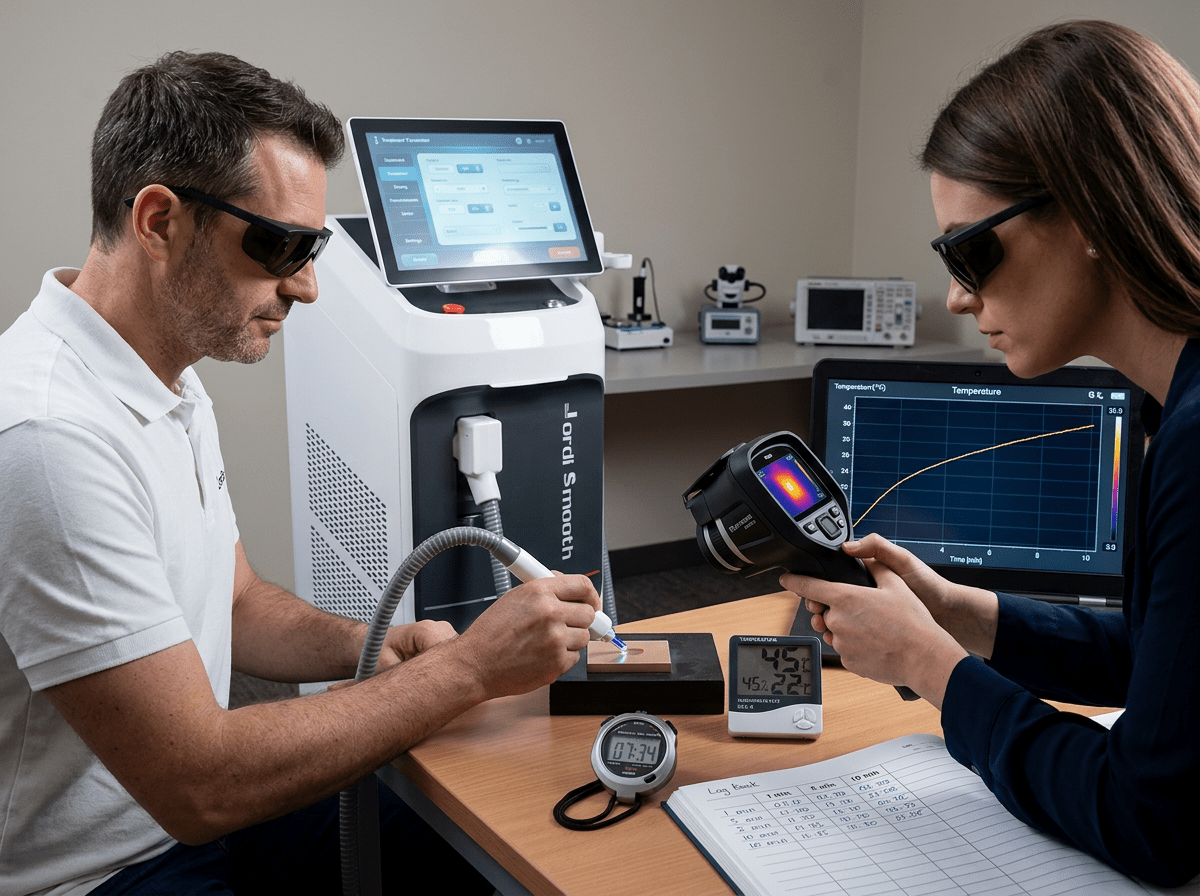
A useful procurement check is a recorded load test with the laser firing under the buyer's expected settings and agreed room conditions. The acceptance criteria, sensor method, duration and allowed drift should be written before the test.
Before the test — get the conditions in writing
Exact machine model, exact handpiece, diode power, spot size, wavelength configuration, ambient temperature, humidity, coolant starting temperature, and software version. All of these change results — none should be missing from the test log.
During the test — sequence to record
Record startup cool-down, no-load contact temperature, under-load temperature at the buyer's expected settings, sustained operation, recovery after a pause, repeatability, condensation, alarms and automatic derating. Use a duration representative of the clinic's workflow. If 10- or 20-minute checkpoints are chosen, identify them as contract acceptance points, not universal standards.
Evidence to collect
Collect continuous video from startup through recovery, the interface display, ambient temperature and humidity, operating parameters and time-stamped readings. Use a calibrated contact sensor with documented placement when suitable. Thermal-camera readings on sapphire may be misleading unless emissivity, reflections and the material's optical properties are controlled and the method is agreed in advance.
Promotional demo vs buyer-grade test
|
PROMOTIONAL DEMO |
BUYER-GRADE TEST |
|
Short clip |
Continuous recorded sequence |
|
Shows idle temperature |
Shows firing under load |
|
No room conditions recorded |
Records ambient conditions |
|
One reading |
Multiple timed readings |
|
No recovery test |
Includes recovery and repeatability |
|
Sales claim |
Documented acceptance test |
Factory Acceptance vs Clinic Acceptance
Two independent tests protect the buyer: one before shipment and one after installation.
Factory acceptance test
Cooling-loop leak test, flow test, fan operation, pump current, TEC response, temperature stability under continuous firing, thermal cutoff verification, and packaging after coolant preparation. The buyer should receive a signed factory test report referencing the serial number.
Clinic acceptance test
Shipping inspection, coolant preparation per manual, startup time, handpiece recognition, sapphire temperature at no-load and under fluence, live load test, error-log check, staff training completion, and maintenance schedule handover.
Diode Laser Cooling Across LEFIS Products
The current K12 product page lists a layered cooling stack of water, air, semiconductor (TEC) and sapphire, along with double contact cooling and several laser-power options. Treat these as shortlisting claims, not a final acceptance specification. Confirm the exact handpiece, laser power, spot size, cooling range, test conditions and included warranty in the quotation and acceptance test.
Fields to compare across suppliers
Sapphire material, number of TEC stages, coolant system, flow monitoring, handpiece cooling range, temperature recovery, ambient operating range, and service access. Request the same fields from every supplier so numbers are comparable, not assembled from marketing summaries.
Cooling Specifications vs Total Machine Quality
Cooling matters, but does not replace the rest of the platform. Evaluate cooling alongside diode-bar manufacturer, optical output, spot size, pulse width, repetition rate, handpiece life, power supply, software, calibration, warranty, and technical service. The diode laser buyer's guide for clinics identifies multi-level cooling as one of several core purchasing factors.
Strong cooling vs strong complete platform
|
STRONG COOLING ALONE |
STRONG COMPLETE PLATFORM |
|
Improves thermal control |
Balances energy, optics, cooling |
|
Does not prove laser quality |
Includes verified laser-bar performance |
|
Does not prove accurate fluence |
Includes calibration records |
|
Does not prove long handpiece life |
Includes replacement and warranty data |
Cooling System Cost vs Lifetime Cost
Cooling architecture affects both purchase price and running cost. The diode laser machine cost guide identifies cooling as one factor separating value platforms from premium systems.
Upfront cost drivers
Extra TEC modules, larger radiator, higher-capacity pump, compressor, sapphire size and quality, dual handpieces, sensors, and control software.
Ongoing cost drivers
Coolant, filters, pump replacement, fan replacement, sapphire damage, handpiece service, and compressor maintenance. A cheaper architecture may reduce purchase price but increase cost per treatment when sessions pause for thermal cutoffs.
How to Compare Diode Laser Cooling Specifications

Apply the same seven steps to every supplier.
1. Identify every cooling stage
Sapphire, TEC, water loop, fans, compressor. A single "cooling" label is not enough.
2. Separate contact and internal temperatures
Request both. Contact temperature affects the patient; internal coolant temperature affects the diode.
3. Request load-test conditions
Do not accept an idle temperature alone. Ask for the parameters — frequency, fluence, duration, ambient.
4. Check condensation control
Ask about humidity limits, dew-point strategy, and any minimum-temperature software lockout.
5. Review water-loop maintenance
Coolant type, replacement interval, filter access, pump and tubing serviceability.
6. Check error protection
Low-flow alarm, overtemperature alarm, TEC sensor fault, fan failure detection, automatic shutdown.
7. Review warranty boundaries
Clarify coverage for handpiece, TEC, pump, compressor, sapphire, diode bars, and coolant-related damage. The training, warranty, and after-sales support page sets out what LEFIS covers as a baseline.
Final Cooling Specification Checklist
Before signing a purchase order, confirm:
- cooling architecture disclosed (sapphire, TEC, water, air, compressor)
- sapphire material and dimensions confirmed
- TEC count and cooling capacity documented in watts
- water-flow rate disclosed
- pump and radiator specifications available
- ambient operating range documented
- contact temperature tested under load
- temperature stability measured over the contract-defined duration
- condensation controls explained
- flow and temperature alarms demonstrated
- maintenance schedule supplied
- coolant specification supplied in writing
- handpiece warranty confirmed
- spare-parts availability confirmed
- live test video completed and shared
- factory acceptance report received
Compare LEFIS Diode Laser Cooling Systems
Cooling is a chain, not a single feature. Sapphire, TEC, water, and air perform different jobs — and stability under sustained firing matters more than headline minimum temperature.
Compare LEFIS diode laser systems, then use the contact page to request the cooling architecture, exact quoted power configuration, load-test conditions, temperature log, condensation controls, coolant and service schedule, warranty boundaries and serial-number acceptance report.
FAQs
How does a diode laser cooling system work?
A common layered design moves heat from the laser bar through a conductive interface or TEC into circulating coolant, then through a radiator to room air. Sapphire forms the skin-contact window and may be cooled by a separate or shared thermal path. The exact sequence varies by model.
Is sapphire cooling better than TEC cooling?
They are different layers, not direct substitutes. Sapphire is the contact window; a TEC is an active heat pump. A system may combine them, but the supplier should document what cools the sapphire, how the TEC hot side rejects heat, and how contact temperature behaves under load.
Does a diode laser need both water and air cooling?
A water loop needs a final heat-rejection stage. Many clinic systems move heat through coolant to a radiator and use fans to discharge it into room air, but the exact architecture must be confirmed. “Water cooled” does not by itself describe radiator capacity, airflow or duty-cycle performance.
Do diode laser machines overheat?
They can overheat when heat generation exceeds the system's ability to move and reject it, or when airflow, coolant flow, sensors or maintenance are compromised. Judge the quoted duty cycle by a documented load test in the buyer's room conditions; stop after repeated thermal warnings or automatic derating.
What temperature should a diode laser handpiece reach?
There is no universal target temperature. Define the acceptable contact-temperature range, sensor method, ambient conditions, load settings, duration and allowable drift for the exact model. A no-load minimum is not a substitute for an under-load stability and condensation test.
Can diode laser cooling cause condensation?
Yes. Condensation forms when a surface reaches or falls below the room's dew point. A supplier should explain operating humidity limits, sealing, drainage, sensor logic and any software temperature floor for the exact handpiece. Verify these controls under the agreed acceptance conditions rather than assuming the design prevents ingress.
What are the benefits of sapphire contact cooling?
Sapphire has high thermal conductivity, transmits treatment wavelengths, resists scratches, and provides a smooth glide across the skin. It spreads cold from the underlying TEC or coolant across the treatment window and supports continuous, comfortable contact.
How often should a diode laser water-cooling system be maintained?
There is no universal coolant-service interval. Follow the model-specific manual for coolant specification, level or flow checks, filter access, tubing inspection and pump service. Stop and escalate after a low-flow warning, unexplained noise, leak, cloudy coolant or repeated thermal alarm.
What happens when a diode laser cooling system fails?
A cooling fault may trigger an alarm, frequency reduction, pause or shutdown, but the response depends on the model and fault logic. Do not assume a protective cutoff proves the laser bar is undamaged. Stop after repeated thermal or flow warnings, preserve the log, and have the pump, coolant, airflow, sensors, TEC stage and handpiece assessed through authorized support.
How can a buyer test diode laser cooling before purchase?
Agree the test protocol in writing. Record ambient temperature and humidity, exact handpiece and software, fluence, pulse width, frequency, spot size and firing duration. Measure with a sensor method suitable for sapphire or contact surfaces at baseline and agreed intervals through sustained operation, then test recovery and repeatability.
Sources
- Laser Diode Coolers · Rogers Corporation
- Active Cooling of Optical Transceivers · Laird Thermal Systems
- Temperature-Controlled Mounts for TO-Can Laser Diodes · Thorlabs
- Design of Multi-Stage Cooling System for High-Power Laser Diodes · SPIE Digital Library
- Dew Point Temperature: Meaning and Calculation · Vaisala
- ISO 13485 — Medical Devices Quality Management Systems · International Organization for Standardization
- Medical Electrical Equipment Standards · International Electrotechnical Commission


Looking for something else?

Do Men Get Cellulite? Causes Differences & What to Know
LEARN MORE
Does Radio Frequency Skin Tightening Work? Results & How It Works
LEARN MORE
Do You Shave Before Laser Hair Removal? Prep Tips & Why It Matters
LEARN MORE
How to Get Rid of Age Spots: Treatments. Natural Remedies & Prevention
LEARN MORELooking for something else?
How to Heal Ingrown Hair: Causes. Treatments & Healing Time
LEARN MORE
How to Get Rid of Freckles: Effective Treatments & Natural Tips
LEARN MORE
Top 10 Picosecond Laser Machine Manufacturers for Clinics in 2026
LEARN MORE


Further reading

Tattoo Removal Laser Machine Cost and Ownership Guide

CO2 Laser Treatment Room Setup Checklist

Aesthetic Machine Factory Acceptance Test Before Shipment


