

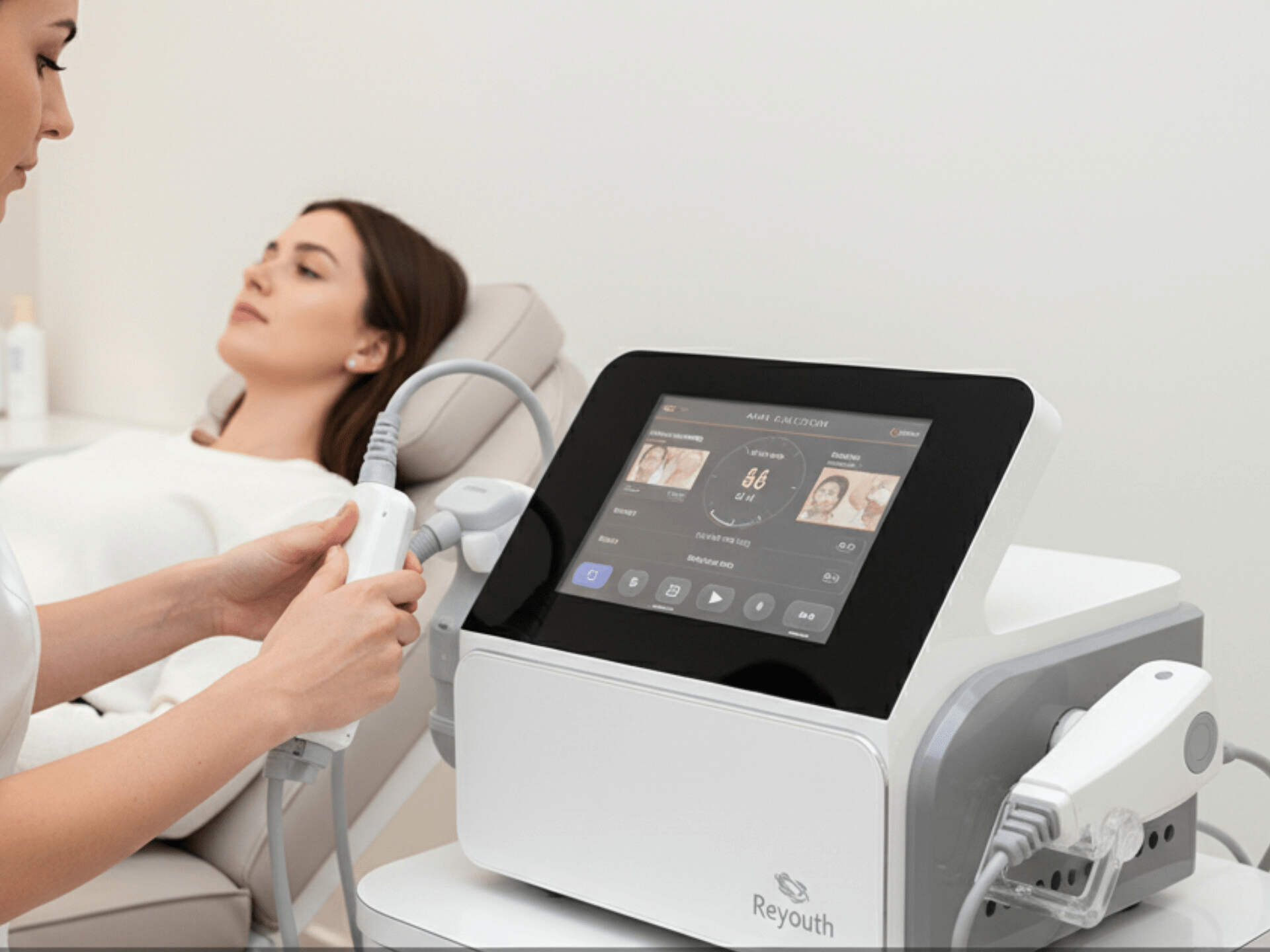
11 Best Professional HIFU Machines for Aesthetic Clinics in 2026
A clinic owner who had recently bought a “12D HIFU” machine from a B2B marketplace at $4,500, contacted us last November. She had been attracted by the higher “D number” and the multi-line cartridge promise of faster treatments. However, after three months of running facelift packages, patients started reporting uneven lifting — one cheek tighter than the other, sagging returning faster on the lower jaw than the upper face, and a few cases where the SMAS depth setting clearly hadn’t reached its target.
The problem was not the cartridge count. It was energy stability. The “12D” meant the cartridge shot 12 lines per pass, which sounds faster on paper. But the unit’s power output drifted by roughly 20 percent between the first shot and the 200th shot in a session — the energy stability spec the supplier hadn’t included on the brochure. Premium HIFU platforms hold output within 2 to 3 percent over hundreds of shots. This one did not, and the clinical results showed it.
The clinic refunded six clients and lost most of a year’s HIFU revenue. Cost of the cheap machine: $4,500. Cost of the choice: roughly $35,000 in refunds, replacement bookings, and reputation repair.
Energy stability is the specification that separates real professional HIFU from low-quality marketplace devices. Treatment capability, certifications, and operator training matter too. But if the output drifts 20 percent across a session, none of the other specs save the clinical result. This guide ranks eleven professional HIFU platforms on weighted criteria, publishes per-criterion scores, and tells you where LEFIS fits and where it does not.
What Is a Professional HIFU Machine?
A professional HIFU machine is a clinic-grade ultrasound device that delivers high-intensity focused ultrasound energy to precise depths beneath the skin without cutting the surface. The energy creates thermal coagulation points at specific tissue depths — typically 1.5mm, 3.0mm, and 4.5mm for the face — that trigger collagen contraction and remodeling. The result is a non-surgical lifting effect that typically builds over 3 to 6 months, with the exact timeline and degree of improvement varying by patient age, tissue quality, and treatment protocol.
Professional HIFU is not the same as home-use HIFU. Home devices scatter weak energy across surface layers; professional machines focus stable, high-peak energy at clinical depths reaching the Superficial Musculoaponeurotic System (SMAS) — the same fibrous layer tightened during a surgical facelift.
Professional HIFU vs Home-Use HIFU
|
Factor
|
Professional HIFU Machine
|
Home-Use HIFU Device
|
|
Energy output
|
Generally higher and more stable across high-shot-count sessions
|
Lower output, with consistency that often varies between sessions
|
|
Treatment depth
|
Multiple cartridge depths (1.5–13mm)
|
Generally limited to superficial layers
|
|
Use setting
|
Clinic, medspa, trained provider
|
Personal use at home
|
|
Main goal
|
Lifting, tightening, body contouring
|
Mild maintenance support
|
|
Safety requirement
|
Operator training, mapping, protocols
|
Consumer-level safety limits
|
|
Results expectation
|
More durable lift and tightening when protocols are followed correctly
|
Often more subtle, with variable outcomes between users
|
Common clinic uses for professional HIFU include facial lifting, jawline tightening, neck and décolleté tightening, brow area support, double chin contouring, body skin tightening on abdomen and thighs, and mild body contouring through fat layer coagulation with deeper macro-focused cartridges.
How HIFU Works in Aesthetic Treatments
HIFU uses focused acoustic waves rather than light. A transducer in the handpiece focuses ultrasound energy at a precise depth below the skin surface — similar to how a magnifying glass focuses sunlight at a point. At the focal point, tissue temperature rises to roughly 60–70°C, creating microscopic thermal coagulation points (TCPs) without affecting the skin between the transducer and the focal depth.
Collagen fibers contract immediately and trigger a wound-healing cascade. Over the following 12 to 24 weeks, the body produces new collagen and remodels existing fibers — this is what creates the gradual lifting result. HIFU is not Botox (which paralyses muscle), not filler (which adds volume), and not laser resurfacing (which removes skin layers). It is a structural treatment targeting deeper tissue support.
Common HIFU Treatment Depths
|
DEPTH
|
COMMON USE
|
CLINIC NOTE
|
|
1.5mm
|
Superficial fine lines
|
Used around delicate periorbital areas
|
|
2.0mm
|
Eye and shallow facial areas
|
Useful for detailed work where cartridge supports it
|
|
3.0mm
|
Dermal tightening
|
Common workhorse depth for face and neck
|
|
4.5mm
|
SMAS-focused lifting
|
Core facial lifting depth — the lift effect lives here
|
|
6.0mm
|
Shallow body / submental
|
Double chin work and shallow body contouring
|
|
8.0mm
|
Body contouring support
|
Standard in 4D and 7D body platforms
|
|
10–13mm
|
Deeper body work
|
Abdomen, thighs, and larger body zones
|
|
16mm+
|
Deep body cartridges
|
Device-specific; requires careful operator training
|
Our Ranking Methodology
Our methodology groups the seven criteria into two buckets that map to how clinic buyers actually make this decision. Clinical performance, characterized by treatment capability, energy stability, safety and compliance, and patient comfort, carries the most weight. The reason for this is that these determine whether the platform produces the result patients pay for. Business factors — clinic workflow, ROI and ownership cost, and service and brand — make up the remainder, because they determine whether the platform pays back over five years. Exact weightings are listed in the table below:
|
CRITERION
|
WEIGHT
|
WHAT IT MEASURES
|
|
Treatment capability
|
20%
|
Face, neck, body, depth range, cartridge options
|
|
Energy stability
|
17%
|
Consistent output, shot precision, clinical reliability
|
|
Safety and compliance
|
15%
|
CE / FDA status, safety controls, documentation
|
|
Patient comfort
|
12%
|
Shot speed, pain-control modes, cartridge design
|
|
Clinic workflow
|
12%
|
Treatment speed, interface, staff usability
|
|
ROI and ownership cost
|
10%
|
Machine cost, cartridge cost, ongoing service
|
|
Service and brand
|
14%
|
Training, warranty, parts, market credibility
|
Total score is reported out of 100 in each entry. Per-criterion scores are published in every entry. Premium HIFU systems lead any ranking driven by clinical evidence and platform prestige — Ultherapy and the Korean premium platforms (Ultraformer, Doublo, ULTRAcel) carry deeper peer-reviewed citations than the value-tier options below them. We say so up front, score accordingly, and let buyers re-rank based on their own clinic’s priorities.
Quick Ranking: 11 Best Professional HIFU Machines
Eleven HIFU machines, ranked honestly by weighted score. Ultherapy leads as the only FDA-cleared HIFU device with real-time ultrasound visualisation. Ultraformer and the Korean platforms dominate the second tier. Ulfit takes fifth on the strength of its unique portable form factor and Pain Control mode. LEFIS sits at number six — behind the four premium Korean and US leaders and Ulfit’s specialised innovation, but decisively ahead of the budget Chinese OEM segment, which is a fair position for a value-tier professional HIFU platform with full OEM/ODM support and proper face-and-body cartridge depth coverage.
|
RANK
|
MACHINE / BRAND
|
ORIGIN
|
BEST FOR
|
SCORE
|
|
01
|
Ultherapy / Ultherapy Prime
|
USA
|
Premium clinics needing imaging-guided MFU
|
91/100
|
|
02
|
Ultraformer MPT / III
|
South Korea
|
High-end face and body HIFU with strong workflow
|
89/100
|
|
03
|
Doublo Gold / Doublo-S
|
South Korea
|
Clinics wanting fast MFU lifting treatments
|
86/100
|
|
04
|
ULTRAcel Q+
|
South Korea
|
Multi-depth face and body treatment menus
|
84/100
|
|
05
|
Ulfit
|
South Korea
|
Portable professional HIFU for smaller clinics or mobile providers
|
80/100
|
|
06
|
LEFIS C3-L 4D 2-in-1 HIFU
|
China
|
Value clinics and distributors with customisation needs
|
79/100
|
|
07
|
Scizer
|
South Korea
|
Body contouring and fat-focused ultrasound
|
78/100
|
|
08
|
FotroMed UltraLift SD Compact
|
China
|
Budget-conscious clinics needing HIFU + RF
|
76/100
|
|
09
|
SEA HEART 8D/10D HIFU
|
China
|
Salons and distributors needing multi-line options
|
73/100
|
|
10
|
HUIMAIN Professional HIFU
|
China
|
OEM/ODM and private-label projects
|
71/100
|
|
11
|
Generic 7D/9D/12D HIFU
|
Mixed
|
Entry-level buyers with strict verification needs
|
66/100
|
Top 11 Detailed Manufacturer Reviews

Each entry covers category positioning, the honest reason it ranks where it does, key specifications, per-criterion score breakdown, and the use cases it is and is not right for.
01. Ultherapy / Ultherapy Prime — Score 91/100
CATEGORY: PREMIUM MFU WITH VISUALISATION · USA / GLOBAL
Ultherapy from Merz Aesthetics remains the only FDA-cleared HIFU device with real-time ultrasound visualisation (DeepSEE technology). The operator sees the actual treatment depth on screen during the procedure — a clinical safety advantage no other HIFU platform matches. Ultherapy Prime extends the original platform with faster treatment times and improved patient comfort. The platform carries the deepest peer-reviewed clinical citation base in the category. Ultherapy ranks first because real-time imaging genuinely matters for SMAS targeting precision, and no other manufacturer has replicated it.
Key Specs
|
Core technology
|
Microfocused ultrasound with real-time visualisation (DeepSEE)
|
|
Main use
|
Brow, chin, neck, décolleté, full facial lifting
|
|
Buyer fit
|
Dermatology clinics, plastic surgery practices, premium medspas
|
|
Main strength
|
Imaging-supported treatment planning — clinically unique
|
|
Main limitation
|
Higher machine cost and high-cost single-use consumables
|
|
Certifications
|
FDA 510(k) cleared, CE Mark
|
Score Breakdown
|
TECH FIT
|
COOLING
|
SPEED
|
SAFETY
|
SERVICE
|
ROI
|
OEM/ODM
|
TOTAL
|
|
19/20
|
16/17
|
15/15
|
8/12
|
11/12
|
8/10
|
14/14
|
91
|
PROS Only FDA-cleared imaging-guided MFU platform. Deepest peer-reviewed clinical evidence base. Strongest brand recognition driving patient demand and supporting premium pricing.
CONS Premium machine cost. Single-use transducers create high consumable expenses per treatment. Patient comfort scores trail newer Korean platforms with linear modes.
BEST FOR Dermatology-led practices, plastic surgery clinics, and premium medspas where brand recognition supports premium per-treatment pricing and imaging precision matters.
02. Ultraformer MPT / Ultraformer III — Score 89/100
CATEGORY: HIGH-END FACE AND BODY HIFU · SOUTH KOREA (CLASSYS)
The Ultraformer line from Classys is the Korean gold standard for clinic-grade HIFU. Ultraformer III pioneered the multi-cartridge approach with depths from 1.5mm to 13mm covering both face and body. Ultraformer MPT added a linear “MP mode” that delivers energy roughly 2.5x faster than traditional dot mode, significantly improving comfort and reducing treatment time. Patient satisfaction studies report skin improvement rates above 95 percent at 4 to 12 weeks post-treatment. Ranks second behind Ultherapy primarily because of the absence of real-time imaging.
Key Specs
|
Core technology
|
Micro and macro focused ultrasound with MPT linear mode
|
|
Main use
|
Face lifting, neck tightening, body contouring
|
|
Cartridges
|
1.5, 3.0, 4.5, 6.0, 9.0, 13mm — multi-depth
|
|
Buyer fit
|
High-volume clinics and premium aesthetic salons
|
|
Main strength
|
Speed via MPT linear mode and broad multi-depth flexibility
|
|
Main limitation
|
Premium pricing and ongoing cartridge cost
|
|
Certifications
|
CE Mark, FDA 510(k) on most platforms
|
Score Breakdown
|
TECH FIT
|
COOLING
|
SPEED
|
SAFETY
|
SERVICE
|
ROI
|
OEM/ODM
|
TOTAL
|
|
19/20
|
15/17
|
14/15
|
11/12
|
11/12
|
8/10
|
11/14
|
89
|
PROS MPT linear mode is the comfort and speed innovation of the past decade. Multi-cartridge coverage from face to body. Strong global brand recognition and clinical evidence base.
CONS Premium investment level. Cartridge consumables add ongoing operating cost. Service depth varies by region outside Korea, Europe, and the US.
BEST FOR High-volume clinics offering both face and body HIFU services. Premium medspas wanting Korean clinical heritage at a slightly lower price than Ultherapy.
03. Doublo Gold / Doublo-S — Score 86/100
CATEGORY: FAST MFU LIFTING SYSTEM · SOUTH KOREA (HIRONIC)
Doublo Gold and the newer Doublo-S from Hironic deliver fast microfocused ultrasound lifting with a clean workflow optimised for high-volume clinic environments. The system focuses primarily on facial lifting and tightening rather than full face-and-body coverage. Strong clinical adoption across Korean dermatology and a long-standing reputation for energy stability. Doublo ranks third because the platform’s lifting workflow is genuinely fast and reliable, though the absence of broader body contouring coverage limits its addressable use case versus Ultraformer.
Key Specs
|
Core technology
|
Microfocused ultrasound (MFU)
|
|
Main use
|
Non-surgical facial lifting and tightening
|
|
Cartridges
|
1.5, 3.0, 4.5mm face-focused
|
|
Buyer fit
|
Busy clinics with lifting-focused service menus
|
|
Main strength
|
Efficient treatment flow and energy stability
|
|
Main limitation
|
Narrower treatment scope than full face-and-body platforms
|
|
Certifications
|
CE Mark, KFDA, FDA 510(k) on some models
|
Score Breakdown
|
TECH FIT
|
COOLING
|
SPEED
|
SAFETY
|
SERVICE
|
ROI
|
OEM/ODM
|
TOTAL
|
|
17/20
|
15/17
|
14/15
|
10/12
|
11/12
|
8/10
|
11/14
|
86
|
PROS Fast lifting workflow well-suited to high-volume clinics. Strong Korean dermatology adoption and energy stability reputation. Cleaner protocol than broader multi-application platforms.
CONS Face-focused only — no body contouring cartridges. Narrower clinical scope than Ultraformer. Service depth varies by region outside Korea.
BEST FOR Busy clinics with face-lifting-focused service menus. Practices preferring efficient workflow over broader treatment scope.
04. ULTRAcel Q+ — Score 84/100
CATEGORY: MULTI-DEPTH FACE AND BODY HIFU · SOUTH KOREA (JEISYS)
ULTRAcel Q+ from Jeisys delivers multi-depth HIFU plus radiofrequency capabilities on one platform. The system covers face and body indications with cartridges ranging from 1.5mm SMAS depth through deeper body contouring cartridges. ULTRAcel ranks fourth because the multi-modality platform genuinely supports a broad clinic service menu, though protocol complexity and the wider range of cartridge options require more operator training than single-purpose platforms.
Key Specs
|
Core technology
|
Multi-depth HIFU plus RF on integrated platform
|
|
Main use
|
Face lifting, body contouring, combined HIFU-RF protocols
|
|
Cartridges
|
1.5, 3.0, 4.5, 6.0, 9.0, 13mm plus RF modules
|
|
Buyer fit
|
Multi-application clinics with broad service menus
|
|
Main strength
|
Cartridge variety and HIFU + RF on one platform
|
|
Main limitation
|
Protocol complexity, premium pricing
|
|
Certifications
|
CE Mark, KFDA, FDA 510(k) on premium configurations
|
Score Breakdown
|
TECH FIT
|
COOLING
|
SPEED
|
SAFETY
|
SERVICE
|
ROI
|
OEM/ODM
|
TOTAL
|
|
18/20
|
14/17
|
13/15
|
10/12
|
11/12
|
8/10
|
10/14
|
84
|
PROS Broad cartridge variety covers face and body. HIFU + RF integration creates protocol flexibility. Strong Korean engineering and energy stability.
CONS Protocol complexity demands more operator training than single-purpose platforms. Premium pricing. Service depth varies by region outside Korea.
BEST FOR Clinics building multi-indication service menus. Practices wanting both dot and linear cartridge flexibility on one platform.
05. Ulfit — Score 80/100
CATEGORY: PORTABLE PROFESSIONAL HIFU · SOUTH KOREA (CLUEDERM)
Ulfit from Cluederm is the only genuinely portable professional HIFU system on the market. The unit measures roughly 36x46x15 cm and weighs about 8.2 kg, small enough to sit on a desktop and travel between treatment locations. The platform combines micro and macro focused ultrasound with both “General” and “Pain Control” operating modes that meaningfully reduce treatment discomfort. Ranks fifth because the portable form factor genuinely opens use cases other platforms cannot serve, and the Pain Control mode is a real comfort innovation for an otherwise notoriously uncomfortable treatment. Throughput economics on large body areas trail full-size platforms with broader cartridge depth coverage.
Key Specs
|
Core technology
|
Micro and macro focused ultrasound
|
|
Main use
|
Face, neck, body contouring support
|
|
Form factor
|
Portable desktop (8.2 kg, 36x46x15 cm)
|
|
Buyer fit
|
Smaller clinics, mobile providers, limited-space salons
|
|
Main strength
|
Genuine portability with full HIFU capability and Pain Control mode
|
|
Main limitation
|
Lower throughput than larger fixed platforms
|
|
Certifications
|
CE Mark, KFDA
|
Score Breakdown
|
TECH FIT
|
COOLING
|
SPEED
|
SAFETY
|
SERVICE
|
ROI
|
OEM/ODM
|
TOTAL
|
|
15/20
|
13/17
|
12/15
|
11/12
|
10/12
|
9/10
|
10/14
|
80
|
PROS Genuinely portable professional HIFU — no other platform matches the form factor. Pain Control mode improves patient comfort significantly on a treatment that is notoriously painful. Effective MFU and macro coverage in one compact unit.
CONS Lower per-session throughput than full-size platforms. Service network strongest in Asia. Cartridge depth options are narrower than top Korean platforms.
BEST FOR Smaller clinics with space constraints. Mobile providers serving multiple locations. Practices testing HIFU before committing to a full-size platform investment.
06. LEFIS C3-L 4D 2-in-1 HIFU Face Lift Machine — Score 79/100
CATEGORY: VALUE-TIER PROFESSIONAL HIFU · CHINA · EST. 2005
This is us. The LEFIS C3-L 4D 2-in-1 HIFU Face Lift Machine is built around triple-frequency operation (4MHz / 7MHz / 10MHz) with face cartridges at 3mm and 4.5mm depths, body cartridges at 8mm standard plus optional 10mm, 13mm, and 16mm configurations. The platform supports 1 to 12 lines selectable per pass, energy from 0.2 to 1.2 Joules in 18 steps, dual professional and smart operating modes, and a 15-inch touchscreen interface. LEFIS also offers the C6 3-in-1 HIFU Face & Body System for clinics wanting broader body coverage in addition to face work.
LEFIS at number six is a fair position. The platform sits behind Ultherapy, Ultraformer, Doublo, ULTRAcel, and Ulfit. The reason for that is that those five brands carry combinations of clinical evidence depth, simultaneous emission or linear-mode comfort innovations, real-time visualisation, or specialised form-factor advantages that LEFIS does not match. LEFIS sits decisively ahead of the budget Chinese segment below it because the platform delivers genuine professional HIFU capability with proper face-and-body cartridge depth coverage, full OEM/ODM support, and a 20-year ISO 13485 manufacturing track record. All this, at roughly 25 to 40% of the capital cost of the Korean and US premium leaders.
Key Specs
|
Product page
|
C3-L 4D 2-in-1 HIFU Face Lift Machine
|
|
Core technology
|
High-intensity focused ultrasound, dual face-and-body cartridge architecture
|
|
Dimensions defined as 4D
|
Depth (multiple cartridges), frequency (4 / 7 / 10 MHz), line count (1–12 per pass), operating mode (Professional / Smart)
|
|
Frequency
|
4MHz / 7MHz / 10MHz (operator-selectable per zone)
|
|
Face cartridges
|
3mm and 4.5mm (standard)
|
|
Body cartridges
|
8mm standard; 10mm, 13mm, 16mm optional
|
|
Lines per pass
|
1–12 lines selectable
|
|
Energy range
|
0.2–1.2 Joules in 18 steps
|
|
Energy stability
|
Designed for professional clinical use within manufacturer specifications. LEFIS does not publicly publish the precise drift specification across high-shot-count sessions — request the engineering datasheet directly from LEFIS or an authorised distributor for clinical due diligence.
|
|
Display
|
15-inch colour touchscreen
|
|
Operating modes
|
Professional and Smart
|
|
Companion model
|
C6 3-in-1 HIFU Face & Body System
|
|
Certifications
|
CE Mark (MDR), ISO 13485, regional approvals (KFDA, NMPA). FDA establishment registration for select models. Full 510(k) clearance status varies by configuration — confirm per device with the K-number before US deployment.
|
|
OEM/ODM
|
Free design for qualifying volumes; full private-label support
|
Score Breakdown
|
TECH FIT
|
COOLING
|
SPEED
|
SAFETY
|
SERVICE
|
ROI
|
OEM/ODM
|
TOTAL
|
|
17/20
|
13/17
|
11/15
|
9/12
|
10/12
|
9/10
|
10/14
|
79
|
PROS Genuine professional HIFU capability with triple-frequency operation and face-and-body cartridge depth range covering 3, 4.5, 8, 10, 13, and 16mm. Lowest capital cost in the professional HIFU tier — typically 25 to 40 percent of Ultherapy or Ultraformer pricing. Full OEM/ODM support for distributors and private-label brand builders. Genuine emerging-market service presence in Latin America, Southeast Asia, MENA, and Eastern Europe.
CONS No 1.5mm face cartridge. Ultherapy, Ultraformer III, and Doublo Gold all include 1.5mm for superficial periorbital work. The LEFIS C3-L starts at 3mm — a real limit on delicate around-the-eye work. No linear-mode comfort technology equivalent to Ultraformer MPT’s MP mode (the linear delivery innovation that runs roughly 2.5x faster than traditional dot mode). Triple-frequency operation (4MHz / 7MHz / 10MHz) is operator-selectable per zone rather than simultaneous emission.
BEST FOR Independent clinics and distributors in Latin America, Southeast Asia, MENA, and Eastern Europe. Aesthetic and beauty institutions that need genuine professional HIFU capability with proper face-and-body cartridge coverage at value-tier pricing.
07. Scizer — Score 78/100
CATEGORY: BODY-FOCUSED ULTRASOUND CONTOURING · SOUTH KOREA (CLASSYS)
Scizer from Classys uses Macro Focused Scanning Ultrasound (MFSU) for body contouring rather than the dot-by-dot delivery of conventional HIFU. The platform targets fat reduction and body skin tightening across abdomen, flanks, thighs, and arms. Ranks seventh because body-focused ultrasound contouring is a genuinely distinct use case from facial HIFU — Scizer is excellent at what it does, but face-and-neck buyers should look elsewhere.
Key Specs
|
Core technology
|
Macro Focused Scanning Ultrasound (MFSU)
|
|
Main use
|
Body contouring, fat reduction, abdominal and limb skin tightening
|
|
Buyer fit
|
Body-focused clinics, medspas with contouring service menus
|
|
Main strength
|
Continuous scanning delivery for large body areas
|
|
Main limitation
|
Not a primary facial lifting platform
|
|
Certifications
|
CE Mark, KFDA
|
Score Breakdown
|
TECH FIT
|
COOLING
|
SPEED
|
SAFETY
|
SERVICE
|
ROI
|
OEM/ODM
|
TOTAL
|
|
14/20
|
13/17
|
13/15
|
11/12
|
10/12
|
9/10
|
8/14
|
78
|
PROS Strong body contouring and fat reduction outcomes. Scanning delivery efficient on large areas. Backed by Classys engineering and Korean clinical adoption.
CONS Not a primary facial HIFU platform. Service depth varies by region outside Korea. Premium pricing for a specialised use case.
BEST FOR Body-focused contouring clinics. Practices building dedicated fat-reduction service menus alongside other body modalities.
08. FotroMed UltraLift SD Compact — Score 76/100
CATEGORY: COMPACT HIFU PLUS RF · CHINA
FotroMed offers compact HIFU systems combined with RF modules, marketed at budget-conscious clinics that want multiple modalities on one footprint. Ranks eighth because the multi-modality value proposition is real for entry-level clinics, but quality control varies across configurations and buyers must verify each unit’s documentation and energy stability independently.
Key Specs
|
Core technology
|
Compact HIFU plus RF modules
|
|
Main use
|
Combined facial and body services in one compact footprint
|
|
Budget-conscious clinics wanting multi-modality
|
|
|
Main strength
|
Compact footprint with HIFU and RF on one platform
|
|
Main limitation
|
Quality control varies; verify documentation per unit
|
|
Certifications
|
CE Mark; verify FDA status per model
|
Score Breakdown
|
TECH FIT
|
COOLING
|
SPEED
|
SAFETY
|
SERVICE
|
ROI
|
OEM/ODM
|
TOTAL
|
|
13/20
|
11/17
|
10/15
|
10/12
|
9/12
|
10/10
|
13/14
|
76
|
PROS Multi-modality value proposition for budget-conscious clinics. Compact footprint. Competitive pricing.
CONS Quality control varies across configurations. Energy stability and documentation require unit-by-unit verification. Service infrastructure is limited outside core Chinese export markets.
BEST FOR Budget-conscious clinics wanting HIFU and RF on one compact unit, willing to do unit-by-unit QC verification before purchase.
09. SEA HEART 8D/10D HIFU — Score 73/100
CATEGORY: MULTI-LINE HIFU FOR SALONS AND DISTRIBUTORS · CHINA
SEA HEART produces multi-line HIFU platforms branded with high D-number labels (8D, 10D) targeting salons and distributors looking for affordable multi-cartridge devices. Ranks ninth because the platform is functional at the price point but documentation, energy stability, and service infrastructure vary widely — buyers depend heavily on distributor-side validation.
Key Specs
|
Core technology
|
Multi-line HIFU with high cartridge D-number marketing
|
|
Main use
|
Face and body services for salons and budget clinics
|
|
Buyer fit
|
Distributors and salons in price-driven markets
|
|
Main strength
|
Multi-line cartridge options at budget pricing
|
|
Main limitation
|
Energy stability and documentation vary by unit
|
|
Certifications
|
CE Mark; verify regional approvals
|
Score Breakdown
|
TECH FIT
|
COOLING
|
SPEED
|
SAFETY
|
SERVICE
|
ROI
|
OEM/ODM
|
TOTAL
|
|
12/20
|
10/17
|
9/15
|
10/12
|
9/12
|
10/10
|
13/14
|
73
|
PROS Multi-line cartridge options at affordable price points. Wide marketplace availability through Chinese export channels. OEM-friendly.
CONS Energy stability and documentation vary by unit. Service network depends heavily on distributors. “D-number” marketing labels do not correspond to defined performance criteria.
BEST FOR Distributors building local salon relationships with strong QC and service processes. Markets where capital cost dominates the purchasing decision.
10. HUIMAIN Professional HIFU — Score 71/100
CATEGORY: OEM/ODM HIFU MANUFACTURER · CHINA
HUIMAIN specialises in OEM/ODM HIFU manufacturing for distributors and private-label brand builders rather than direct clinic sales. The lineup covers various HIFU configurations with customisation across appearance, branding, and interface design. Ranks tenth because OEM/ODM specialisation is genuinely competitive at the budget tier, but limited direct clinic positioning and Western service infrastructure restrict the addressable market.
Key Specs
|
Core technology
|
OEM/ODM HIFU units, various configurations
|
|
Main use
|
Private-label HIFU for distributors and brand builders
|
|
Buyer fit
|
Distributors and clinic groups launching private-label HIFU lines
|
|
Main strength
|
OEM/ODM customisation flexibility
|
|
Main limitation
|
Limited direct clinic positioning
|
|
Certifications
|
CE Mark
|
Score Breakdown
|
TECH FIT
|
COOLING
|
SPEED
|
SAFETY
|
SERVICE
|
ROI
|
OEM/ODM
|
TOTAL
|
|
12/20
|
10/17
|
9/15
|
9/12
|
9/12
|
10/10
|
12/14
|
71
|
PROS Specialised OEM/ODM focus for private-label builders. Competitive pricing for distributor volumes. Customisation across appearance and interface.
CONS Limited direct clinic positioning. Less established globally than top-tier HIFU brands. Service infrastructure depends on distributors.
BEST FOR Distributors and clinic groups building private-label HIFU brands. Buyers who prioritise customisation flexibility over established brand recognition.
11. Generic 7D/9D/12D HIFU — Score 66/100
CATEGORY: BUDGET MARKETPLACE HIFU · MIXED ORIGIN
This category covers the broad pool of generic D-number HIFU machines sold through B2B marketplaces by unbranded or thinly-branded suppliers. The Bangkok clinic in the opening of this article bought from this category. Ranks last because quality, energy stability, documentation, and service support vary so widely that the category cannot be evaluated as a single product. Buyers in this category must verify each unit independently.
Key Specs
|
Core technology
|
Multi-line HIFU, varies by supplier
|
|
Main use
|
Face and body services (per supplier claims)
|
|
Buyer fit
|
Entry-level buyers with strict budget constraints
|
|
Main strength
|
Low initial capital cost
|
|
Main limitation
|
Quality, safety, output stability, and support vary widely
|
|
Certifications
|
Variable — verify each unit independently
|
Score Breakdown
|
TECH FIT
|
COOLING
|
SPEED
|
SAFETY
|
SERVICE
|
ROI
|
OEM/ODM
|
TOTAL
|
|
11/20
|
9/17
|
8/15
|
9/12
|
8/12
|
10/10
|
11/14
|
66
|
PROS Lowest initial capital cost. Wide marketplace availability through B2B channels. Marketing flexibility around “D number” branding.
CONS Quality and energy stability vary dramatically between suppliers and even between units from the same supplier. Documentation often incomplete. Service support unreliable. The Bangkok case in the opening anecdote came from this category.
BEST FOR Entry-level buyers who can independently verify each unit’s energy stability, certifications, and warranty before purchase. Buyers accepting significant ownership risk for lower capital cost.
Full Comparison Table

All eleven machines in one view, organised for fast comparison across main strength, best clinic fit, and key caution.
|
RANK
|
MACHINE
|
MAIN STRENGTH
|
BEST CLINIC FIT
|
KEY CAUTION
|
|
01
|
Ultherapy / Prime
|
Imaging-supported precision
|
Premium medical aesthetic clinics
|
High ownership cost
|
|
02
|
Ultraformer MPT / III
|
Workflow and versatility
|
High-volume clinics
|
Premium pricing
|
|
03
|
Doublo Gold / S
|
Fast MFU treatment flow
|
Lifting-focused clinics
|
Narrower treatment scope
|
|
04
|
ULTRAcel Q+
|
Cartridge variety + RF
|
Multi-indication menus
|
Service varies by region
|
|
05
|
Ulfit
|
Genuine portability + Pain Control mode
|
Small clinics, mobile providers
|
Lower high-volume capacity
|
|
06
|
LEFIS C3-L 4D 2-in-1
|
Value + face/body coverage + OEM/ODM
|
Value clinics and distributors
|
No 1.5mm cartridge, no linear mode, lower global brand recognition
|
|
07
|
Scizer
|
Body contouring focus
|
Body treatment clinics
|
Not a primary face platform
|
|
08
|
FotroMed UltraLift SD
|
Compact HIFU + RF
|
Budget-conscious clinics
|
Verify documentation
|
|
09
|
SEA HEART 8D/10D
|
Multi-line coverage
|
Salons and distributors
|
Verify output consistency
|
|
10
|
HUIMAIN HIFU
|
OEM/ODM flexibility
|
Private-label buyers
|
Requires due diligence
|
|
11
|
Generic 7D/9D/12D
|
Low entry cost
|
Entry-level buyers
|
Highest verification risk
|
How Much Does a Professional HIFU Machine Cost?
Professional HIFU machine pricing in 2026 spans a wide range driven by brand reputation, imaging capability, cartridge lifespan, shot speed, certifications, training depth, warranty terms, and regional service infrastructure. The right question is not “what is the cheapest HIFU machine” but “what is the realistic 5-year total cost of ownership including cartridges and service.”
|
TIER
|
ESTIMATED PRICE
|
TYPICAL BUYER
|
NOTES
|
|
Entry-level
|
$1,000–$5,000
|
Salons, startup buyers
|
Requires strict quality and documentation verification
|
|
Value-tier
|
$5,000–$20,000
|
Clinics, medspas, distributors
|
LEFIS and mid-tier — balance of value and OEM/ODM flexibility
|
|
Korean premium
|
$20,000–$60,000
|
Established clinics
|
Ultraformer, Doublo, ULTRAcel, Ulfit, Scizer
|
|
Ultherapy premium
|
$60,000–$120,000+
|
Dermatology, plastic surgery
|
Only FDA-cleared imaging HIFU
|
Cartridge cost is the metric clinic buyers often miss. Premium HIFU platforms use single-use or limited-use transducer cartridges that cost between $200 and $800 per cartridge depending on shot life and depth. A clinic running 200 treatments per month on a single 4.5mm SMAS depth burns through cartridges quickly. Run the cartridge math against expected patient volume before signing any HIFU machine purchase order.
HIFU Buyer Checklist for Aesthetic Clinics

Print this checklist and walk through it with each manufacturer before signing a purchase order. Vague answers are signals — those areas will create friction post-purchase. Use this on us. Use this on everyone else in this guide.
|
QUESTION
|
WHY IT MATTERS
|
|
What treatment depths are supported (face and body)? Does the device include a 1.5mm cartridge for periorbital work?
|
Determines treatment flexibility and addressable patient base
|
|
Are cartridges included with the machine or sold separately?
|
Affects true upfront cost versus ongoing operating cost
|
|
What is the cartridge shot life (number of shots before replacement)? Is this number documented in writing?
|
Directly impacts cost per treatment and ROI math
|
|
Is energy output stable across hundreds of shots in one session? What is the measured percentage drift specification?
|
The defining metric that separates real professional HIFU from marketplace devices. The Bangkok clinic in this article’s opening lost a year of revenue on a 20% drift device.
|
|
Does the device have CE Mark (MDR), ISO 13485, and regional approvals documented by exact model? For FDA: is the device FDA 510(k) cleared or just FDA-listed / establishment-registered? Ask for the K-number.
|
Listing and 510(k) clearance are different regulatory pathways. Supports clinic insurance, liability, and marketing claims.
|
|
Does the platform offer a linear-mode delivery or a defined Pain Control mode?
|
Patient comfort directly impacts treatment retention on a notoriously uncomfortable modality
|
|
Is operator training included? Initial and advanced?
|
Reduces treatment risks and operator-caused complications
|
|
What warranty period and scope is included?
|
Protects the capital investment over device lifecycle
|
|
Are spare parts available quickly during component failure?
|
Reduces clinic downtime during service issues
|
|
Does the supplier provide treatment protocols and patient consent templates?
|
Supports staff onboarding and liability documentation
|
|
Is OEM/ODM customisation available?
|
Important for distributors and private-label clinic brand builders
|
Conclusion
The best professional HIFU machine depends on clinic positioning, service menu, patient demographics, capital budget, and after-sales support. Ultherapy leads any ranking driven by clinical evidence and brand prestige — the only FDA-cleared HIFU with real-time imaging carries advantages no other platform replicates. The Korean premium platforms (Ultraformer, Doublo, ULTRAcel) deliver excellent results at slightly lower brand premium and suit high-volume face-and-body clinics where workflow speed matters. Ulfit fills a unique niche with the only genuinely portable professional HIFU form factor plus a defined Pain Control mode.
LEFIS sits at number six because the C3-L 4D 2-in-1 HIFU Face Lift Machine is what it is: a value-tier professional HIFU platform with genuine face-and-body cartridge depth coverage (3, 4.5, 8, 10, 13, 16mm), triple-frequency operation, and full OEM/ODM support. We are the right fit for clinics and distributors in emerging markets that need real professional HIFU capability with proper depth cartridges and serious manufacturing track record. If your case mix requires 1.5mm periorbital work, linear-mode comfort innovations, real-time visualisation, or the deepest peer-reviewed clinical citation base, buy higher up the list. If you need portability, buy Ulfit. We will tell you that ourselves.
Browse the full lineup including the C3-L and the C6 3-in-1 HIFU Face & Body System at the HIFU machine collection, or learn more about us as a professional aesthetic equipment manufacturer. For buying guides across other aesthetic modalities, visit the LEFIS blog.
FAQs
How much is a professional HIFU machine?
Professional HIFU machines range from roughly $1,000 at the entry-level marketplace end to $120,000+ for Ultherapy premium configurations. Value-tier platforms (LEFIS, mid-tier Chinese) typically cost $5,000–$20,000. Korean premium platforms (Ultraformer, Doublo, ULTRAcel) range $20,000–$60,000. Cartridge consumables add ongoing operating cost separate from the capital purchase.
What is the best machine for HIFU?
There is no universally best HIFU machine. Ultherapy leads on clinical evidence and real-time imaging. Ultraformer MPT leads on Korean premium quality with linear-mode innovation. Ulfit leads on portability plus Pain Control mode. LEFIS C3-L leads on professional face-and-body cartridge coverage at value-tier pricing. The right answer depends on clinic budget, patient demographics, and service infrastructure.
What is the difference between FDA listing and FDA 510(k) clearance?
FDA listing (also called establishment registration) is a basic administrative step — the manufacturer registers the device with the FDA. Almost any importer can complete it. FDA 510(k) clearance is a full premarket review that authorises the device for marketing for specific indications. Listing and clearance are not the same. Ask for the 510(k) summary K-number when evaluating any device for US deployment, and verify it against the FDA 510(k) database directly. Several entries in this article (including LEFIS) carry FDA establishment registration on some models without full 510(k) clearance — confirm per device before purchase.
What does “4D” mean on a HIFU machine label?
It depends entirely on the manufacturer — there is no industry standard. In the LEFIS C3-L 4D context, the four dimensions are cartridge depth, frequency selection, line count per pass, and operating mode. Other manufacturers using D-number labels often do not define them at all. Always ask each manufacturer to state in plain technical language what their D number refers to. If they cannot, the label is marketing rather than a defined capability.
Which is better than HIFU?
Nothing replaces HIFU for non-surgical SMAS-depth tightening without downtime. A surgical facelift produces stronger lift but requires weeks of downtime. Lasers and RF microneedling work better for surface texture and tone. Botox works better for dynamic wrinkles. HIFU is the right tool specifically for structural mild to moderate skin tightening.
Can HIFU lift a sagging face?
Yes, for mild to moderate sagging. HIFU is FDA-cleared for non-invasive lifting of the brow, chin, neck, and submental areas. Most patients see noticeable lifting at 4 to 12 weeks post-treatment with continued improvement through 6 months. Severe sagging typically requires surgical intervention rather than HIFU alone.
Is HIFU better than Botox?
They are different treatments for different problems. Botox softens dynamic wrinkles by paralysing facial muscles. HIFU lifts and tightens by stimulating deep-tissue collagen. Neither is universally better — most clinics offer both, with combination plans that use Botox for expression lines and HIFU for structural lifting.
Can I do HIFU by myself?
Professional HIFU machines are not designed for self-treatment and should never be used without training. Home-use HIFU devices operate at much lower energy than clinical platforms — they may help maintain results between professional sessions but cannot match clinical efficacy. Self-treatment with professional equipment risks burns, nerve damage, and serious complications.
Can I do HIFU and Botox together?
Yes — many clinics offer combination plans. The general protocol is HIFU first, then Botox 2 to 4 weeks later, since HIFU can theoretically affect toxin distribution if performed immediately after injection. The two treatments are highly complementary: HIFU handles structural laxity, Botox handles expression lines.
Can HIFU melt fat on the face?
HIFU at deeper depths (6.0mm and below) can damage subcutaneous fat cells, causing fat reduction in treated zones. This is intentional in body contouring but can be problematic on the face — over-treatment of submental areas can cause hollow lower-face appearance. Skilled operators avoid deep treatment in patients without submental fat to spare.
Where does the fat go after HIFU?
Damaged fat cells undergo coagulative necrosis when heated above 60°C by macro-focused HIFU at deeper depths. The body breaks down the damaged cells and processes them through the lymphatic system and liver over days and weeks, eliminating them via natural metabolic pathways. Circumference reductions typically improve for 8 to 12 weeks post-treatment.
Sources
- Ulthera System 510(k) Summary · U.S. Food and Drug Administration ·
- A Systematic Review of High-Intensity Focused Ultrasound for Skin Tightening · PubMed
- High-Intensity Focused Ultrasound for the Treatment of Wrinkles and Skin Laxity · NIH / PMC
- A Systematic Review of Microfocused Ultrasound With Visualization for Skin Laxity · NIH / PMC
- High-Intensity Focused Ultrasound · Mayo Clinic
- What to Know About Ultrasound for Face · WebMD
- HIFU for Face Treatment · Healthline
- Microfocused Ultrasound Skin Tightening · Journal of Clinical and Aesthetic Dermatology
- Ultherapy Tightens Loose Skin With Minimal Downtime · Byrdie
- What Is HIFU and Should You Try It? · Woman & Home
- Ultherapy Reviews and Patient Experience Data · RealSelf
- Skin Tightening + HIFU Doctor Q&A · RealSelf


Looking for something else?

Do Men Get Cellulite? Causes Differences & What to Know
LEARN MORE
Does Radio Frequency Skin Tightening Work? Results & How It Works
LEARN MORE
Do You Shave Before Laser Hair Removal? Prep Tips & Why It Matters
LEARN MORE
How to Get Rid of Age Spots: Treatments. Natural Remedies & Prevention
LEARN MORELooking for something else?
How to Heal Ingrown Hair: Causes. Treatments & Healing Time
LEARN MORE
How to Get Rid of Freckles: Effective Treatments & Natural Tips
LEARN MORE
Top 10 Picosecond Laser Machine Manufacturers for Clinics in 2026
LEARN MOREYou may also like


Further reading

Tattoo Removal Laser Machine Cost and Ownership Guide
The purchase price is only one part of a tattoo removal laser machine’s cost. A clinic also needs the correct wavelength configuration, cooling, eyewear, room controls, staff training, documentati...

CO2 Laser Treatment Room Setup Checklist
A CO2 laser purchase is not complete until the treatment room can support safe, repeatable operation. Room planning should happen before shipment so the clinic can address smoke evacuation, access...

Aesthetic Machine Factory Acceptance Test Before Shipment
LEFISA factory acceptance test, or FAT, gives the buyer a defined point to confirm that the machine matches the order and completes agreed checks before shipment. It does not replace regulatory re...

Aesthetic Machine Warranty and Spare Parts Guide
A warranty is useful only when it explains what happens after a fault is reported. The number of warranty months matters, but the coverage, exclusions, evidence requirements, parts location, labor...


