

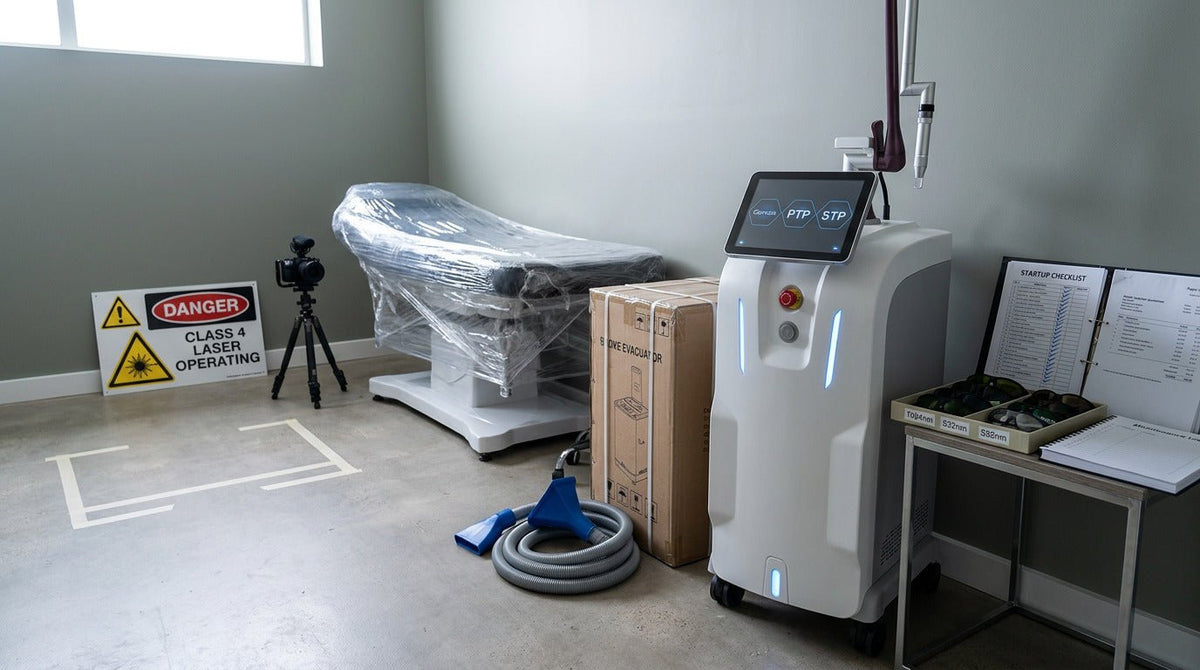
Tattoo Removal Clinic Startup Checklist: Laser, Cooling, Smoke Extraction, Eyewear and Training
Tattoo removal clinic startup equipment is a full system, not a single machine. Selection starts from the service menu and patient mix, then extends to room safety, cooling, plume management, photography, consent, training, maintenance, insurance and working capital. Operator qualification and premises licensing rules vary by jurisdiction. Compare the Q-Switched Nd:YAG tattoo removal machines against the intended service menu before pricing the full stack.
Tattoo Removal Startup Equipment Framework
The categories below cover every layer a new clinic must budget for — not just the laser.
STARTUP EQUIPMENT — WHAT TO BUY, WHAT TO VERIFY
|
STARTUP CATEGORY |
WHAT TO BUY / VERIFY |
WHY IT BELONGS IN THE LAUNCH BUDGET |
|
Tattoo-removal laser |
Wavelengths, pulse architecture, spots, output |
Core treatment platform |
|
Cooling |
Machine cooling and patient comfort strategy |
Thermal stability and workflow |
|
Laser eyewear |
Wavelength-rated protection |
Eye safety |
|
Room controls |
Door, signage, access, interlock as required |
Controlled laser area |
|
Plume extraction |
Local smoke evacuation where the procedure generates plume |
Staff and environment control |
|
Photography |
Camera, lighting, position marks |
Baseline and progress documentation |
|
Consultation |
Intake, consent, aftercare documents |
Clinical workflow |
|
Patch-test supplies |
Per protocol and regulatory requirement |
Risk assessment |
|
Training |
Device, laser safety, protocols |
Competency |
|
Maintenance |
Cleaning, calibration, service package |
Uptime |
|
Insurance |
Professional, business, equipment as applicable |
Risk management |
|
Working capital |
Repairs, marketing, consumables, downtime |
Business continuity |
Every category has to be present at opening. One missing layer can stop the clinic from operating regardless of the rest.
Start With Your Service Menu Before Choosing a Laser
Define the menu first — black or dark tattoos only, multicolor work, cosmetic tattoos and permanent makeup, or fading for cover-ups. Adding pigmentation treatments changes wavelength and mode requirements; adding skin rejuvenation changes the value of a multi-mode platform. Buy against the menu, not the other way round.
|
NARROW SERVICE MENU |
BROADER SERVICE MENU |
|
Simpler equipment decision |
More wavelengths or modes may matter |
|
Lower initial complexity |
More training required |
|
Easier startup workflow |
More room for cross-service use |
|
Can upgrade later |
Higher initial capital cost |
Q-Switched Nd:YAG vs Picosecond Laser for a Startup Clinic
Q-Switched Nd:YAG is the established tattoo-removal category — typically 1064/532 nm at nanosecond pulse widths, lower capital cost. Picosecond platforms use shorter pulses that can improve clearance on stubborn colours at higher capital cost. The pico vs Q-Switched tattoo removal machines guide covers the trade-offs; the picosecond laser machines collection is the upgrade path when the case mix justifies it.
|
Q-SWITCHED ND:YAG |
PICOSECOND |
|
Established tattoo-removal category |
Shorter-pulse category |
|
Often lower initial capital |
Often higher capital |
|
Common 1064/532 nm pairing |
Wavelengths vary by platform |
|
Good startup option where the menu fits |
Useful where case mix justifies the added capability |
|
Requires measured output verification |
Same — verify measured pulse-duration trace |
The FDA notes that tattoo colours absorb different wavelengths differently, so multicolour tattoos may require different laser wavelengths — the decision depends on the case mix, not on category alone.
1064 nm vs 532 nm: Build the Wavelength Plan Around the Menu
1064 nm is used for darker and deeper pigments and is generally more forgiving on darker skin types when specified correctly. 532 nm is used for warmer colours because of different absorption. Do not assume two wavelengths remove every tattoo colour — clearance depends on ink chemistry, layering, depth and patient factors.
|
DUAL-WAVELENGTH PLATFORM |
BROADER WAVELENGTH PLATFORM |
|
Covers core tattoo-removal work |
Expands colour options |
|
Lower complexity |
More attachments / modules |
|
Easier startup training |
More service and calibration variables |
|
May suit a focused startup |
May suit a specialist case mix |
X9 vs C16: Startup Platform Comparison

The X9 Q-Switched Nd:YAG laser page lists 532/1064 nm, 1–8 mm spots, approximately 6 ns pulse width, 1–10 Hz and air-plus-water cooling. The C16 laser system page lists 532/1064 nm, adjustable 2–10 mm spots, up to 10 Hz and closed-loop cooling. Treat the differences as questions to ask any shortlisted platform, not a ranking.
|
X9 QUESTIONS |
C16 QUESTIONS |
|
Does its Q-switched architecture match the planned menu? |
What exact pulse architecture does the purchased configuration use? |
|
Is 1–8 mm spot range sufficient for the clinic? |
Does 2–10 mm improve workflow for the intended cases? |
|
What maintenance schedule applies? |
What service and calibration evidence is supplied? |
|
What is replacement-parts cost? |
What is replacement-parts cost? |
The K7 Q-Switched Nd:YAG system page describes a multifunctional platform combining IPL and Q-Switched Nd:YAG — a different buying question, because a multi-function machine trades focus for versatility.
Laser Specification vs Supplier Evidence
A specification sheet lists wavelengths, pulse duration, energy, spots, Hz and cooling. Supplier evidence — serial-level output test, energy-stability report, beam profile, wavelength verification, cooling test and certification documents — proves the shipped machine matches the sheet. The LEFIS certifications and compliance page describes model-specific documentation available on request; insist on the same from any supplier.
Machine Cooling vs Patient Cooling
Two systems, both needed. Machine cooling — internal water loop, air cooling, radiator, fan, thermal sensor, flow protection — protects equipment stability. Patient cooling is a separate surface-cooling strategy per the clinical protocol and device instructions.
|
MACHINE COOLING |
PATIENT COOLING |
|
Protects equipment stability |
Supports patient comfort and skin management |
|
Internal engineering function |
Treatment-workflow function |
|
Monitor flow and temperature warnings |
Follow the clinical protocol |
|
Does not replace a skin-cooling plan |
Does not cool the laser internals |
The X9 currently lists combined air and water cooling — a working example of why a clinic still budgets separately for patient-side cooling and workflow, not just the machine's own thermal system.
Built-In Cooling vs Separate Cooling Equipment
If cooling is integrated, ask what it cools, what output it provides and what its continuous-duty limits are. If a standalone device is planned, budget for purchase, floor space, service, cleaning and consumables. Not every laser needs the same external setup.
Do Tattoo Removal Clinics Need Smoke or Plume Extraction?

Not every tattoo-removal pulse produces the same amount of visible plume, but laser procedures that thermally destroy or ablate tissue can produce airborne plume. NIOSH recommends local exhaust controls such as smoke evacuators for laser and electrosurgical smoke rather than relying on general room ventilation alone.
|
GENERAL ROOM VENTILATION |
LOCAL PLUME EXTRACTION |
|
Treats room air |
Captures near the source |
|
Important for room comfort |
Specific plume-control function |
|
Not source capture |
Source capture |
|
May already exist in the room |
May require a dedicated purchase |
Do not assume every non-ablative tattoo pulse requires a surgical smoke evacuator. Tie the requirement to procedure, risk assessment and local rules.
Smoke Evacuator vs Ordinary Room Suction
A purpose-built smoke evacuator uses high-efficiency filtration (HEPA at minimum, ULPA where available) with a dedicated capture nozzle at the source. Ordinary room suction does neither. Ask for filtration specification, hose and tubing, filter replacement schedule and cost, noise level at working suction, airflow and maintenance.
Laser Safety Eyewear: Wavelength Rating Matters More Than Lens Colour

Eyewear is selected from the wavelength, the optical density required by the laser risk assessment, direct-versus-reflected exposure and device-specific specifications — not from generic "laser glasses." Operator eyewear and patient eye protection are not interchangeable.
|
OPERATOR EYEWEAR |
PATIENT EYE PROTECTION |
|
Wavelength-specific |
Procedure and site-specific |
|
Must support clear work |
Must protect the patient appropriately |
|
Selected from the laser hazard assessment |
Selected for the treatment location |
|
Not based on lens colour alone |
Same |
One Pair of Goggles vs Multi-Wavelength Coverage
If the clinic operates 1064 nm, 532 nm or any additional wavelength, verify the eyewear specification covers every wavelength used. One lens does not automatically protect against every handpiece — ask for the OD marking per wavelength on every pair purchased.
Treatment Room vs Ordinary Beauty Room
A laser treatment room is a controlled area under most jurisdictions' safety rules. Three groups apply: controlled access (door, signage, access restriction, key control, emergency procedures); beam and reflection control (reflective surfaces, mirrors, windows, equipment placement); and electrical and environmental (power specification, grounded supply, ventilation, clearance, ambient). Actual requirements come from local regulation and the clinic's laser-safety risk assessment.
Laser Warning Sign vs Full Room-Control Plan
|
WARNING SIGN ONLY |
ROOM-CONTROL SYSTEM |
|
Communicates hazard |
Controls hazard |
|
Passive |
Includes procedures and access |
|
Necessary in many setups |
Broader safety framework |
|
Does not prevent entry |
Can restrict entry |
Consultation Photography vs Marketing Photography
Clinical baseline photography is a repeatable record — same camera, lighting, distance, angle, patient position, colour reference where useful. Marketing photography is a promotional image needing separate consent and privacy handling. One system does not serve both.
|
CLINICAL DOCUMENTATION |
MARKETING IMAGE |
|
Treatment record |
Promotion |
|
Consistency is the priority |
Presentation is the priority |
|
Patient record and privacy controls |
Separate usage permission |
|
Should be repeatable |
May be edited or cropped per policy |
Smartphone Photos vs Standardized Clinic Photography
A dedicated DSLR is not mandatory. What matters is repeatability, lighting, framing, secure storage, metadata and privacy. A well-controlled smartphone workflow can outperform an inconsistent DSLR workflow — the standard matters, not the sensor.
Intake Form vs Informed Consent
Intake and screening collects information relevant to treatment suitability — tattoo history, skin history, medications and medical issues per clinic protocol. Informed consent documents the patient's understanding of procedure, risks, alternatives, expected course, photography, aftercare and questions. One does not replace the other.
|
INTAKE |
CONSENT |
|
Collects information |
Documents informed decision |
|
Supports assessment |
Explains procedure and risk |
|
Updated as appropriate |
Signed according to policy |
|
Does not replace consent |
Does not replace screening |
Patch Test vs First Full Treatment
Not every patient in every jurisdiction is legally required to have a patch test. The requirement depends on device manual, clinic protocol, skin type, unusual pigment, cosmetic tattoo considerations, prior reactions and local rules. Where performed, document wavelength, spot, energy, pulse, location, immediate response and follow-up observation — the entry belongs in the treatment record.
Training Certificate vs Operator Competency
Training covers three areas: equipment (startup/shutdown, settings, wavelength selection, handpieces, cleaning, error handling); laser safety (eye hazards, controlled area, PPE, incident response, plume); and clinical (consultation, skin assessment, tattoo characteristics, endpoints, contraindications, documentation, aftercare).
|
TRAINING CERTIFICATE |
DEMONSTRATED COMPETENCY |
|
Shows course completion |
Shows ability to operate safely |
|
One-time document |
Needs ongoing maintenance |
|
May be supplier-specific |
Includes clinical judgment |
|
Useful record |
More important operationally |
Ask what training is included and what is available afterwards — the laser training and technical support page describes LEFIS's package as one example of a serious training and support programme.
Supplier Training vs Independent Qualification
Manufacturer training on a specific machine does not automatically satisfy a professional licence, medical-supervision rule, local laser credential or insurance requirement. Qualifications vary by jurisdiction — include a dedicated local compliance review before the equipment purchase, not after.
Daily Maintenance vs Professional Preventive Service
Operator checks cover accessible optics, handpiece, cable, cooling status, error log and external cleanliness. Professional service covers calibration, energy verification, internal optics, cooling and electrical diagnosis. Both belong in the schedule.
|
OPERATOR MAINTENANCE |
PROFESSIONAL SERVICE |
|
Frequent |
Scheduled or condition-based |
|
Accessible areas |
Internal systems |
|
Visual and function checks |
Instrumented testing |
|
Prevents avoidable problems |
Diagnoses drift and failure |
Warranty Length vs Service Response
A warranty defines what is covered — components, handpiece, shipping, labour, exclusions. Service response defines how quickly issues get addressed — remote diagnosis, response time, parts availability, onsite support, escalation. LEFIS advertises a two-year full-machine warranty, 24-hour response and lifetime parts and maintenance support, but the purchase contract should define exact model coverage in writing.
Regulation vs Supplier Certification
Device compliance and clinic/operator compliance are separate. Device documentation confirms model, intended market, certificate holder, applicable clearance or registration and validity. Clinic and operator authorisation covers who may operate, whether medical supervision is required, whether the premises needs licensing, whether a laser safety officer is required and whether inspections apply. See the LEFIS certifications and compliance page for device-level evidence, and check operator rules with the local regulator separately.
|
DEVICE COMPLIANCE |
CLINIC / OPERATOR COMPLIANCE |
|
Applies to equipment |
Applies to service delivery |
|
Supplier provides evidence |
Clinic verifies locally |
|
Does not license the operator |
Does not validate the machine |
|
Model and market specific |
Jurisdiction specific |
Professional Liability Insurance vs Equipment Insurance
Professional or clinical liability responds to treatment claims. Equipment or property cover responds to machine damage, theft, electrical events, fire and water. Business interruption cover — worth asking about separately — responds to downtime. Do not accept universal premium figures; policies depend on the exact device, procedure and practitioner credentials.
Laser Price vs Full Startup Budget
The laser is the largest single line, not the full budget. Group the numbers in three buckets and price each against local quotes.
Capital equipment: laser, cooling equipment if separate, smoke evacuation if required, photography, treatment furniture, eyewear, room modifications.
Compliance and professional: licensing, training, insurance, professional consultation, inspections.
Operating reserve: rent, staff, marketing, maintenance, spare parts, unexpected downtime.
STARTUP BUDGET WORKSHEET
|
BUDGET CATEGORY |
QUOTE / ESTIMATE |
|
Laser platform |
Enter |
|
Cooling |
Enter |
|
Smoke extraction |
Enter |
|
Safety eyewear |
Enter |
|
Room setup |
Enter |
|
Photography |
Enter |
|
Treatment furniture |
Enter |
|
Training |
Enter |
|
Licensing / compliance |
Enter |
|
Insurance |
Enter |
|
Maintenance / spares |
Enter |
|
Marketing |
Enter |
|
Working capital |
Enter |
|
Total startup requirement |
Calculate |
Functional worksheet — the clinic populates real values from local quotes before signing. "Enter" and "Calculate" are instructions to the buyer, not decorative placeholders.
Cheapest Laser vs Lowest Startup Risk
|
LOWEST MACHINE PRICE |
LOWER STARTUP RISK |
|
Focuses on purchase |
Includes training and support |
|
May exclude accessories |
Includes full room setup |
|
Service unknown |
Parts and service defined |
|
Compliance may be unclear |
Documentation verified |
|
Can create hidden costs |
Total cost of ownership considered |
What Equipment Should Be in the Treatment Room on Opening Day?

- Laser and approved handpieces or accessories
- Wavelength-rated operator eyewear and patient eye protection
- Cooling equipment where required, and plume evacuation where required
- Treatment bed or chair and operator stool
- Photography setup with fixed lighting and position marks
- Approved cleaning products, consumables and waste containers
- Emergency equipment required by local policy
- Printed or digital intake, consent, aftercare and maintenance log
What Should Be Ready Before the First Patient?
See the professional tattoo removal solutions page for context on equipment, training and clinical support as part of the investment decision. Equipment ownership is not operational readiness — the following must be in place before treating the first patient:
- Local regulatory review completed; insurance active; operator authorisation confirmed
- Device documentation filed; training completed; room safety controls installed
- Eyewear verified per wavelength; machine and patient cooling checked
- Machine acceptance test completed; photography workflow tested
- Intake, consent and aftercare documents ready; patch-test protocol defined
- Maintenance log opened; technical-support contact saved
Startup Equipment Package: What to Ask the Supplier to Quote Together
Request one itemised quote covering: laser machine, included wavelengths, handpieces, cooling accessories, protective eyewear, spare optical windows, maintenance kit, manuals, operator training, technical training, compliance pack, spare-parts list, warranty, shipping, installation and acceptance testing. A quote that lists only the machine price is not a startup quote — it is a component quote.
Tattoo Removal Clinic Startup Red Flags
- Choosing the laser before defining the service menu
- Buying generic "laser glasses" with no wavelength specification
- No room-safety plan or ventilation/plume assessment
- Supplier training treated as proof of legal qualification
- No local regulatory check or liability insurance quote
- No standardised photography and no consent workflow
- No maintenance budget, spare-parts pricing or factory acceptance report
- Support escalation process not documented
- Budgeting only for the laser and no working capital
Final Tattoo Removal Clinic Startup Checklist
- Define the service menu, target tattoo colours and patient mix.
- Choose Q-Switched, picosecond or another appropriate platform.
- Verify wavelengths, pulse architecture, pulse energy and spot sizes.
- Request factory output evidence for the shipped machine.
- Confirm machine cooling requirements and define patient cooling workflow.
- Assess plume and smoke extraction requirements.
- Buy wavelength-rated operator eyewear and appropriate patient eye protection.
- Establish controlled-room access, warning signage and manage reflective surfaces.
- Set up standardised photography and prepare intake, consent, patch-test and aftercare documents.
- Complete equipment training and required laser-safety training.
- Verify local operator qualifications, medical oversight and device regulatory documentation.
- Obtain professional liability and equipment or business insurance.
- Create a daily maintenance checklist and schedule preventive service.
- Get spare-parts pricing and budget for downtime.
- Complete factory or site acceptance testing and keep support contact details accessible.
- Open only after clinical, technical and regulatory readiness is complete.
Request a Tattoo-Removal Equipment Package and Startup Quotation
Opening a tattoo removal clinic requires more than buying a laser. Match the platform to service menu and wavelength needs; budget cooling, eyewear, room controls and plume management; build photography, consent and maintenance systems before launch; verify qualifications and local rules independently; include insurance and working capital.
Compare LEFIS Q-Switched Nd:YAG tattoo removal machines and picosecond laser machines, then use the training, warranty and after-sales support page to request the full startup equipment package quotation — machine, training, warranty, spare-parts terms, service SLA and compliance pack — for the specific service menu.
FAQs
What equipment do you need to start a tattoo removal clinic?
A laser matched to the service menu, machine and patient cooling, wavelength-rated eyewear, room controls, plume extraction where required, photography setup, intake and consent workflow, training, maintenance programme and insurance. The laser is the largest single item, not the full stack.
How do I choose a tattoo removal laser for a new clinic?
Start with the intended colours, skin types and case mix; then verify wavelengths, pulse architecture, measured energy, spot range, cooling and serial-level factory evidence for the exact machine. Do not select from brochure copy — insist on the shipped unit's test data.
Is Q-Switched Nd:YAG or picosecond better for a startup tattoo removal clinic?
Neither automatically. Q-Switched Nd:YAG is often the entry platform for clinics with a standard menu and lower capital budget; picosecond adds clearance on stubborn colours at higher capital cost. Match the platform to the case mix, not to marketing.
What laser safety eyewear does a tattoo removal clinic need?
Wavelength-rated eyewear for every installed wavelength, with clear OD markings and appropriate optical density from the laser risk assessment. Separate patient eye protection is required. Generic "laser glasses" without wavelength specification are not adequate.
Does a tattoo removal clinic need smoke extraction?
Not every non-ablative pulse produces significant plume, but NIOSH recommends local exhaust for laser smoke when procedures generate it. Base the decision on procedure, risk assessment and local rules — a dedicated HEPA/ULPA evacuator is standard where plume is generated.
What cooling equipment is needed for laser tattoo removal?
Two separate systems: machine cooling protects the laser source (water loop, air cooling, fan, thermal sensor, flow protection); patient cooling supports comfort and skin management per the clinical protocol. One does not replace the other.
What training or qualifications are required to perform laser tattoo removal?
Jurisdiction-dependent. Some markets restrict it to physicians, physician assistants or registered nurses; some allow certified laser technicians under medical direction; some require a laser safety officer. Confirm the rule with the local health regulator before advertising the service.
Do you need insurance to start a tattoo removal clinic?
Yes. Professional liability responds to treatment claims, equipment cover to machine damage or loss, and business interruption cover to downtime. Insurers should name the specific device, procedure and practitioner credentials — general policies that omit these may not respond in a claim.
How much does it cost to start a tattoo removal clinic?
No single figure — laser, room fit-out, cooling, plume, eyewear, training, insurance and working capital vary widely by jurisdiction and menu. Price each budget category against local quotes, not a generic "typical startup cost" from a competitor blog.
What should be included in a tattoo removal clinic startup package?
Machine, handpieces, cooling accessories, protective eyewear, spare optical windows, maintenance kit, manuals, operator and technical training, compliance pack, spare-parts list, warranty, shipping, installation and acceptance testing — as an itemised total, not a single line.
Sources
- Tattoo Removal: Options and Results · U.S. Food & Drug Administration
- Medical Lasers · U.S. Food & Drug Administration
- Control of Smoke From Laser/Electric Surgical Procedures · U.S. National Institute for Occupational Safety and Health
- Laser and Electrosurgery Smoke Hazards · U.S. Occupational Safety and Health Administration
- ANSI Z136.3 — Safe Use of Lasers in Health Care · Laser Institute of America
- IEC 60825-1 — Safety of Laser Products · International Electrotechnical Commission


Looking for something else?

Do Men Get Cellulite? Causes Differences & What to Know
LEARN MORE
Does Radio Frequency Skin Tightening Work? Results & How It Works
LEARN MORE
Do You Shave Before Laser Hair Removal? Prep Tips & Why It Matters
LEARN MORE
How to Get Rid of Age Spots: Treatments. Natural Remedies & Prevention
LEARN MORELooking for something else?
How to Heal Ingrown Hair: Causes. Treatments & Healing Time
LEARN MORE
How to Get Rid of Freckles: Effective Treatments & Natural Tips
LEARN MORE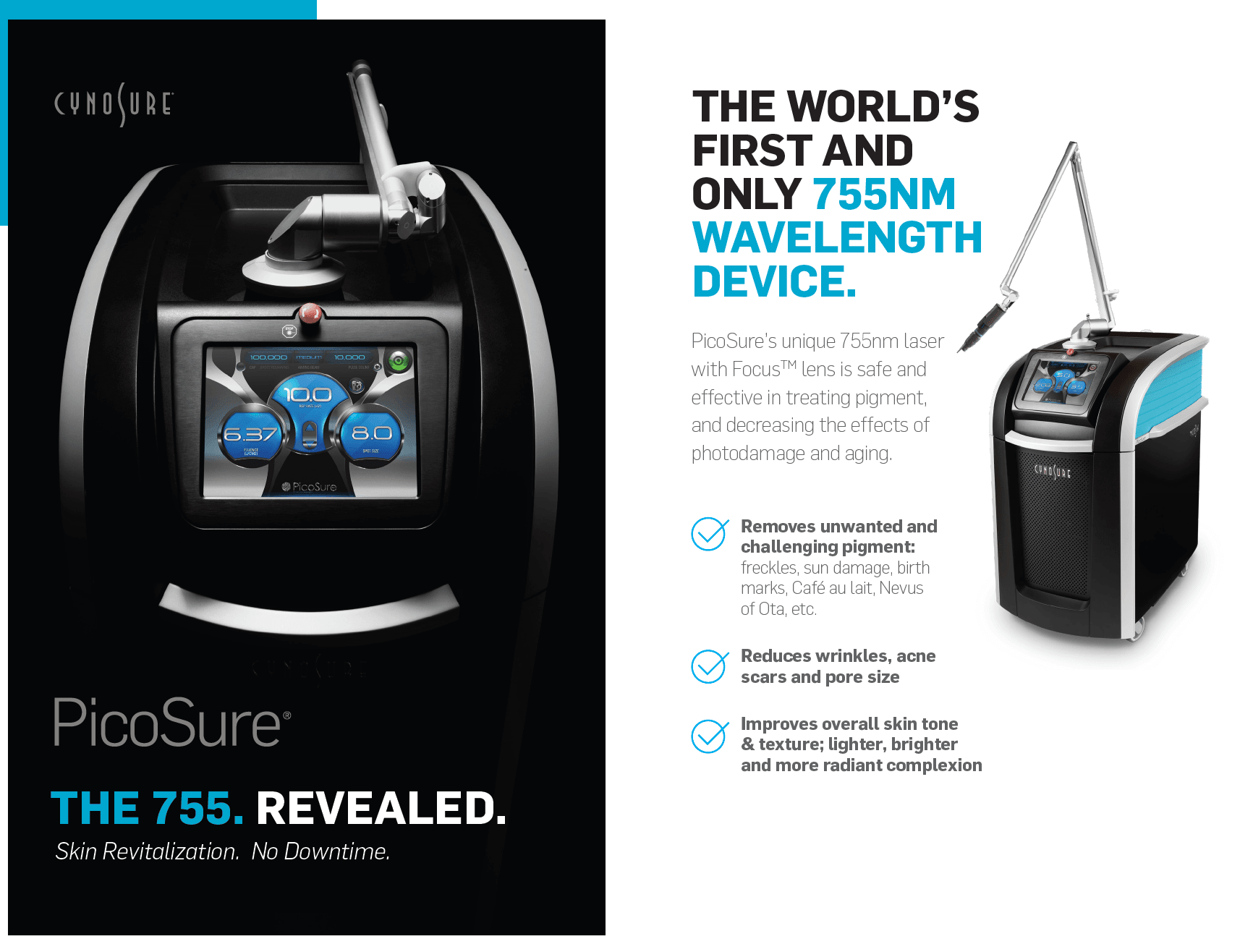
Top 10 Picosecond Laser Machine Manufacturers for Clinics in 2026
LEARN MOREYou may also like


Further reading

Tattoo Removal Laser Machine Cost and Ownership Guide

CO2 Laser Treatment Room Setup Checklist

Aesthetic Machine Factory Acceptance Test Before Shipment


