

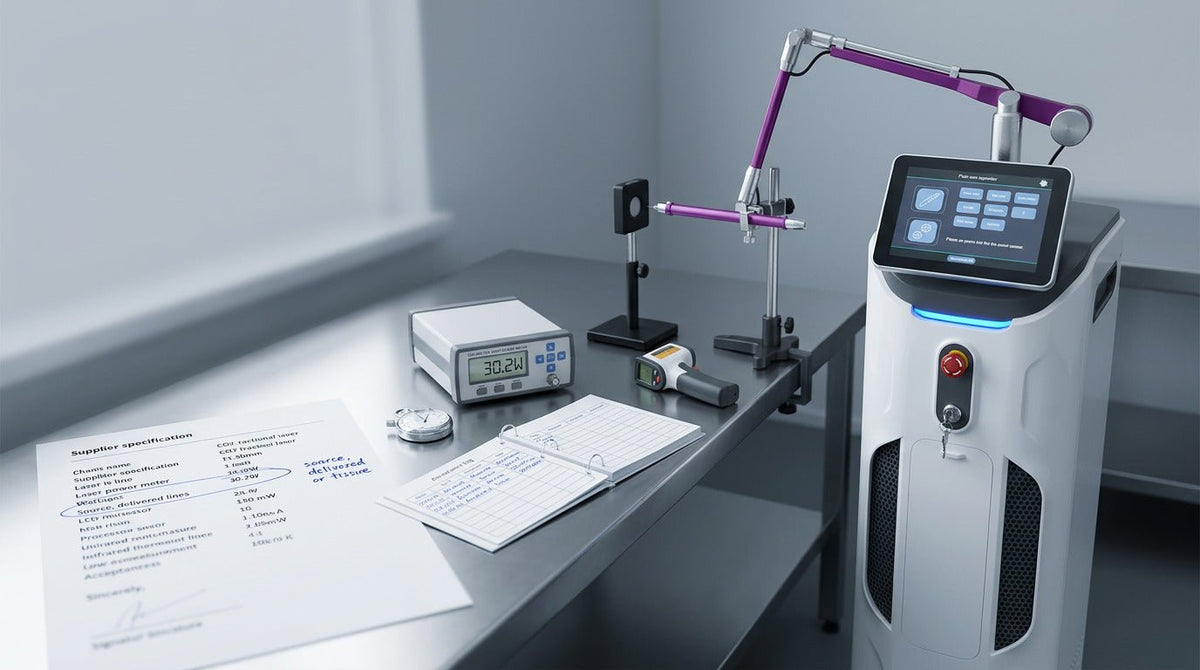
How to Choose CO2 Laser Tube Power and Lifespan for Your Clinic Workload
CO2 laser tube power and lifespan are the two specifications aesthetic-clinic buyers most often misread. Headline wattage is not proof the source will meet a busy fractional and surgical mix; a rated-hours figure with no operating conditions is not a service-life guarantee. Compare source architecture, usable output, duty cycle, thermal management and output stability against the clinic's actual workload — and treat replacement as a full service event, not a component swap.
Quick answer: How should a clinic buyer approach CO₂ tube power and lifespan?Match the source to workload rather than headline wattage. Confirm what the watt rating measures (source, delivered or tissue). Verify usable output — sustained, warm, at the operating mode. Get source-life specification in hours with defined test conditions and an end-of-life definition. Include replacement cost, calibration, freight and downtime in total-cost thinking. Any claim of "more watts is better" or "long-life tube" without measurement conditions is marketing, not procurement evidence. |
How to use this guide
This guide is for clinic owners, distributors and technical buyers evaluating CO2 fractional laser machines for aesthetic use. Every acceptance figure — wattage, hours, duty cycle, replacement cost — should come from the supplier's documented specification for the exact model on the quotation, not from a competitor's engraver or cutter blog.
CO₂ Tube Power and Lifespan: Quick Buyer Framework
Each buyer question below has evidence to verify and a reason it matters. Verification comes from the manufacturer's documented specification and the signed proposal.
QUICK BUYER CHECKLIST — TUBE POWER AND LIFESPAN
|
BUYER QUESTION |
WHAT TO VERIFY |
WHY IT MATTERS |
|
What type of CO₂ source is used? |
RF or other architecture and manufacturer |
Changes maintenance and replacement model |
|
What does the watt rating represent? |
Source, delivered or tissue output |
Prevents false comparisons |
|
Is output measured when warm? |
Power or energy stability report |
Shows sustained performance |
|
What operating modes are available? |
Fractional, UltraPulse, CW where applicable |
Determines workload fit |
|
How is the source cooled? |
Cooling architecture and duty limits |
Influences thermal stability |
|
What is the source-life specification? |
Hours, conditions, end-of-life definition |
Makes the lifespan claim meaningful |
|
What indicates the end of life? |
Measured output, beam or service criteria |
Supports planned replacement |
|
What does replacement cost? |
Source + labour + calibration + freight + downtime |
Determines total ownership cost |
Every verification answer should be in writing before payment. Any question returned as "we send that later" should be treated as a supplier red flag.
What Does "CO₂ Laser Tube Power" Actually Mean?

A watt figure without a measurement location is not a specification. Three distinct values get labelled the same way.
Source power = generated at the laser source, before delivery optics.
Delivered power = available after the articulated arm, mirrors and handpiece transmission.
Power at tissue = measured or specified at the treatment plane.
|
SOURCE POWER |
DELIVERED / TISSUE POWER |
|
Generated by the laser source |
Available after delivery optics |
|
Does not include optical loss |
Includes system transmission |
|
Useful for source comparison |
More relevant to treatment |
|
Must state measurement location |
Must state test conditions |
The D6 and D9 specifications illustrate why definitions matter: the D6 CO2 fractional laser page labels its specification "Laser Power 40W," while the D9 CO2 fractional laser page uses "Power to Tissue 40W." These should not automatically be treated as identical measurements without technical confirmation from the manufacturer.
Rated vs Maximum vs Usable Power
Three power figures should be separated in every quote.
Rated power = the manufacturer's design specification. Ask whether it is continuous or nominal, and at which operating mode.
Maximum or peak power = the highest advertised value. Ask for how long, at which mode, and under which repetition conditions.
Usable clinic output = output available while remaining within the approved operating range, thermal limits, treatment mode and stable-output specification. This is the number that matters for daily workload.
|
RATED POWER |
MAXIMUM CLAIM |
USABLE POWER |
|
Design specification |
Highest advertised value |
Practical operating range |
|
Should have test method |
May be short-duration |
Must remain stable |
|
Useful for comparison |
Easy to overvalue |
Most relevant to workload |
Power headroom — buying above the required limit — preserves flexibility for future treatments and stable performance without depending on the maximum setting. There is no universal headroom percentage worth publishing. The reserve a clinic needs comes from workload analysis and the source's duty rating.
RF-Excited CO₂ Source vs Glass DC Tube
Source architecture changes the maintenance model, replacement pathway, cooling requirements and clinic behaviour of the machine.
|
RF-EXCITED SOURCE |
GLASS DC TUBE |
|
Common in professional aesthetic platforms |
Common in lower-cost / industrial machines |
|
Often compact and sealed |
Glass resonator |
|
Different excitation architecture |
High-voltage DC excitation |
|
Service or refurbishment path varies |
Usually treated as a replaceable tube |
Buyer questions for either source: manufacturer and model, housing and construction, cooling method, modulation capability, serviceability and refurbishment pathway. The D6 page specifically identifies its CO₂ source as an RF laser tube with 40W output and air cooling — that architecture cue drives every downstream lifespan and service question. Do not compare lifespan across architectures by headline hours alone.
Fractional Workload vs Surgical or CW Workload
The same 40W rating behaves differently across treatment modes. A fractional-heavy clinic runs a pulsed and scanned workload where scanner performance, treatment density and pulse structure matter. A surgical or CW-heavy clinic runs longer continuous-output demand where sustained output and operating duration matter.
|
FRACTIONAL-HEAVY CLINIC |
SURGICAL / CW-HEAVY CLINIC |
|
Pulsed and scanned workload |
Longer continuous-output demand |
|
Scanner performance matters |
Sustained output matters |
|
Treatment volume drives duty |
Operating duration drives duty |
|
Peak or rated watt alone insufficient |
Peak or rated watt alone insufficient |
The D9 page explicitly lists UltraPulse, CW and fractional operating modes — which makes workload mix a real evaluation criterion when accepting the machine rather than a specification to skip past.
Clinic Workload vs Tube Wattage

There is no universal wattage for a low-volume, high-volume or multi-site clinic. Sizing runs from the treatment mix, not from the machine spec. A low-volume clinic evaluates sessions per day, mode mix and average operating time. A high-volume clinic adds back-to-back sessions, thermal recovery and service redundancy. Distributors add standardisation and service lead time.
CLINIC WORKLOAD WORKSHEET
|
INPUT |
CLINIC VALUE |
|
Treatments per day |
Enter |
|
Operating days per week |
Enter |
|
Fractional share of workload |
Enter |
|
CW or surgical share of workload |
Enter |
|
Average laser-on time per session |
Enter |
|
Back-to-back peak-hour count |
Enter |
|
Annual planned operating hours |
Calculate |
Functional worksheet — the clinic populates real values before comparing supplier quotes. "Enter" and "Calculate" are instructions to the buyer, not decorative placeholders.
Tube Wattage vs Treatment Energy
Watts and joules are different specifications and should never be compared as if interchangeable.
40W source rating ≠ 40J treatment pulse. Watts measure power; joules measure energy. Pulse duration determines energy delivered per pulse. Scanner and dwell parameters determine how fractional treatment distributes that energy across the treated area.
Any supplier who quotes energy where the specification calls for power — or the other way round — should be asked to restate the number against the correct definition.
Rated Lifespan vs Real Clinic Service Life
A published source-life figure is only meaningful with conditions attached — hours, operating power, duty cycle, ambient temperature, mode, and end-of-life definition. A rated figure without those conditions is a marketing number.
|
RATED LIFESPAN |
REAL SERVICE LIFE |
|
Laboratory or manufacturer claim |
Clinic experience |
|
Defined test assumptions |
Variable operating conditions |
|
Useful only with conditions |
Depends on workload |
|
Not a replacement date |
Better trended from measured output |
Real service life is affected by workload, temperature, source quality, optical transmission, maintenance, storage and usage pattern. Do not import competitor claims like "1,500–3,000 hours", "10,000 hours" or "50,000 hours" as universal CO₂ lifespans — these come from industrial engraver blogs and do not apply to clinical fractional systems.
Operating hours vs calendar age vs duty cycle
Operating-hour aging tracks active source use; calendar aging captures storage, seal integrity, gas or source architecture, and environmental exposure. Duty cycle sits on top of both — two clinics can log the same annual hours while imposing very different thermal loads. Ask which metric the lifespan claim uses: firing hours, total powered hours, pulses, calendar years, or another measure.
Cooling Capacity, Cold-Start and Warm-System Behaviour

Cooling architecture influences source lifespan directly. Ask: air or liquid cooling; thermal alarms; airflow requirements; operating-temperature limits; duty limits at the intended workload. Then check room requirements — ambient temperature, ventilation, clearance around vents. Both D6 and D9 list air cooling, which makes a sustained thermal test more informative than confirming a cooling method is present at all.
|
COLD-START TEST |
WARM-SYSTEM TEST |
|
Initial output |
Sustained output |
|
Low accumulated heat |
Clinic-like thermal load |
|
Can hide drift |
Can expose instability |
|
Necessary baseline |
Important workload test |
Run cold and warm tests with the same mode, output setting, delivery handpiece, measurement method and geometry — otherwise the comparison measures the test conditions instead of the machine.
Stable Output, Declining Output and Energy Stability
A single peak reading is weak evidence. Ask for multiple readings at low, mid and high operating points; a warm-system reading; the measurement instrument identity; and the agreed tolerance. Trend measured output, warm-vs-cold difference, beam quality, scan uniformity, error frequency and required setting changes — that trend is what tells the clinic when a source nears end of life, not an hours counter alone.
|
POWER RATING |
STABILITY EVIDENCE |
|
What the source should deliver |
Repeatability |
|
Static number |
Measured series |
|
Does not reveal drift |
Detects drift |
|
Useful procurement input |
Better acceptance evidence |
Output loss vs confirmed source failure
Before blaming the source, rule out dirty optics, articulated-arm misalignment, damaged lens or window, and scanner issues. The LEFIS CO2 laser calibration and maintenance guide identifies tube wear, dirty mirrors and temperature shifts as separate reasons measured output may change — treating them all as "the tube is dying" leads to unnecessary replacements.
|
OUTPUT LOSS |
CONFIRMED SOURCE FAILURE |
|
A symptom |
A diagnosis |
|
Can come from optics |
Source-specific evidence |
|
Requires troubleshooting first |
Supports replacement decision |
Warning Signs That a Source Is Nearing Replacement
Group signs by category rather than by count. Any one is a reason to investigate, not automatic proof of source failure.
- Verified measured-output decline against baseline
- Increasing warm-up drift over time
- Unstable output at previously stable settings
- Beam or scan inconsistency
- Repeated source-related errors in the log
- Inability to meet the documented output specification
Before ordering a replacement, rule out optics, delivery arm, scanner, calibration, power supply and cooling as separate failure modes with their own diagnostic paths.
Can a CO₂ Laser Source Be Recharged or Repaired?
The honest answer is architecture-specific and manufacturer-specific — not a universal yes or no. Ask: is the source sealed? Is factory refurbishment or reconditioning available for this specific model? Is the unit exchanged rather than repaired? Does third-party repair void coverage under warranty? Industrial glass tubes are sometimes regassed; clinical RF-excited sources follow a different service model — the manufacturer of the exact machine should confirm.
Replacement Cost, Downtime and Continuity
The source component price is only one line on a replacement invoice.
|
SOURCE COMPONENT PRICE |
TOTAL REPLACEMENT EVENT |
|
Component only |
Full clinic cost |
|
Easy to quote |
More useful for ROI |
|
Excludes downtime |
Includes service interruption |
|
May exclude calibration |
Includes recommissioning |
Total replacement cost adds labour, freight, import, calibration, optical alignment, testing and downtime. For distributors and busy clinics, continuity matters as much as component price — ask whether the replacement source is stocked, the lead time, whether remote and onsite service are available, whether a loaner policy exists, and whether the clinic can hold a spare. The fractional CO2 laser cost and ROI guide covers the ownership economics behind those trade-offs.
D6 vs D9: Compare the Workload Questions, Not Just the 40W

Both LEFIS platforms publish a 40W headline and both use air cooling — but that shared surface hides the questions a buyer should actually ask. This is a template for how to interrogate any 40W CO₂ system, LEFIS or otherwise.
D6 verification questions
The D6 CO2 fractional laser page lists an RF laser tube, 40W laser power, 10.57–10.63 μm wavelength range, Ultra Pulse and fractional modes, a 7-joint articulated arm and air cooling. Ask: who manufactures the RF source? How is source life defined? What warm-output stability is specified at the fractional mode? What is source replacement cost, including labour and calibration?
D9 verification questions
The D9 CO2 fractional laser page lists 40W "power to tissue," 10,600 nm, UltraPulse and CW operation, fractional modes, a 7-joint arm and air cooling. Ask: what source architecture sits behind the tissue specification? How does CW use affect the duty rating? What warm-output stability is specified across fractional and CW? What is source replacement cost?
Tube Specifications and Factory Evidence to Request
Request the following in writing before payment, on supplier letterhead, tied to the specific model on the quotation.
- Source architecture, manufacturer and model
- Rated optical output, and maximum output if different, with measurement location
- Wavelength, pulse/CW modes, duty-cycle limitations
- Cooling requirements, warm-up requirement, output-stability tolerance
- Rated service-life metric with end-of-life definition
- Source warranty; replacement source price; labour, calibration and freight cost; source lead time; refurbishment options
Factory test evidence
For each shipped machine, request a serial-number-linked output test with a calibrated meter and stated conditions; a warm-stability test comparing cold and sustained use; a beam and delivery test covering articulated-arm transmission, spot consistency and scan uniformity; and a signed QC or factory-acceptance report. This is the evidence the clinic uses to confirm the shipped unit matches the specification the quotation described.
CO₂ Laser Source Buying Red Flags
Any signal below is a reason to slow the procurement process and ask for written evidence.
- Wattage quoted with no measurement location
- Peak power presented as continuous output
- Lifespan hours without test conditions or end-of-life definition
- No source brand or model disclosed
- No warm-output data or duty-cycle information
- No replacement price, replacement lead time or post-replacement calibration procedure
- Industrial cutting-tube specifications reused as aesthetic-equipment claims
- "Lifetime tube" marketing without technical evidence
Final CO₂ Laser Tube Power and Lifespan Checklist
Before signing the purchase agreement, confirm the buyer has:
- defined clinic workload, separating fractional from CW/surgical use and identifying back-to-back peaks
- confirmed source architecture, manufacturer or model and what the watt rating actually measures
- distinguished rated, maximum and usable output for the intended workload
- requested warm-system output evidence and confirmed output stability
- verified cooling requirements and duty limits at the intended workload
- obtained the lifespan claim with hours, test conditions and end-of-life definition
- obtained source warranty, replacement source price, labour, calibration and freight
- confirmed replacement lead time and service escalation path
- requested serial-level factory test evidence for the shipped machine
- compared total ownership cost — not headline watts alone
Request Tube Specifications, Service-Life Evidence and Replacement Pricing
Highest wattage is not automatically best. Match source architecture and usable power to workload, separate fractional and continuous-use demands, treat every lifespan claim as conditional, verify cooling and warm-system stability, and budget replacement as a full service event.
Compare the LEFIS CO2 fractional laser machines and use the CO2 laser technical support page to request tube specifications, service-life evidence and replacement pricing for the exact model on the quotation. Confirm end-of-life definition, warm-system stability and replacement lead time in writing before payment.
FAQs
How long does a CO2 laser tube last in an aesthetic clinic?
There is no universal figure. Life depends on source architecture, workload, duty cycle, cooling, mode mix and operating temperature. Ask the manufacturer for its rated service-life metric with operating conditions attached and end-of-life definition. Real life is best judged from trended measured output.
How do you know when a CO2 laser tube needs replacement?
Verified measured-output decline against baseline, increasing warm-up drift, unstable output at previously stable settings, beam or scan inconsistency, and repeated source-related errors. Rule out dirty optics, arm misalignment, damaged windows, scanner faults, calibration and cooling first.
What is the difference between rated and usable CO2 laser power?
Rated power is the manufacturer's design specification. Usable power is what remains while the source stays within its approved operating range, thermal limits, treatment mode and stable-output specification. Two machines with the same rating can deliver very different usable output.
Is an RF CO2 laser tube different from a glass CO2 tube?
Yes. RF-excited sources — common in professional aesthetic platforms — use a different excitation architecture, service model and cooling requirement than glass DC tubes used in many industrial engraving machines. Do not carry lifespan or service assumptions from one architecture to the other.
Does running a CO2 laser at higher power shorten its lifespan?
Sustained operation near rated maximum, combined with insufficient cooling or aggressive duty cycles, is associated with faster degradation. The exact relationship is defined by the source manufacturer and the machine's duty rating. Verify the acceptable operating band for the exact model.
How does clinic workload affect CO2 laser tube life?
Two clinics with identical annual hours can see very different service life if one runs distributed sessions with recovery periods and the other runs back-to-back blocks. Thermal load, mode mix and peak concentration all matter — not annual hours in isolation.
Can a CO2 laser tube be repaired or recharged?
Architecture-specific and manufacturer-specific — not a universal yes or no. Some sealed sources are exchanged rather than repaired; some are factory-refurbishable; some third-party repairs void warranty. Ask the manufacturer of the exact model on the quotation.
How should CO2 laser output be tested before replacing the tube?
Measure output at the treatment plane with a calibrated meter at defined operating conditions; compare against baseline; repeat cold and warm; check optics, delivery arm, scanner and calibration before concluding the source is the fault. One reading is not sufficient evidence for replacement.
How much does it cost to replace a CO2 laser source?
A meaningful cost includes source component price, labour, calibration, optical alignment, testing, freight and downtime — not just the source line. Ask the supplier to quote each element separately for the exact model, and treat the total as an ROI input.
What tube specifications should a clinic request before buying a CO2 laser?
Source architecture, manufacturer and model; rated and maximum output with measurement location; wavelength, modes and duty limits; cooling and warm-up requirements; output-stability tolerance; service-life metric with end-of-life definition; source warranty; replacement source price with labour, calibration and freight; and lead time.
Sources
- Laser Products and Instruments · U.S. Food & Drug Administration
- Performance Standards for Light-Emitting Products (21 CFR 1040.10) · U.S. Food & Drug Administration
- IEC 60825-1 — Safety of Laser Products · International Electrotechnical Commission
- ISO 13485 — Medical Devices Quality Management Systems · International Organization for Standardization
- CO₂ Lasers and Delivery Systems — Technical Documentation · Coherent Corp.
- Physical Measurement Laboratory — Optical Radiation · U.S. National Institute of Standards and Technology


Looking for something else?

Do Men Get Cellulite? Causes Differences & What to Know
LEARN MORE
Does Radio Frequency Skin Tightening Work? Results & How It Works
LEARN MORE
Do You Shave Before Laser Hair Removal? Prep Tips & Why It Matters
LEARN MORE
How to Get Rid of Age Spots: Treatments. Natural Remedies & Prevention
LEARN MORELooking for something else?
How to Heal Ingrown Hair: Causes. Treatments & Healing Time
LEARN MORE
How to Get Rid of Freckles: Effective Treatments & Natural Tips
LEARN MORE
Top 10 Picosecond Laser Machine Manufacturers for Clinics in 2026
LEARN MOREYou may also like


Further reading

Tattoo Removal Laser Machine Cost and Ownership Guide

CO2 Laser Treatment Room Setup Checklist

Aesthetic Machine Factory Acceptance Test Before Shipment


