

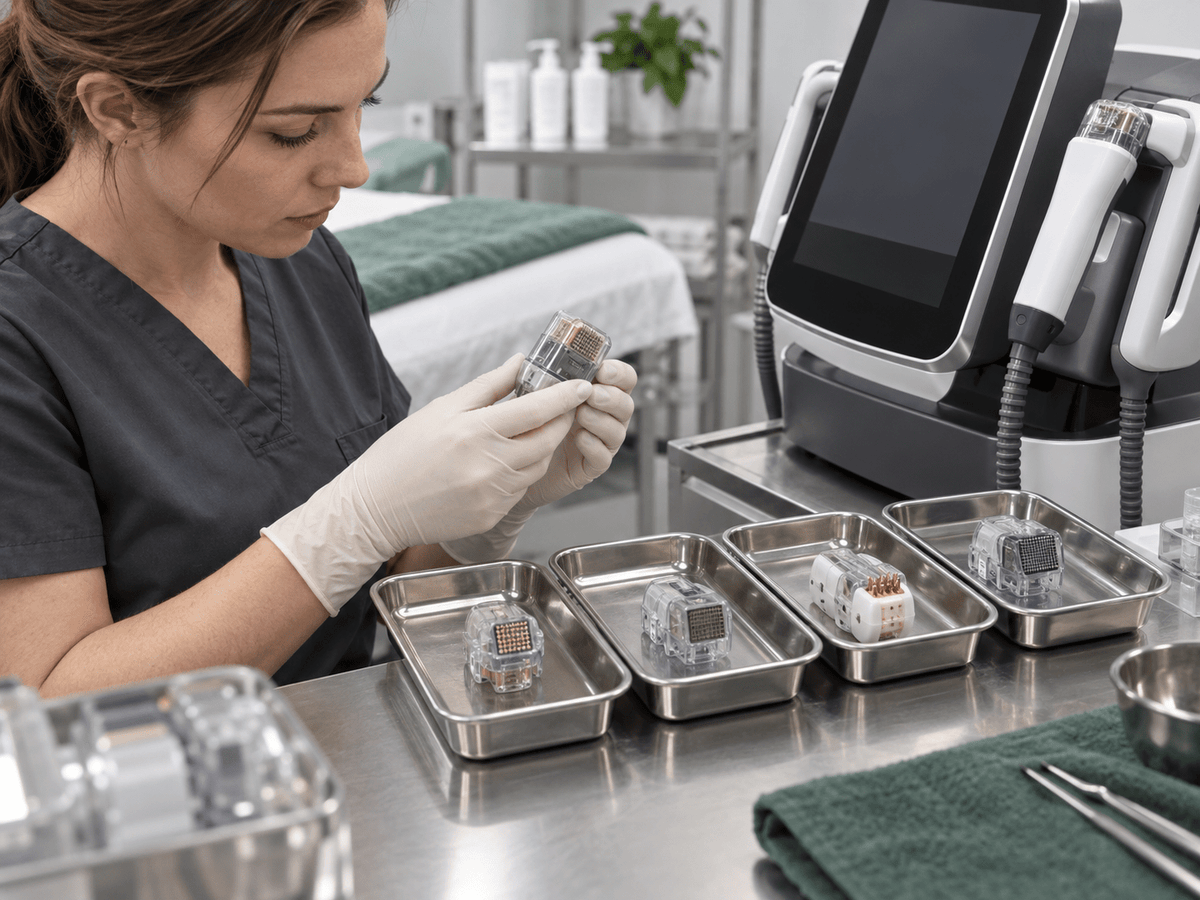
RF Microneedling Cartridge Guide for Clinics
An RF microneedling cartridge is a small component with a large effect on clinical workflow. It determines the needle array presented to the skin, must connect correctly with the handpiece and often represents the main disposable cost of each treatment. A low machine price can become expensive if cartridges are costly, difficult to source or poorly controlled.
Buyers should compare cartridges as part of the device system, not as generic tips. The safest choice is the cartridge specified in the device instructions, supplied in intact packaging and used according to the authorized labeling and local requirements.
Quick Answer
Choose an RF microneedling platform only after confirming that its cartridges are compatible, traceable, sterile where required, consistently available and economical for the planned treatment mix. The lowest cartridge price is not automatically the lowest operating cost. Misfires, damaged packaging, limited configurations or delayed replenishment can cancel appointments and lock the clinic into an unreliable supply chain.
- Best for: Clinics comparing RF microneedling platforms and recurring consumable costs.
- Verify first: Cartridge identity, needle configuration, packaging integrity, batch traceability and local stock.
- Decision standard: Buy only when quality evidence and the replenishment plan support the clinic's treatment calendar.
Treat the cartridge as part of the machine, not an accessory
The cartridge determines the needle array presented to the skin, the electrical connection to the handpiece and, in many systems, the main disposable cost of each treatment. It should therefore be evaluated as part of the complete device rather than as a generic tip. A cartridge that looks similar or physically fits may still differ in pin geometry, insulation pattern, depth control, material, packaging, recognition method or authorized use.
Ask the supplier for a model-specific compatibility list that names the handpiece, cartridge codes, needle or electrode counts, supported depth range, insulation format, intended applications and software requirements. The instructions supplied with the machine should agree with that list. If the system uses electronic recognition, confirm what happens when a cartridge is incorrectly seated, unsupported, previously used or expired. The safest workflow makes an incorrect choice difficult to overlook and gives the operator a clear response when recognition fails.
Sterility and single-use status are purchasing specifications, not details to review after delivery. Request the packaging configuration, stated shelf life, storage conditions, lot and expiry marking, sterilization information where applicable, and the instructions governing reuse or disposal. The FDA advises that a new cartridge should be used for each patient and treatment session when required by the device labeling. [2] Build this requirement into staff training, inventory control and treatment costing from the beginning.
Figure 1. Cartridge format, packaging and compatibility should be reviewed with the handpiece as one system.
Why cartridge selection deserves its own review
RF microneedling places electrodes into or under the skin and delivers radiofrequency energy through them. In October 2025, the FDA issued a safety communication after reports of serious complications with certain uses, including burns, scarring, fat loss, disfigurement and nerve damage. The agency advises patients to seek trained licensed providers and reminds providers to report problems. [1]
This makes procurement discipline especially important. A buyer should review the complete system: machine, handpiece, cartridge, software, instructions, training and service. A cartridge that physically fits is not automatically an approved or safe substitute.
Compare the cartridge specification
|
Item |
Why it matters |
What to request |
|
Needle or electrode count |
Affects the treatment pattern and device protocol |
Available formats and intended applications |
|
Needle depth range |
Must match device design and approved protocol |
Displayed depth, tolerance and verification method |
|
Insulation format |
Changes where energy is intended to be delivered |
Device-specific explanation; no universal “best” claim |
|
Pin material and finish |
Relates to consistency and skin contact |
Material declaration and quality controls |
|
Connector and recognition |
Prevents loose contact or wrong-tip use |
Compatibility list and machine detection behavior |
|
Packaging and sterility |
Supports infection-control workflow |
Sterility status, lot, expiry and package integrity |
|
Single-use status |
Defines reuse and disposal |
Clear IFU statement and staff procedure |
|
Supply continuity |
Controls appointment and margin risk |
Lead time, minimum order and shelf life |
Insulated and non-insulated designs are often marketed as if one is always superior. That is not a responsible comparison. The relevant question is whether the cartridge design, device output and labeled protocol are appropriate for the intended procedure and operator. Ask the supplier to explain the system in writing and provide the instructions for use before purchase.

Figure 4. Compare cartridge connectors and handpiece compatibility before approving a consumable format.
Treat every cartridge as a traceable disposable
The FDA states that reusing a needle cartridge is unsafe and is not consistent with the agency’s review and authorization, even if the cartridge is cleaned. Clinics should use a new cartridge for each patient and treatment session when required by the device labeling. [2]
- Check that the pouch is sealed and undamaged before use.
- Record the cartridge lot and expiry when your local policy or device instructions require it.
- Do not use cartridges with bent pins, damaged packaging or an uncertain storage history.
- Do not improvise cleaning or resterilization methods for a single-use product.
- Keep opened and unused cartridges separate from sealed inventory.
- Use the disposal route required for sharps and contaminated clinical waste.
Build a consumables model that survives normal waste and lead time
The invoice price of a cartridge is only the starting point. Calculate the landed cost after freight, duty, handling, payment charges and any minimum-order requirement. Then include expected losses from damaged pouches, expiry, obsolete formats, training use and stock held for emergencies. Divide that total by completed treatments, not by the number of cartridges originally ordered. This produces a more honest cost per treatment and exposes the commercial effect of poor inventory control.
Forecast each cartridge format separately. Average monthly demand can hide a shortage when one depth, pin count or treatment area is used much more often than the others. A practical reorder point combines normal weekly use, supplier production time, transport time, customs variability and a modest safety allowance. Clinics should also know whether urgent stock can be supplied locally, shipped by air or transferred from a regional distributor, and whether replacement supply will still be available in the second and third year of ownership.
Do not accept a large free starter pack as a substitute for a long-term supply plan. Ask for current replenishment prices, price validity, minimum order, lead time, carton quantity, storage limits and product-change policy in writing. If a cartridge design is revised, the supplier should explain compatibility with installed handpieces, how old stock will be handled and whether software or training must change. These points protect appointment capacity as well as treatment margin.
Figure 2. Inventory should be controlled by cartridge format, lot, expiry and expected weekly use.
Calculate the real cartridge cost per treatment
Start with the delivered cartridge cost, not only the factory unit price. Include freight, duties, local taxes, damaged or expired stock and any minimum-order effect. Then divide the usable inventory cost by the number of completed treatments.
A practical formula is: cartridge cost per completed treatment = total landed cartridge spend ÷ completed treatments supported by that shipment. Track this figure monthly. It captures losses that a simple price-per-tip calculation misses.
|
Cost element |
Include |
Buyer question |
|
Unit price |
Cartridge and required adapter |
Is pricing fixed by volume tier? |
|
Logistics |
Freight, duties and handling |
Can cartridges ship with the machine and later by air? |
|
Inventory loss |
Expiry, damaged pouches and obsolete formats |
What is the shelf life and change-control policy? |
|
Clinical use |
One new cartridge per treatment as labeled |
Which treatments use each format? |
|
Downtime risk |
Lost appointments when stock is unavailable |
Is emergency stock available locally or from the factory? |

Figure 5. Landed consumable cost and normal waste determine the real cartridge cost per completed treatment.
Set a reorder point that reflects clinic demand
Use recent treatment volume, supplier lead time and a modest safety stock rather than guessing. A simple reorder point is average cartridges used during the replenishment lead time plus safety stock. Review it whenever appointment volume, shipping route or cartridge mix changes.
For a clinic using several cartridge formats, keep separate counts. A high total inventory number can hide a shortage in the depth or format used most often. Record sealed quantity, expiry, average weekly use, open orders and the next expected delivery.

Figure 6. Set reorder points by cartridge type, lead time and safety stock rather than total inventory.
Questions to ask before choosing the machine
- Which cartridge models are authorized and supported for this exact handpiece?
- Are cartridges single use, sterile and individually packaged?
- What are the needle count, depth range, insulation format and intended applications?
- How does the machine confirm correct insertion or cartridge recognition?
- What is the delivered price at our normal order volume?
- What are the minimum order, lead time, shelf life and storage conditions?
- How are cartridge changes communicated to existing customers?
- What training covers insertion, disposal, error handling and adverse-event reporting?
Verify cartridge quality before committing to a platform
A pre-purchase sample should be used to evaluate more than appearance. Inspect whether the pouch is sealed and undamaged, whether lot and expiry information is clear, whether the cartridge seats smoothly, and whether the handpiece recognizes it consistently. Compare several cartridges from the same lot and, where possible, from more than one lot. Repeated insertion should not require force, improvisation or pressure on the connector.
Ask the manufacturer which incoming and final inspections control pin alignment, material, insulation, connector dimensions, package integrity and identification. The buyer does not need confidential production formulas, but should receive enough information to understand that the product is controlled by specification and traceable by lot. When a defect is reported, the supplier should be able to identify affected stock, request the necessary evidence and explain replacement or field-action procedures.
Finally, observe how the supplier handles a deliberately realistic question, such as a cartridge that is not recognized or a pouch found damaged before use. A useful answer should tell the operator to stop, quarantine the item, record the lot and machine details, photograph the condition and contact the defined support channel. Vague advice to clean, bend, reopen or reuse a questionable single-use cartridge is a serious warning sign.
Figure 3. Connector geometry and package integrity should be checked before routine purchasing begins.
Avoid three common buying mistakes
Choosing by pin count alone
A larger number is not proof of better outcomes. Device output, electrode geometry, depth control, protocol, intended use and operator training work together.
Accepting third-party compatibility without documentation
A cartridge that attaches to the handpiece may still differ in materials, tolerances, electrical characteristics or sterility controls. Ask who manufactures it and whether its use is supported by the device documentation.
Ignoring the second-year supply plan
Confirm prices and lead times for routine replenishment, not only the free starter pack. A reliable cartridge supply is part of machine uptime.
Run a receiving inspection for every cartridge batch
Do not move a new shipment directly from the carton to the treatment room. Check the outer carton, inner packaging, SKU, lot number, expiry date, quantity and visible damage against the purchase record. Separate any pack with a broken seal, unreadable code, moisture, deformation or contamination concern. Photograph the issue before opening more stock from the same lot.
Test recognition and fit using the clinic's approved process before the batch is released for routine use. The check should confirm that the cartridge seats normally, is identified correctly by the system and does not require pressure, bending or improvised adjustment. Record the machine model and serial number used for the check. A short receiving record provides useful evidence if a later failure affects more than one cartridge.

Figure 7. Batch traceability should connect receiving records, released stock and the treatment record.
Measure consumption by treatment mix, not total appointments
One monthly cartridge total can hide the formats that actually create stock risk. Track usage by SKU, treatment area, provider and week. Separate completed treatments from damaged packs, recognition failures, training use and expired inventory. This shows whether higher consumption comes from demand, poor handling, protocol changes or a quality problem.
Use the data to set a reorder point for each format. A practical calculation is average weekly use multiplied by replenishment lead time, plus a safety quantity for shipping variation and demand peaks. Review the result when the service menu, appointment volume or supplier lead time changes. The aim is not to hold the most stock; it is to avoid cancellations without allowing slow-moving cartridges to expire.
Agree the replacement and complaint process before launch
The purchase terms should explain what evidence is needed when a cartridge is damaged, rejected by the machine or does not perform normally. Confirm whether the supplier needs the lot number, package photographs, error code, video, unused sample or return of the affected item. Staff should know how to quarantine stock from the same lot while the issue is reviewed.
Also define the commercial response. Ask how credits or replacements are approved, who pays freight, whether emergency stock can be dispatched and how repeated failures are escalated. A low unit price is not attractive when the clinic must cancel appointments while a complaint waits for the next routine shipment. Test the support channel with a realistic question before committing to a platform.
Protect the treatment calendar from supply interruption
Ask how the supplier handles factory holidays, freight disruption, discontinued cartridge formats and sudden demand. Confirm minimum order, normal production lead time, regional stock and the notice period for a packaging, connector or SKU change. A clinic should not discover a format transition after its final compatible stock has been used.
Set a response for each disruption. That may include increasing safety stock temporarily, reserving a production quantity or moving future appointments away from a constrained format. Do not buy an unverified substitute simply because it fits the handpiece. Supply continuity still depends on documented compatibility, intact packaging and the same quality controls used for routine orders.
Turn Cartridge Planning Into Two Working Records
A cartridge guide becomes operational only when the clinic can inspect each delivery and predict when to reorder. These two records connect purchasing, treatment-room use and traceability without relying on memory.
Cartridge Receiving Inspection Log
Complete the log before a new batch is released to treatment rooms. The check should use the exact cartridge reference and the supplier's documented storage and handling requirements.
|
Check |
Pass condition |
Action if failed |
|
Identity |
Part number, pin format and compatible machine match the purchase order. |
Quarantine the batch and confirm compatibility in writing. |
|
Barrier and expiry |
Packaging is sealed, dry and undamaged; lot and expiry are readable. |
Isolate damaged or short-dated stock and photograph the issue. |
|
Fit and recognition |
A sampled cartridge seats securely and the machine recognizes it as intended. |
Stop the check; record the machine, cartridge lot and error shown. |
|
Functional sample |
Needle movement, displayed depth and device response are consistent with the approved protocol. |
Do not release the batch until the cause and replacement route are agreed. |
|
Traceability release |
Quantity, lot, expiry, inspection result and storage location are recorded. |
Keep stock on hold until the receiving record is complete. |
A failed sample does not automatically condemn an entire shipment, but it should stop routine release. Record the affected lot, isolate the stock and agree the investigation or replacement route before more units are used.
Reorder Planning Worksheet
Update the inputs by cartridge type because demand, lead time and expiry exposure may differ. Use actual clinic consumption once enough treatment history is available.
|
Input |
How to use it |
Decision controlled |
|
Monthly treatments |
Use a rolling average for each cartridge type, adjusted for booked growth. |
Expected demand during replenishment. |
|
Use per treatment |
Include planned cartridges plus normal setup loss, damage and failed starts. |
Real consumption rather than ideal consumption. |
|
Usable stock |
Count only released, compatible stock that will remain in date. |
Whether current inventory can cover the lead-time window. |
|
Replenishment lead time |
Use the supplier's realistic production, shipping and customs time. |
When the purchase order must be placed. |
|
Safety allowance |
Set a documented buffer for demand variation and delivery delay. |
How much stock remains protected from routine use. |
The reorder point should be reviewed whenever the treatment mix, supplier lead time or minimum order changes. This keeps safety stock large enough to protect appointments without creating avoidable expiry waste.
Plan the next step with LEFIS Laser
Review the available RF microneedling machines and send us your treatment menu, expected monthly volume and destination market. We can discuss the supported cartridge formats, training, replacement supply and quotation. For service terms, visit Training Warranty and After-Sales Support or contact LEFIS Laser.
FAQs
Can an RF microneedling cartridge be reused after sterilization?
Short answer: A cartridge labeled for single use should not be reused, even if a clinic believes it can be cleaned or sterilized.
What to check: The internal path, needle assembly, insulation and connector may not be validated for reprocessing, and damage can be difficult to see. Reuse also weakens traceability because the clinic can no longer link one sealed cartridge and batch to one treatment. Follow the manufacturer's instructions for use and local infection-control rules, and dispose of used cartridges as required for sharps or contaminated waste.
Buyer action: open the cartridge in front of the patient, record the lot number when appropriate, and include one new cartridge in the treatment price so staff never feel pressure to reuse a consumable.
Keep on file: Keep the device IFU, single-use statement, cartridge lot and expiry, staff procedure and any complaint or incident record linked to that batch.
Are insulated needles always better?
Short answer: No. Insulated and non-insulated needles deliver energy differently, so the better option depends on the treatment objective, approved protocol, skin condition and device design.
What to check: Insulated needles concentrate energy near the exposed tip, while non-insulated needles can distribute energy along more of the inserted shaft. Neither format should be selected from a marketing claim alone. The machine, cartridge and software must be compatible, and operators need training on depth, energy, passes and endpoint recognition. Review the available RF microneedling systems and confirm which cartridge types are supported for the intended protocols.
Buyer action: ask the supplier for a treatment matrix that connects cartridge type, needle count and depth range to each supported indication, then test staff understanding during training.
Keep on file: Retain the device-specific explanation of needle design, intended treatment areas, supported depth and energy settings, material information and operator training record.
How much safety stock should a clinic keep?
Short answer: There is no universal number; safety stock should cover expected consumption during the supplier's true replenishment lead time plus a reasonable disruption buffer.
What to check: Calculate average weekly treatments by cartridge type, multiply by weeks of lead time, then add stock for demand variation, customs delays and occasional damaged packs. Fast-moving cartridges usually need a larger buffer than specialized formats. Also consider expiry dates and storage limits, because excessive inventory can create waste.
Buyer action: set a reorder point for each cartridge SKU using recent treatment data, review it monthly, and keep a small emergency reserve physically separated from normal stock so it is not consumed without approval.
Keep on file: File the demand calculation, supplier lead time, minimum order, shelf life, current usable stock and the approved reorder threshold for each cartridge type.
What should a buyer confirm about cartridge sterility?
Short answer: Confirm whether the cartridge is supplied sterile, the sterilization method, shelf life, packaging integrity requirements and the lot or batch information available for traceability.
What to check: The label and instructions should explain storage conditions and what to do if a pouch is wet, torn, opened or expired. Buyers should also verify that the cartridge is intended for the exact machine and handpiece version, because a connector that appears to fit may still create performance or safety problems. LEFIS Laser's after-sales and technical support resources are useful when confirming compatibility or reporting a questionable batch.
Buyer action: add pouch condition, expiry date, SKU and lot number to receiving inspection, then quarantine any shipment with damaged packaging until the supplier provides a documented disposition.
Keep on file: Keep the sterilization method and status, applicable quality evidence, lot and expiry data, package-integrity check and the supplier's quarantine and complaint procedure.
How should a clinic choose the needle depth range?
Short answer: Choose depth according to the treated area, tissue characteristics, intended endpoint, device instructions and the operator's authorized protocol, not simply the deepest setting available.
What to check: Areas with thinner tissue require different planning from thicker facial or body areas, and energy delivery changes the clinical effect alongside depth. A cartridge's maximum depth therefore says little about whether it suits the clinic's actual service menu. Training should cover depth selection, energy, pulse delivery, pass count, overlap and exclusion zones as one system.
Buyer action: build a clinic-approved protocol sheet for every treatment area and cartridge type, require supervised competency before independent use, and record any protocol changes rather than allowing operators to improvise from memory.
Keep on file: Retain the labeled depth range, treatment-area protocol, training record and demonstration evidence showing that displayed depth and cartridge movement match the intended workflow.
How is cartridge cost per treatment calculated?
Short answer: Start with the delivered cost of one cartridge, including freight, duties, handling and expected wastage, then divide by the number of treatments it can legitimately serve.
What to check: For a single-use cartridge, that number is normally one. Add any treatment-specific consumables, preparation materials and disposal cost to understand the full variable cost. Do not use advertised shot life to justify reuse when the instructions specify single use. Clinics should also account for expired stock, damaged packaging and emergency freight, because these can materially raise the real average.
Buyer action: track cartridges issued, treatments completed and units discarded by SKU each month; a widening gap often reveals booking errors, stock loss or inconsistent operating practice.
Keep on file: Keep the landed unit cost, cartridges used per completed treatment, normal waste and failed starts, freight, duties and any adapter or minimum-order cost.
Which cartridge details should be recorded for traceability?
Short answer: Record enough information to connect the supplier, received stock and patient treatment when a complaint or recall occurs.
What to check: Useful fields include device model, handpiece version, cartridge SKU, needle type and count, depth range, lot or batch number, expiry date, quantity received, receiving date and disposition. At treatment level, follow local privacy and recordkeeping rules while preserving the cartridge identifier and operator information. If compatibility or labeling is unclear, contact the LEFIS Laser team before use rather than relying on appearance alone.
Buyer action: print or scan the package identifier into the stock and treatment record, and test the retrieval process quarterly so the clinic can identify affected units quickly without searching through loose invoices.
Keep on file: Record SKU, lot, expiry, receiving result, storage location, machine reference, operator or treatment record link and disposal or complaint status.
Sources
- FDA — Potential Risks with Certain Uses of Radiofrequency Microneedling
- FDA — Microneedling Devices
- FDA — Aesthetic Cosmetic Devices
- ISO — ISO 13485 Medical Devices Quality Management Systems


Looking for something else?

Do Men Get Cellulite? Causes Differences & What to Know
LEARN MORE
Does Radio Frequency Skin Tightening Work? Results & How It Works
LEARN MORE
Do You Shave Before Laser Hair Removal? Prep Tips & Why It Matters
LEARN MORE
How to Get Rid of Age Spots: Treatments. Natural Remedies & Prevention
LEARN MORELooking for something else?
How to Heal Ingrown Hair: Causes. Treatments & Healing Time
LEARN MORE
How to Get Rid of Freckles: Effective Treatments & Natural Tips
LEARN MORE
Top 10 Picosecond Laser Machine Manufacturers for Clinics in 2026
LEARN MOREYou may also like


Further reading

Tattoo Removal Laser Machine Cost and Ownership Guide

CO2 Laser Treatment Room Setup Checklist

Aesthetic Machine Factory Acceptance Test Before Shipment


