

Laser Device Purchasing Guide for Clinics: 25 Questions to Ask Before Ordering
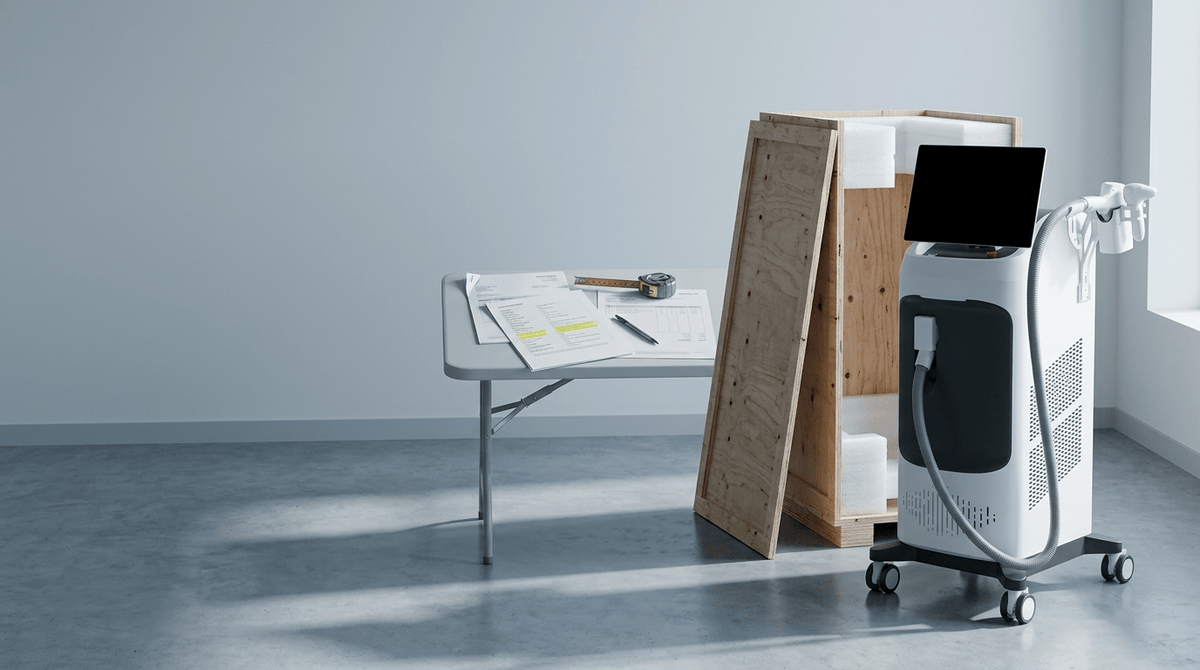
In early 2024, a Nairobi clinic purchased a $32,000 Q-switched Nd:YAG laser following a demonstration at a trade-show. The order sheet indicated that it would deliver dual 1064 nm and 532 nm output, 6 ns pulse width, spot size adjustable from 6 to 8 mm and sapphire contact cooling. The equipment that was received 4 weeks later was equipped with a fixed pulse of 8 ns, one 6 mm spot, and air cooling. What arrived four weeks later had a fixed 8 ns pulse, a single 6 mm spot, and air cooling only. When the handpiece failed at month four, service response ran two weeks. No FDA 510(k) K-number was ever provided. The purchase contract said nothing about specification tolerances, service response, or compliance documentation. The clinic recovered a partial refund after eight months of dispute — and lost half a year of expected revenue. Every one of those failures was avoidable at the pre-order stage.
This laser device purchasing guide for clinics sets out 25 questions to send directly to a manufacturer or supplier before approving an order — covering treatment fit, energy platform, technical specifications, safety and compliance, installation, training, warranty, spare parts, service response, and total cost of ownership. Clinics comparing equipment can review LEFIS Laser's approach as an aesthetic machine manufacturer before requesting specifications.
Start With Your Treatment Menu, Not the Machine
Clinics tend to purchase a device simply because it is popular, discounted, used for multiple functions, or heavily marketed at a trade show. The first place to begin is the clinic's treatment menu, patient mix, the volume of patients anticipated, the operator qualifications, and the local compliance requirements. Every technical specification and price discussion that follows should be filtered through that starting point. If the machine cannot deliver the clinic's core services efficiently and safely, its other features do not matter.
Question 1 — Which treatments must the device perform well?
List the top three to five procedures the clinic intends to sell consistently — hair reduction, pigmentation treatment, tattoo removal, vascular treatment, acne-scar treatment, fractional resurfacing, skin rejuvenation. A broad list of claimed indications is far less useful than proven clinical performance in the clinic's actual core treatments. Request the supplier to tell you which 2 or 3 indications the device is really optimized for and not all the marketing sheet.
Question 2 — Who are the patients the clinic will handle?
Identify Fitzpatrick skin types, hair colours and thickness, typical treatment areas, age range, level of concern, downtime and frequency of contraindications. For patient-facing background on hair-removal candidates, see LEFIS's guide to ingrown hair causes and treatment considerations. A device suited to Fitzpatrick I-III is not equivalent to one indicated across I-VI.
Question 3 — What monthly patient volume must the device support?
Estimate number of treatments per day, per month, average session length, average utilization, peak hours, and if the device will be shared in rooms. The more patients, the more cooling, the more duty cycle, the longer handpiece life, the more maintenance, the faster service. A device rated for boutique-clinic volume will not survive a busy multi-room medspa without accelerated wear.
Question 4 — Should the clinic buy a focused device or a multifunction platform?
Standalone devices tend to be stronger on a single application, offer faster treatment, use simpler protocols, and suit established specialist clinics. Multifunction platforms offer broader treatment menus, lower space requirements, and easier starting points for growing clinics — with the risk of paying for handpieces that stay unused.
STANDALONE VS MULTIFUNCTION PLATFORM
|
FACTOR |
STANDALONE DEVICE |
MULTIFUNCTION PLATFORM |
|
Treatment range |
One or two core indications |
Multiple indications, one console |
|
Treatment speed |
Faster on primary application |
Handpiece swap overhead |
|
Space |
Multiple devices, more floor space |
Single console, smaller footprint |
|
Maintenance |
Isolated per device |
Shared power/cooling risk single-point failure |
|
Staff training |
Simpler per device |
Broader curriculum required |
|
Upgrade path |
Replace whole unit |
Add handpieces incrementally |
|
Clinic stage fit |
Established specialist |
Growing multi-service clinic |
Compare the Energy Platform and Clinical Application
Distinguish between laser, IPL, and other energy-based platforms before comparing brands. Judge the device by its energy source, wavelength, pulse delivery, target chromophore, and intended clinical use — not by the marketing name on the front panel.
Question 5 — Is the system a true laser, IPL device, or another energy-based platform?
Lasers produce a specific wavelength of light by stimulated emission. IPL is based on a broad-spectrum flash lamp equipped with cut-off filters. Neither of these are radiofrequency or ultrasound. The terms "laser IPL" or "picosecond IPL" should be avoided as a replacement for a proper technical description. Request the energy source (laser gain medium, xenon lamp, RF generator, ultrasound transducer), the emission profile and the delivery method.
Question 6 — Which wavelength or wavelengths does the device use?
Common aesthetic wavelengths include 755nm Alexandrite for hair reduction and pigment, 808-810nm diode for hair reduction and pigment, 1064nm Nd:YAG for deeper targets and darker skin tones, 2940nm Er:YAG for ablative resurfacing and 10,600nm CO₂ for ablative and fractional resurfacing. For a patient-facing background on pigment demand, LEFIS's article on freckles and pigmentation treatment options covers the clinical framing. Wavelength alone does not prove effectiveness — pulse width, fluence, spot size, beam profile, and cooling determine the actual result.
Question 7 — Does the system cover the clinic's patient skin-type range?
Ask the supplier for indicated Fitzpatrick skin types, recommended protocols by skin type, cooling method, test-spot guidance, contraindications, and clinical evidence for darker skin types. A device indicated only for Fitzpatrick I-III will exclude a large portion of many clinic patient bases. Demand documented protocols for the clinic's actual demographic — not a generic "safe for all skin types" marketing claim.
Question 8 — Are all advertised treatments supported by the same level of performance?
Multifunction platforms typically have an extensive treatment program, with only two or three of them well supported. Inquire if every treatment has its own handpiece, the appropriate wavelength, energy range, adjustable pulse width, an approved regulation indication, published clinical data and a documented treatment protocol. Anything else is marketing and not clinical ability.
Examine the Technical Specifications That Affect Treatment

Request a full specification sheet and compare devices line by line. No single specification proves quality — but weakness in any core parameter constrains the entire treatment envelope.
Question 9 — What are the available fluence and energy settings?
Request energy range, fluence range in J/cm² where applicable, adjustment increments, maximum output, output stability during long sessions, and the tolerance between stated and delivered energy. A device that drifts from stated fluence under load compromises safety and clinical results — asking for stability data across an hour of continuous operation.
Question 10 — What pulse widths and treatment modes are available?
Cover nanosecond, picosecond, microsecond, and millisecond ranges; continuous or quasi-continuous delivery where applicable; and single-pulse versus stacking or scanning modes. Pulse duration should match the intended target and treatment goal — a fixed pulse width limits what the device can treat safely. Ask for the specific adjustment range and step increments, not just the shortest possible pulse.
Question 11 — What spot sizes are available?
Larger spot sizes improve treatment speed and depth in some applications; smaller sizes improve precision on facial anatomy. Handpiece ergonomics also matter. Confirm whether changing spot size affects maximum fluence or repetition rate — many devices drop peak fluence at larger spot sizes.
Question 12 — What is the repetition rate and realistic treatment speed?
Request maximum repetition rate, sustained operating rate, treatment speed under normal settings, warm-up time, pauses required during long sessions, and area treatable per minute. A headline hertz figure in a brochure rarely reflects real clinic throughput under sustained operator load.
Question 13 — How does the cooling system protect the patient and device?
Compare sapphire contact cooling, air cooling, cryogen spray, water circulation, semiconductor cooling, and external chiller requirements. Ask for minimum tip temperature, cooling stability during long sessions, water or filter maintenance, and alarm or overheat protections. Cooling often separates a good demonstration from a difficult clinical day.
Question 14 — How long are the handpiece and energy source expected to last?
Request life expectancy in shots, pulses, operating hours, and years under defined use. Then request replacement cost for diode bars, flash lamps, laser rods, handpieces, scanner assemblies, and optical components. The gap between stated lifespan and actual replacement cost is where many total-cost calculations go wrong.
Question 15 — How is energy output tested and calibrated?
Ask whether the supplier provides a factory calibration report, output test report, energy-meter readings, calibration procedure, recommended calibration interval, and technician access to a suitable power meter. Uncalibrated output is a clinical risk and a warranty problem. A supplier that cannot document calibration procedures is a supplier to walk away from.
Verify Compliance Before Discussing the Final Price

A certification logo in a brochure is not enough. Verify that the exact device model, intended use, and configuration are covered — and that documentation names the correct legal manufacturer. Rules vary by jurisdiction; do not assume one country's requirements apply everywhere.
Question 16 — Which compliance documents cover the exact device model?
Demand relevant documents (ISO 13485 certificate, CE documentation, EU declaration of conformity, notified-body certificate (if applicable), FDA 510(k) clearance (if applicable), IEC electrical safety reports, IEC laser safety classification, electromagnetic compatibility reports, risk-management documentation, and test reports containing the exact model). Check all K-numbers on the FDA 510(k) database and CE marks using notified-body registries.
Question 17 — Is the device cleared, registered, or permitted for the intended use in the buyer's market?
The supplier should identify permitted intended use, device classification, responsible legal manufacturer, local authorized representative, importer or distributor responsibilities, and market-specific registration. A device cleared in one jurisdiction may require additional registration or restrictions elsewhere — check before wiring capital.
Question 18 — Can the supplier provide a complete compliance pack before payment?
A useful compliance pack includes certificate copies, declarations, test-report summaries, labeling, user manual, device classification, manufacturer details, model and serial-number format, packaging information, and applicable safety warnings. A supplier who resists producing this pack before payment is a supplier with something to hide. Legitimate manufacturers have this ready as a PDF within twenty-four hours.
Question 19 — What safety controls and accessories are included?
Confirm inclusion of key switch, emergency stop, door interlock connection, emission indicator, warning labels, footswitch, protective eyewear with correct optical density for the specific wavelength, patient eye shields, smoke evacuation where required, and password or user-level controls. Missing safety hardware creates operator liability and in some jurisdictions invalidates the clearance to operate.
Plan the Treatment Room and Installation Before Shipping

Installation requirements can change the real project cost by tens of thousands of currency units. Confirm every requirement in writing before the device leaves the factory.
Question 20 — What electrical, environmental, and room conditions are required?
Ask the following questions: voltage, frequency, current, plug type, dedicated circuit, grounding, UPS/surge protection, ambient temperature, humidity, air conditioning, ventilation, water, minimum room size, device clearance, smoke evacuation if required. A project is a device that needs 380V three-phase electricity in a clinic where the electricity supply is 220V.
Question 21 — What does delivery and installation entail?
Define the responsibilities for shipping, customs paperwork, duties and taxes, transport insurance, unloading, moving to the treatment room, setup, testing, calibration, installation report and acceptance sign off. Often the word "delivery" is followed by the word "installation" in one country, but the word "installation" is followed by the word "the box has been opened." Get the scope in writing with named responsibilities before payment.
Evaluate Training, Protocols, and Operator Readiness
Basic startup instruction is not clinical competency. The gap between the two shows up in patient outcomes and adverse events.
Question 22 — What training is included, and who provides it?
Request remote or on-site format, trainer qualifications, training duration, number of staff included, theory content, supervised hands-on practice, patient-model requirements, safety instruction, maintenance instruction, assessment, certificates, and retraining for new employees. A half-day walkthrough with the sales rep is not clinical training. Manufacturer-led programmes run two to five days minimum for a serious device.
What Training Materials Should Be Included?
Beyond the training programme itself, the supplier should provide the operator manual, clinical protocol guide, parameter guidance for common indications, contraindication checklist, consultation forms, consent templates, pre-care and aftercare guidance, adverse-event procedures, cleaning and maintenance schedule, and troubleshooting flowchart. These materials should arrive with the device — not as an afterthought three months in.
Put Warranty, Spare Parts, and Service Terms in Writing
This is where clinics lose money after purchase. A generous headline warranty with narrow coverage is worse than a shorter comprehensive one. Read the exclusions list before celebrating the length.
Question 23 — What is covered and what is not covered under the warranty?
Request all the terms of the main console, handpieces, laser source, diode bars, flash lamps, cooling system, power supply, scanner, display, accessories, labour, travel, shipping, and software be covered separately. Explain the starting date of the warranty, parts versus labour, pulse-count limits, improper-use exclusions, required maintenance, unauthorized-repair restrictions, transferability, and extended-warranty cost. A "two-year warranty" excluding the handpiece and laser source is a marketing number, not real coverage.
Question 24 — Which spare parts are stocked, and how quickly can they ship?
Request a spare-parts list with part name, part number, unit price, typical lifespan, current stock status, dispatch time, shipping origin, and installation requirements. Ask specifically about high-failure components: handpieces, pumps, filters, flash lamps, power supplies, control boards, footswitches, screens, and optical components. A device the supplier cannot service within 72 hours costs real revenue every time it fails.
Question 25 — What service-level agreement applies when the device stops working?
Get written commitments covering support hours, first-response time, remote-diagnosis time, escalation process, engineer availability, parts dispatch time, on-site visit target, average repair time, loaner-device availability, preventive maintenance schedule, software support, and service outside warranty. "24/7 support" means nothing unless response and resolution targets are defined in the contract.
Calculate Total Cost of Ownership Before Comparing Quotations
The 25 questions above surface the information. This section turns the answers into a buying decision.
Include More Than the Purchase Price
Total ownership cost should include device price, freight, customs, taxes, installation, room modifications, electrical upgrades, training, consumables, handpiece replacement, spare parts, preventive maintenance, warranty extensions, software charges, finance costs, insurance, downtime, and marketing launch costs. A quotation that lists only the console price is the beginning of the calculation — not the answer.
Calculate Cost per Treatment
Estimated cost per treatment equals total ownership cost over the evaluation period divided by the expected number of completed treatments. Model conservative, expected, and high-volume scenarios. The gap between conservative and expected is often larger than clinics assume — and it drives the real ROI.
Calculate the Break-Even Treatment Volume
Monthly break-even treatments equals monthly device-related cost divided by the average contribution margin per treatment. The contribution margin should be based on treatment revenue after consumables, operator time, and other variable costs — not on gross price per session.
Compare Buying, Leasing, and Renting
Buying carries higher upfront cost, full ownership, potentially lower long-term cost, and depreciation risk. Leasing lowers immediate cash requirements with fixed payments and interest charges. Renting suits testing demand and low volume but becomes expensive over time, with scheduling constraints.
Use a Weighted Device Comparison Scorecard
Score each candidate device across the same categories, using the same weights. Price should not automatically receive the highest weight — service failures and compliance gaps cost more over three years than a modest purchase-price premium.
Suggested Scoring Categories
|
COMPARISON CATEGORY |
SUGGESTED WEIGHT |
|
Fit with treatment menu and patient base |
20% |
|
Clinical and technical performance |
20% |
|
Compliance documentation |
15% |
|
Warranty and service SLA |
15% |
|
Training and usability |
10% |
|
Spare-parts availability |
10% |
|
Total cost of ownership |
10% |
Evidence to Request From Each Supplier
Full specification sheet, compliance pack, quotation, warranty policy, service SLA, installation checklist, training plan, spare-parts price list, consumables list, maintenance schedule, clinical references, customer references, and sample purchase agreement. Buyers can explore LEFIS Laser when comparing aesthetic equipment categories, manufacturer capabilities, and available support documentation across categories.
Warning Signs Before You Place an Order

Certain patterns show up repeatedly in problem purchases. Any one of these is grounds to slow the process. Two or more are grounds to walk away.
Compliance Claims Cannot Be Verified
The certificate does not name the manufacturer. The model number is missing. The certificate has expired. The testing applies to another device. The supplier refuses to provide documents before payment. Any of these means the compliance stack is not real — regardless of how confident the salesperson sounds.
The Supplier Avoids Written Service Commitments
No response-time target. No spare-parts list. No warranty exclusions document. No identified repair process. Support handled only through a salesperson rather than a defined service team. These gaps become expensive the first time the device stops working.
The Demonstration Uses Different Settings or Hardware
The demo unit should match the quoted model, handpiece, software version, energy source, cooling system, and included accessories. A demo running a higher-tier configuration than the quoted unit is a bait-and-switch pattern — either the demo or the quotation is misleading.
The Price Is Pressured by an Immediate Deadline
A high-value device purchase requires time for document verification, quotation comparison, legal review, reference checks, technical review, and financial modeling. "This price is only valid today" is a classic close tactic. The purchase decision should never be forced faster than the compliance verification.
Final Pre-Order Checklist for Clinics
Do not approve the purchase order until the clinic has:
- defined its treatment menu and patient base
- estimated patient volume across conservative and expected scenarios
- matched technology to patient needs and skin-type mix
- reviewed full specifications with tolerances documented
- attended a live demonstration on the quoted configuration
- verified the exact device model, serial format, and clearance status
- received the complete compliance pack in writing
- confirmed installation and room-preparation requirements
- received a written training plan with named trainer qualifications
- reviewed warranty exclusions and pulse-count limits
- obtained a spare-parts price list with dispatch times
- agreed to a written service SLA with response and resolution targets
- calculated total ownership cost across a 36-month horizon
- compared at least two or three supplier quotations
- reviewed the final purchase contract with legal support
Bottom Line
The best purchase is not the device with the most handpieces, the highest power claim, the lowest price, or the longest treatment list. It is the device that best matches the clinic's treatment demand, patient mix, staff capability, compliance obligations, and expected operating volume — with a supplier that stands behind the compliance pack, training programme, warranty, and service SLA.
Planning a new device purchase? Request a device comparison, compliance pack, and quotation from LEFIS Laser. Compare specifications, included accessories, training, warranty, spare parts, installation requirements, and service support before approving your order.
FAQs
What are the important components of a laser device?
Energy source, active laser medium, pump or excitation source, optical resonator, power supply, beam-delivery system, handpiece, cooling system, control software, and safety interlocks. The exact configuration varies by laser type — a diode laser and a CO₂ laser share the general architecture but differ in medium, pump, and delivery.
What are the three required components for every laser?
A gain or active medium, an energy or pump source, and an optical resonator formed by mirrors. A clinical device also needs a delivery system, cooling, control electronics, and safety interlocks — but the three physical fundamentals apply to every laser regardless of application.
What are the five types of lasers?
Lasers are commonly grouped by gain medium: solid-state, gas, liquid or dye, semiconductor or diode, and fibre. This maps to common aesthetic systems — Nd:YAG and Er:YAG are solid-state; CO₂ is gas; diode lasers are semiconductor; the newer fibre-based systems are their own category.
What are the four characteristics of laser light?
Monochromaticity, coherence, directionality, and high intensity or brightness. These properties are what allow selective photothermolysis — the precise targeting of a chromophore at a specific depth with minimal collateral damage to surrounding tissue.
What are Class 4 lasers?
Class 4 devices can present direct-beam and reflected-beam hazards and may create skin, fire, or plume risks. Clinics operating Class 4 equipment need controlled use, wavelength-appropriate eye protection, operator training, and local safety compliance. Most aesthetic treatment lasers fall in this classification.
What does 532 nm mean on a laser?
532 nm is the light wavelength — visible green light, commonly associated with superficial pigment and selected vascular applications depending on the device and indication. Wavelength defines target absorption; it does not by itself determine treatment outcome.
What laser is used at laser clinics?
Clinics may use diode, Alexandrite, Nd:YAG, Q-switched or picosecond systems, CO₂, Er:YAG, and pulsed-dye lasers. The right choice depends on the clinic's treatment menu, patient demographic, and skin-type mix — not on which technology is currently most heavily marketed.
What warranty terms should clinics negotiate on an aesthetic laser?
Separate coverage for main console, handpieces, laser source, diode bars, flash lamps, cooling system, power supply, and software — with parts, labour, travel, and shipping all specified in writing. Confirm warranty start date, pulse-count limits, exclusions for improper use, required maintenance schedule, transferability on resale, and extended-warranty pricing. A headline warranty length means nothing without exclusion details.
How do clinics calculate total cost of ownership for a laser device?
Total ownership cost equals device price plus freight, customs, taxes, installation, room modifications, electrical upgrades, training, consumables, handpiece replacement, spare parts, preventive maintenance, warranty extensions, software charges, finance costs, insurance, downtime, and marketing launch costs. Divide the 36-month total by expected treatments to get true cost per session — then compare against average treatment revenue to model realistic ROI.
How should a clinic prepare before installing a laser?
Verify electrical supply and dedicated circuit, confirm room temperature and ventilation, install warning signs and access controls, provide wavelength-specific eyewear, arrange smoke evacuation where relevant, confirm operator training, prepare adverse-event protocols, and complete required registrations before the device arrives.
Sources
Authoritative third-party clinical, regulatory, and industry-reference sources cited in this guide.
- Aurangabadkar SJ, Mysore V, Ahmed ES. Buying a Laser—Tips and Pearls. · Journal of Cutaneous and Aesthetic Surgery, 2014 ·
- 510(k) Premarket Notification Database · U.S. Food & Drug Administration ·
- ISO 13485 — Medical Devices Quality Management Systems · International Organization for Standardization ·
- IEC 60825-1 — Safety of Laser Products · International Electrotechnical Commission ·
- What to Look for When Purchasing a Laser · American Med Spa Association ·
- Things to Consider When Purchasing an Aesthetic Laser Device · Alma Lasers ·
- Rent, Lease, or Buy? A Practical Guide to Laser System Procurement · Cook Medical ·
- 10 Critical Questions to Ask Before Buying an Aesthetic Laser · Astanza Laser ·


Looking for something else?

Do Men Get Cellulite? Causes Differences & What to Know
LEARN MORE
Does Radio Frequency Skin Tightening Work? Results & How It Works
LEARN MORE
Do You Shave Before Laser Hair Removal? Prep Tips & Why It Matters
LEARN MORE
How to Get Rid of Age Spots: Treatments. Natural Remedies & Prevention
LEARN MORELooking for something else?
How to Heal Ingrown Hair: Causes. Treatments & Healing Time
LEARN MORE
How to Get Rid of Freckles: Effective Treatments & Natural Tips
LEARN MORE
Top 10 Picosecond Laser Machine Manufacturers for Clinics in 2026
LEARN MORE


Further reading

Tattoo Removal Laser Machine Cost and Ownership Guide

CO2 Laser Treatment Room Setup Checklist

Aesthetic Machine Factory Acceptance Test Before Shipment


