

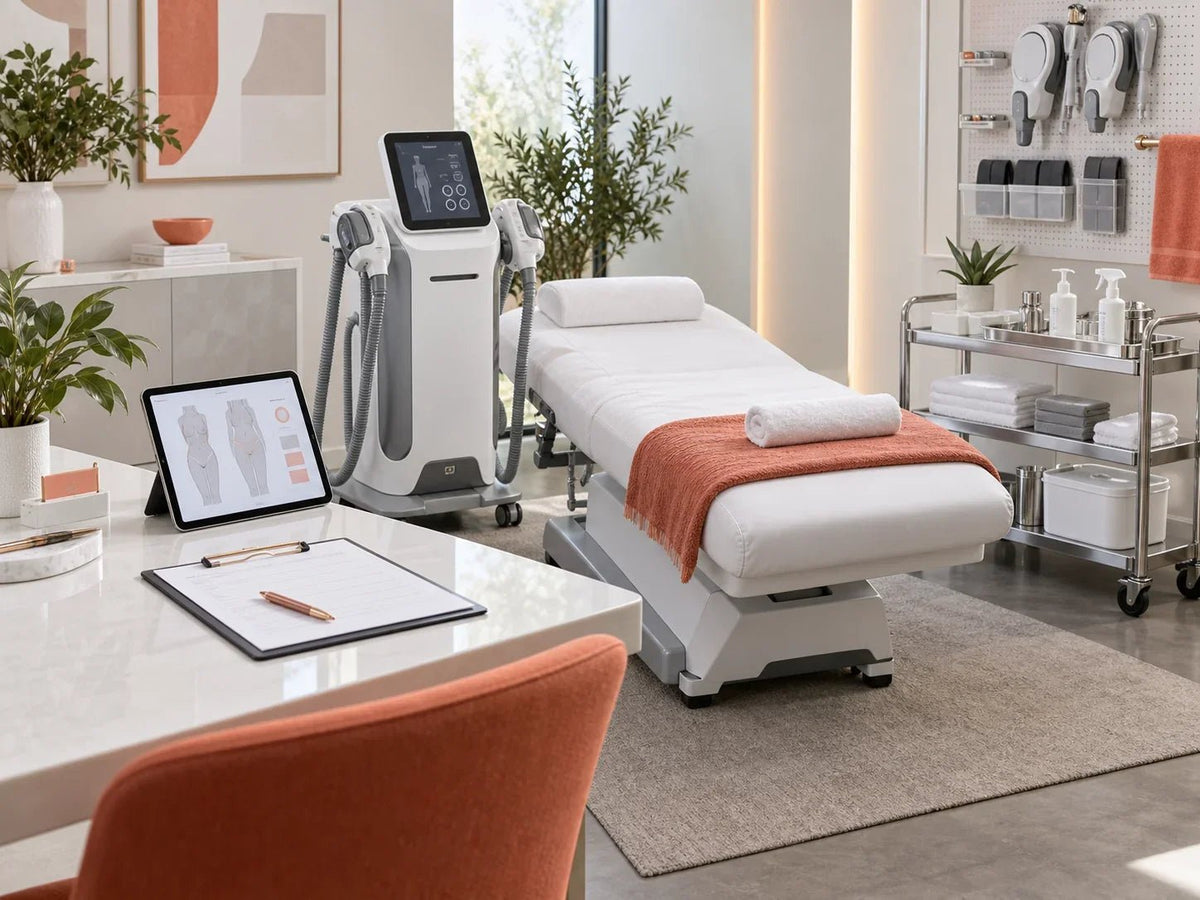
How to Choose a Body Slimming Machine for Your Clinic
The right body slimming machine is the one that supports a clear service menu and a repeatable clinic workflow. A multifunction platform with a long feature list can look attractive, but it only creates value when each function has a defined purpose, suitable patient-selection process, trained operator and realistic appointment plan.
Begin with the result category your clinic wants to offer, then work backward to technology, documentation, room requirements and cost. This approach produces a more useful comparison than choosing by the number of handles.
Quick Answer
The right body slimming machine is the platform that fits a defined treatment objective, permitted claims, room workflow and paying demand. Do not compare systems by handle count alone. Map each function to a service the clinic can actually sell and deliver, then test staffing, appointment time, consumables, training, safety controls, downtime and total ownership cost.
- Best for: Clinics deciding between focused and multifunction body-contouring systems.
- Verify first: Service objective, technology purpose, patient selection, workflow and recurring costs.
- Decision standard: Exclude any function that lacks a clear service role, evidence pack or operating plan.
Separate treatment objectives before comparing machines
Body slimming is a commercial category, not one technical function. A clinic may be planning services for the appearance of cellulite, temporary tightening, muscle conditioning, localized contouring or a combined menu. These objectives involve different technologies, workflows, patient-selection rules and consumables. A long list of handles is only valuable when each function has a clear place in the service menu.
Create a one-page service brief for every planned treatment. Record the customer need, intended body area, technology family, labeled use, contraindication process, appointment time, consumables, operator attention, cleaning method and expected course of treatments. Then ask suppliers to map the proposed machine to those requirements. Functions that cannot be explained, demonstrated, documented or supported should not be included in the business case simply because they are present on the console.
This separation also improves quotation comparison. One machine may be a focused platform designed for a repeatable high-demand service; another may combine several modalities for a clinic that is still testing demand. Neither is automatically better. The right choice depends on whether the clinic will actually use the functions, whether workflows can coexist in one room and whether the supplier can train and service every included modality.
Figure 1. Compare technology families by service objective, not by the number of handles on the quotation.
Define the service before choosing the platform
Non-invasive body contouring can refer to reducing small visible fat bulges, changing circumference, improving the appearance of cellulite, supporting muscle conditioning or creating a temporary tightening effect. These are different objectives. The FDA notes that non-invasive body contouring is not a treatment for obesity and does not provide the health benefits of weight loss. Results and duration vary by technology and patient. [1]
|
Service objective |
Technology family to evaluate |
Operational questions |
|
Appearance of cellulite |
Vacuum, massage and selected RF systems |
Applicator control, bruising risk, cleaning and session frequency |
|
Temporary tightening or circumference change |
RF or other controlled heating systems |
Temperature monitoring, cooling, contraindications and contact quality |
|
Muscle conditioning |
EMS or magnetic-field systems |
Applicators, placement, intended use and output evidence |
|
Localized fat contouring |
Authorized cold, heat, ultrasound or light-based systems |
Treatment area, consumables, cycle time and patient selection |
|
Combined service menu |
Multifunction platform |
Whether each function is documented, trainable and commercially used |
This table is a procurement starting point, not a treatment recommendation. The exact device labeling, contraindications and professional judgment control clinical use.
Do not count handles before checking their purpose
Two machines can both advertise six handles and still deliver very different workflows. Ask the supplier to identify each applicator, energy modality, intended body area, required consumable and normal setup. Then remove any function your team does not plan to sell or is not permitted to use.
- Confirm whether two or more applicators can operate at the same time.
- Ask whether each channel has independent controls and monitoring.
- Check how contact, suction, temperature or placement is verified.
- Review cleaning between patients and the parts that touch skin.
- Price routine consumables and high-wear accessories separately.
- Request the manual and contraindication list before finalizing the menu.
Model the complete appointment, not only device-on time
The treatment timer is only one part of the room schedule. Include consultation, consent, screening, photography, preparation, positioning, gel or membrane application, applicator securing, parameter confirmation, monitoring, removal, cleaning, documentation and room turnover. A 30-minute programmed cycle can occupy considerably more room time once these steps are included.
Decide which tasks require a trained operator to remain present and which can be monitored at intervals under the device instructions and clinic policy. Consider privacy, gowning, handwashing, storage of consumables and the movement of carts or large applicators. The room should allow staff to reach the emergency stop and observe the patient without stretching cables across walking routes. These practical details influence safety, customer experience and daily capacity.
Use the model to test peak-time scheduling. If a multifunction platform cannot run two popular services simultaneously, a queue may develop even when the console appears versatile. Conversely, a clinic with moderate demand may benefit from one platform if it reduces training, room and maintenance overhead. The decision should follow the expected booking pattern and staffing model rather than a theoretical maximum.
Figure 2. Room layout, staff time and the full appointment sequence should be planned before equipment is ordered.

Figure 4. Evaluate the complete appointment workflow, not only the minutes when the machine is active.
Build a room and staffing model
The appointment includes more than active device time. Allow for consultation, photographs, positioning, gel or membrane application, applicator securing, monitoring, cleaning and room turnover. A platform that needs frequent hands-on adjustment may require a different staffing model from one that can be monitored at intervals under the device instructions.
Calculate room utilization with your real opening hours and staffing. If a combined machine prevents two popular services from running at the same time, separate platforms may provide better capacity. If demand is still developing, one multifunction platform may reduce the initial investment.

Figure 5. Confirm room clearance, utilities and ventilation before choosing the final platform.
Compare safety controls and training
Each technology has different risks. The FDA lists potential complications for body-contouring procedures, including pain, redness, swelling, bruising and technology-specific problems such as burns or other injuries. It also advises buyers and patients to understand the device information and whether disposable parts are replaced as required. [1]
|
Control area |
Buyer check |
Acceptance evidence |
|
Patient selection |
Contraindications and labeled treatment areas |
Manual and training module |
|
Energy delivery |
Adjustments, limits and monitoring |
Live demonstration using agreed settings |
|
Contact parts |
Cleaning method and disposable policy |
Written procedure and supply list |
|
Alarms |
Meaning, stop behavior and reset process |
Alarm demonstration |
|
Operator training |
Setup, monitoring, adverse response and records |
Agenda, attendance and competency record |
|
Service |
Remote diagnosis and replacement process |
Written support route and parts list |
Run a conservative service-level business case
Separate the economics of each service instead of placing all revenue against one machine price. Fixed costs may include equipment, freight, installation, room preparation, training, insurance and financing. Variable costs include consumables, cleaning supplies, laundry, direct labor, payment fees, photography and applicator wear. Allocate shared costs consistently so a weak service is not hidden by a stronger one.
Calculate contribution per completed treatment as collected revenue minus direct variable costs. Then estimate break-even treatments from the relevant setup cost divided by that contribution. Test the result at conservative, expected and strong demand, and include a downtime allowance. Do not assume every open hour becomes a paid treatment or use a supplier's maximum sessions per day without checking whether the clinic's appointment workflow can support it.
The final quotation should make the business model auditable. It should list the exact machine and software, applicators and quantities, required consumables, current replacement prices, training, warranty exclusions, parts availability, delivery terms and acceptance method. A lower purchase price can lose its advantage quickly if one essential applicator is expensive, slow to replace or unavailable during the clinic's busiest months.
Figure 3. The business case should connect the selected technology to the actual service workflow and recurring operating cost.
Calculate ownership cost by service
Separate fixed and variable costs. Fixed costs include the machine, delivery, installation and training. Variable costs include membranes, gels, cartridges, cleaning materials, applicator wear, payment fees and staff time. Add a downtime allowance rather than assuming every available hour becomes a paid appointment.
Contribution per treatment = collected treatment revenue minus direct consumables, direct labor and payment costs. Estimated break-even treatments = total setup cost divided by contribution per treatment. Use conservative appointment volume and compare several scenarios. Do not use supplier revenue projections without checking every assumption.

Figure 6. Compare machines by cost per completed treatment under realistic utilization.
A quotation should describe the whole system
- Model, voltage, software, applicators and included quantities.
- Intended use, labels, instructions and destination-market documents.
- Starter consumables and current replenishment prices.
- Training scope, language, format and refresher access.
- Warranty coverage, exclusions, response process and spare parts.
- Delivery terms, packaging, installation and acceptance method.
Choose between a focused and multifunction machine
Choose a focused platform when
One service already has proven demand, staff need a simple repeatable workflow, or the clinic wants dedicated room capacity and clear specialist positioning.
Choose a multifunction platform when
The service menu is still being tested, the same team will use several modalities, room space is limited and the supplier can document and support every included function.
The decision should come from demand and workflow, not from the idea that more functions are automatically better.
Score each technology against the clinic's real constraints
Create a short decision matrix before comparing brands. Score each candidate technology for service fit, candidate pool, appointment time, operator involvement, room requirements, consumables, training, evidence, local authorization and after-sales support. Give more weight to the factors that can stop the service, such as weak demand, unavailable consumables or a room that cannot support the machine.
Use the score to remove unsuitable options before price negotiation. A machine with more handles may look attractive but still rank poorly when several functions duplicate services the clinic already offers. A simpler platform can be the stronger purchase when it supports one clear client need, fits existing staff and produces a repeatable appointment. Keep the scoring notes so the final decision can be explained later.
Launch one service pathway before expanding the menu
A broad menu creates more training, consultation scripts, consent materials, cleaning procedures and marketing claims at the same time. A new clinic can reduce this load by launching the strongest service pathway first. Define the target client, screening process, appointment sequence, photography, follow-up, price structure and staff responsibilities before adding another modality.
Use early appointments to test the complete workflow, not just the device. Measure consultation time, room turnover, consumables, rebooking, operator questions and support requests. Once the process is stable, add the next service only when it has a clear audience and does not disrupt the first one. This phased approach gives the clinic better information for deciding whether a multifunction platform is actually being used.

Figure 7. Launch one repeatable treatment pathway before adding more services and configurations.
Use utilization checkpoints to protect the investment
Set review points for the first months of operation. Track completed appointments, collected revenue, direct treatment cost, machine availability, cancellations caused by equipment, staff capacity and marketing cost. Compare actual figures with the conservative business case used before purchase. A low booking rate and a high downtime rate require different responses.
Decide in advance what action follows each result. Weak demand may call for a narrower offer, stronger referral relationships or a change in scheduling. Strong demand with limited capacity may support longer hours, more trained operators or another system. Repeated technical interruptions should trigger a service review before more money is spent on expansion. The machine should earn the next investment through measured use.
Keep sales claims aligned with the operating documents
The website, consultation script, consent information and staff training should describe the same service the clinic is actually permitted and prepared to provide. Before launch, compare proposed claims with the exact device labeling, intended use, treatment areas and local requirements. Remove language that turns a cosmetic or body-contouring service into a guaranteed medical or weight-loss result.
Give staff one approved source for client-facing information and define who may change it. When the service menu or device configuration changes, review the website, booking page and consultation materials together. Consistent claims reduce customer confusion and prevent marketing from running ahead of training, evidence or the machine the clinic purchased.
Use Two Decision Records Before Choosing the Platform
A body slimming machine should fit the clinic's service model, not simply offer the longest function list. These records help a buyer decide between a focused and multifunction platform, then test whether the chosen service is ready to launch.
Focused Versus Multifunction Decision Matrix
Complete this comparison against the clinic's first twelve months of demand. A future service has value only when the team can train, market and operate it within that period.
|
Clinic condition |
Focused platform signal |
Multifunction signal |
|
Demand pattern |
One service has clear demand and a repeatable referral path. |
Several services have measured demand and distinct patient pathways. |
|
Team capability |
A small team needs one protocol to master quickly. |
Named operators can train and maintain competence across functions. |
|
Room and utilities |
Space or power limits favor a simpler installation. |
The room supports every planned function without repeated reconfiguration. |
|
Commercial model |
Revenue depends on depth and repeat use of one core service. |
Revenue plan depends on a managed menu, not occasional add-ons. |
|
Downtime tolerance |
A dedicated unit can be supported or backed up economically. |
Shared-console risk is accepted and covered by a service plan. |
The stronger choice is the configuration with the fewest unused dependencies. A multifunction platform can be commercially sound, but only when each planned function has a defined patient pathway, trained owner and measurable demand.
Clinic Launch Readiness Scorecard
Use ready, verify and hold as working statuses. Do not mark an area ready because a brochure or sales demonstration mentions it; require a clinic-owned procedure and named responsibility.
|
Area |
Ready when |
Hold if |
|
Service protocol |
Treatment objective, workflow, contraindications and handoff are documented. |
The service is described only by a device function name. |
|
Patient selection |
Consultation criteria and referral or exclusion routes are approved. |
Staff cannot explain who should not be treated. |
|
Room and utilities |
Electrical, ventilation, cleaning and storage needs are confirmed. |
Any required utility or room control remains assumed. |
|
Staff competence |
Operators complete device, safety and abnormal-event training. |
Training is limited to button operation or one sales demonstration. |
|
Pricing and demand |
Price, appointment time, consumables and conservative demand support the service. |
Break-even depends on full utilization from launch. |
Resolve every hold item before opening bookings. Verify items may be closed during commissioning, but they should have an owner and due date so uncertainty does not move into the treatment calendar.
Discuss your service menu with LEFIS Laser
Compare vacuum and cavitation body contouring machines with EMS and HIFEM systems. Our body slimming solution page shows the wider category. To request a configuration and quotation, contact LEFIS Laser with your service menu, expected appointments, room plan and destination market.
FAQs
Is a multifunction body slimming machine always better value?
Short answer: No. A multifunction platform is good value only when the clinic will use its technologies often enough and can operate them well.
What to check: More handles can broaden the menu, but they also add training, cleaning, consumables, storage and service dependencies. Some combinations look impressive in a quotation yet contribute little to actual bookings. Start with client demand and defined treatment pathways, then check whether each function supports those services and is permitted for the intended claims.
Buyer action: assign expected monthly appointments, price and variable cost to every included function; treat any function without a credible launch plan as zero revenue when comparing the multifunction machine with dedicated equipment.
Keep on file: Keep a service pathway for every purchased function showing demand, patient selection, protocol, training owner, appointment time, consumables and expected utilization.
Can body contouring be marketed as weight loss?
Short answer: Generally, clinics should avoid presenting non-invasive body contouring as a substitute for weight loss unless the exact device authorization and local advertising rules support that claim.
What to check: These treatments are usually positioned around localized contouring, appearance or muscle-stimulation objectives, not broad changes in body weight. Clear language protects the clinic from regulatory complaints and prevents clients from expecting outcomes the service was not designed to provide. The selected technology also matters, so review the relevant cavitation and vacuum body contouring options together with their documented intended uses.
Buyer action: have a qualified reviewer check the website, consultation script, before-and-after captions and consent form as one package before launch.
Keep on file: Retain the device's intended use and approved claims together with the website, consultation script, consent form and before-and-after language used by the clinic.
What should a clinic test during a demo?
Short answer: Test the entire appointment workflow on the exact model under consideration.
What to check: Confirm startup time, software version, handpiece recognition, parameter controls, contact and comfort, noise, heat, cleaning access and error recovery. Run the main technology for a full protocol rather than accepting a five-minute sample. If the machine has several functions, test each one and check whether simultaneous operation affects performance. Inspect cables, filters, connectors and supplied accessories, then ask staff to repeat the setup without the salesperson leading them.
Buyer action: bring a scored checklist with pass criteria and record photos, settings and serial information so different suppliers are evaluated on the same evidence.
Keep on file: File a full-workflow demonstration scorecard for the exact configuration, including startup, settings, handpiece recognition, monitoring, alarms, cleaning, turnover and restart.
Which body slimming technology is suitable for a new clinic?
Short answer: The best starting technology is the one that matches a clear client need, realistic budget, staff capability and permitted service claim.
What to check: Cavitation, vacuum, radiofrequency and EMS-based systems have different operating workflows, appointment lengths and client expectations. A new clinic usually benefits from launching one well-defined treatment pathway before adding several loosely connected services. Compare the body slimming machine range by treatment objective, number of stations, room requirements, training and after-sales support.
Buyer action: choose the platform that can serve the largest share of existing clients with the simplest repeatable workflow, then build demand and documented results before purchasing another modality.
Keep on file: Keep the service-objective matrix that links local demand and patient pathway to one selected technology, along with the staffing and room assumptions behind the choice.
What room and utility requirements should be checked?
Short answer: Check the manufacturer's electrical rating, plug and grounding requirements, ventilation, ambient temperature, humidity, machine clearance, treatment-bed access and storage before delivery.
What to check: Water-based or cooled platforms may have additional filling, drainage or maintenance needs. The room must also support privacy, cleaning, safe cable routing and emergency access. Do not assume that a standard wall outlet or a visually large room is sufficient; the final requirement depends on the exact configuration and local rules.
Buyer action: send the equipment specification and proposed floor plan to the supplier and a qualified local electrician before shipment, then photograph the completed utilities and verify them again during installation.
Keep on file: Retain the site-readiness sheet covering electrical supply, grounding, ventilation, drainage or cooling where applicable, treatment clearance, storage and installer sign-off.
How is total ownership cost calculated?
Short answer: Add every cost required to keep the service available over the planned ownership period.
What to check: Begin with purchase price, freight, import charges, installation and financing. Then include staff training, room preparation, consumables, filters, applicator or handpiece replacement, preventive maintenance, software fees, warranty exclusions, repair freight and estimated downtime. Subtract a realistic resale value only if there is evidence for it. Divide total cost by conservative completed treatments, not maximum theoretical capacity, to estimate ownership cost per treatment.
Buyer action: compare suppliers using the same three-year template and run a stress case with lower bookings, one major repair and a delayed part shipment; the machine that remains viable is often the stronger purchase.
Keep on file: Keep a cost model for each service showing delivered equipment cost, consumables, labor, room time, maintenance, downtime and conservative completed-treatment volume.
Should a clinic buy a combination platform or dedicated machines?
Short answer: A combination platform suits clinics that value a compact footprint, shared interface and flexible menu, while dedicated machines can offer simpler workflows, independent scheduling and less concentration of downtime risk.
What to check: The right choice depends on treatment volume and whether multiple technologies need to operate at the same time. If one combination machine fails, several services may stop; with dedicated units, the impact is narrower but capital and room requirements are higher. Review EMS and HIFEM body sculpting systems alongside other modalities before deciding.
Buyer action: map the clinic's top three treatments, busiest hours and acceptable downtime, then price both configurations with identical service, training and spare-part assumptions.
Keep on file: File the shared-component dependency map, replacement lead times, service escalation route and the clinic's backup plan for any failure that disables several functions.
Sources
- FDA — Non-Invasive Body Contouring Technologies
- FDA — Aesthetic Cosmetic Devices
- ISO — ISO 14971 Medical Device Risk Management
- FDA — Product Classification Database


Looking for something else?

Do Men Get Cellulite? Causes Differences & What to Know
LEARN MORE
Does Radio Frequency Skin Tightening Work? Results & How It Works
LEARN MORE
Do You Shave Before Laser Hair Removal? Prep Tips & Why It Matters
LEARN MORE
How to Get Rid of Age Spots: Treatments. Natural Remedies & Prevention
LEARN MORELooking for something else?
How to Heal Ingrown Hair: Causes. Treatments & Healing Time
LEARN MORE
How to Get Rid of Freckles: Effective Treatments & Natural Tips
LEARN MORE
Top 10 Picosecond Laser Machine Manufacturers for Clinics in 2026
LEARN MOREYou may also like


Further reading

Tattoo Removal Laser Machine Cost and Ownership Guide

CO2 Laser Treatment Room Setup Checklist

Aesthetic Machine Factory Acceptance Test Before Shipment


